
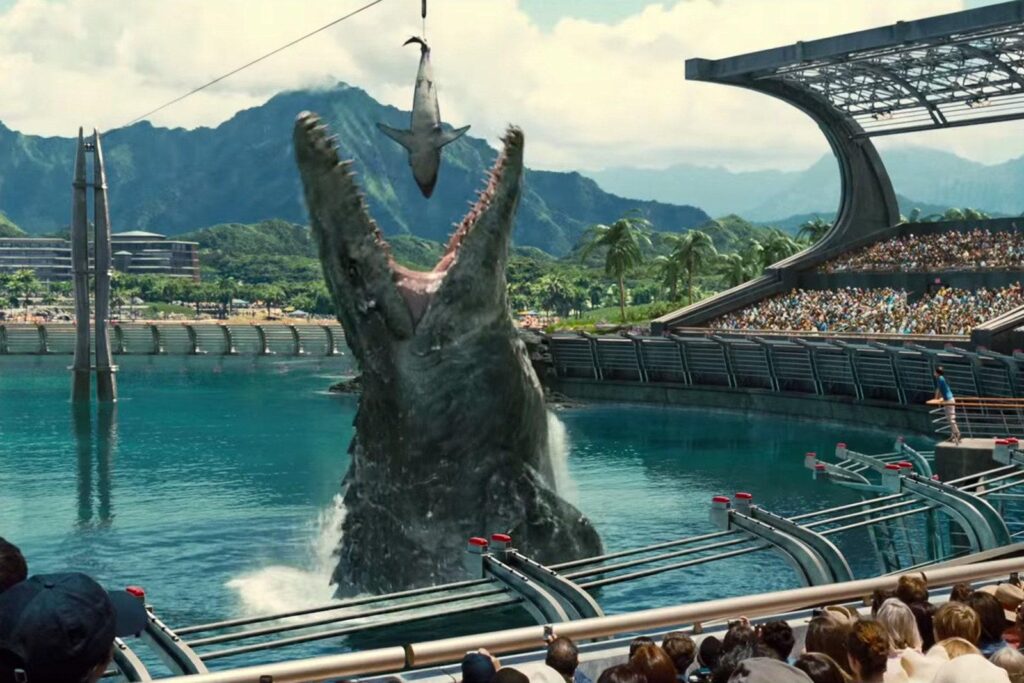
Most people assume the roaring sea monster from *Jurassic World*’s lagoon is just a bigger, movie version of a real ancient predator – same body, same behavior, just scaled up for spectacle. **That assumption is almost entirely wrong.**
Paleontologists who study actual mosasaur fossils say the film’s version diverges from the fossil record in ways that go far beyond size – its skin, swimming style, color, reproduction, and even its basic biology bear little resemblance to the animal that once ruled Cretaceous seas. Here’s what marine reptile experts actually say, starting with the lie that’s easiest to spot.
#10 – The Size Is Almost Double What Fossils Actually Support
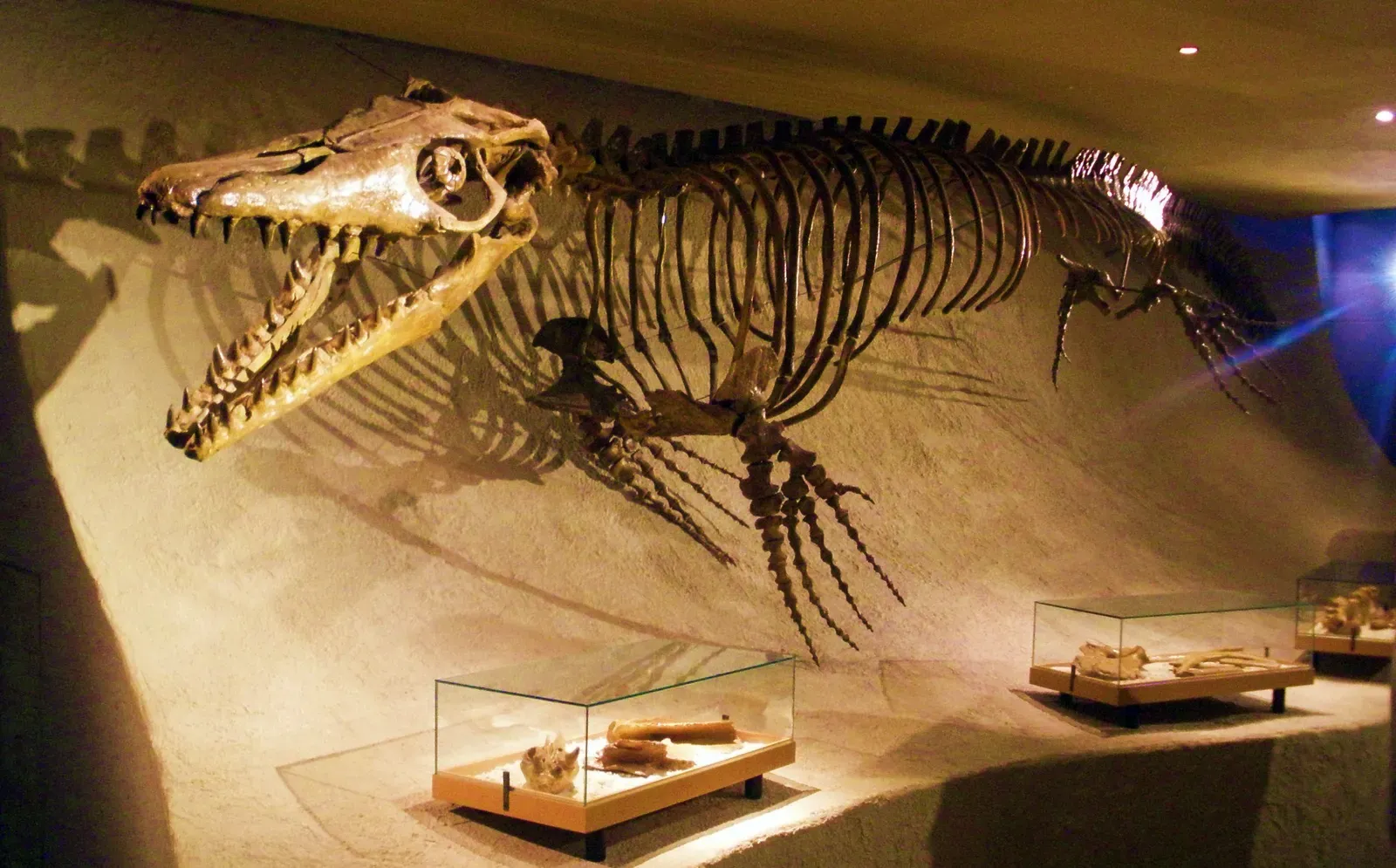
The single biggest myth about *Jurassic World*’s Mosasaurus is its jaw-dropping scale, and it’s not even close to accurate.
The film’s version is presented at roughly 22 meters, or about 72 feet – nearly double the estimated maximum length of the real animal. Fossil evidence tells a very different story. Real M. hoffmannii specimens indicate a maximum of around 13–14 meters (43–46 feet). Some official franchise materials have pushed the number even further, with one size chart listing it at **22 meters – longer than any mosasaur ever discovered.**
Quick Compare
- Movie Mosasaurus: ~22 meters (72 feet)
- Real M. hoffmannii: ~13–14 meters (43–46 feet)
- Size gap: nearly double the real animal’s confirmed max length
- Why the upsize: needed to look big enough for the final showdown with the Indominus rex
This wasn’t an accident or a rounding error. ILM purposely made the Mosasaur in Jurassic World larger than its real life counterpart to make it look big enough for the final fight with Indominus rex at the end of the film. That’s a filmmaking decision, not a scientific one – and it set the tone for nearly every other liberty the franchise would take.
#9 – Its Diet Looks Nothing Like What Real Mosasaurs Actually Ate
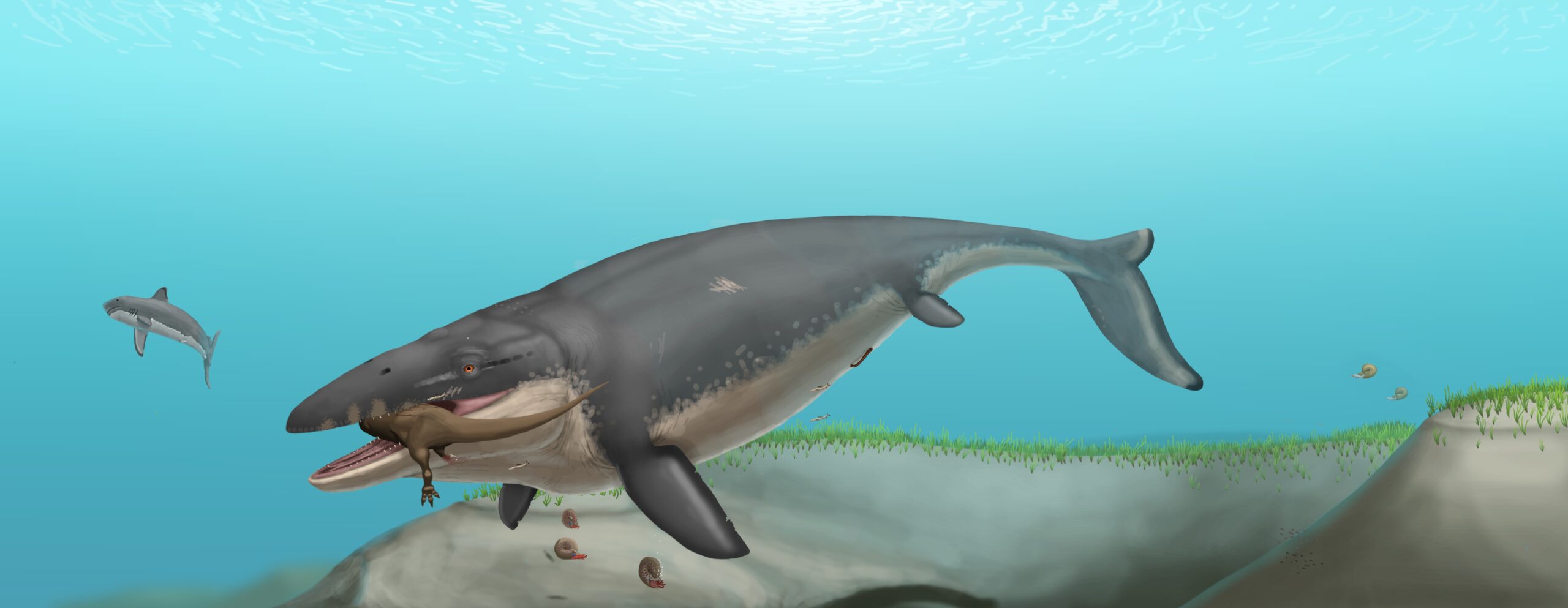
Everyone remembers the scene: the Mosasaurus explodes out of the water and swallows a full-grown great white shark like an appetizer.
It’s a jaw-dropping moment, but it stretches plausibility hard. Comparing the movie’s proportions, the cloned Mosasaur head is large enough to nearly swallow whole what appears to be an adult great white shark, a species that can grow up to 6 meters in length, while the largest mosasaur skulls ever discovered only reach to about the size of a human being. **That single detail alone reveals just how exaggerated the franchise’s creature really is.**
The real animal’s actual menu was still impressive – just less cartoonish. Its diet included bony fish, sharks, seabirds, pterosaurs, turtles, ammonites, plesiosaurs, and even smaller members of its own kind – but its teeth lacked cutting edges or grinding surfaces, meaning prey had to be swallowed whole, aided by double-hinged jaws and a highly flexible skull. So the “swallow it whole” mechanic is accurate – the shark-sized meal in one gulp is not, and that mismatch only gets stranger the deeper you look.
#8 – Real Mosasaurs Didn’t Have Crocodile-Like Armored Skin
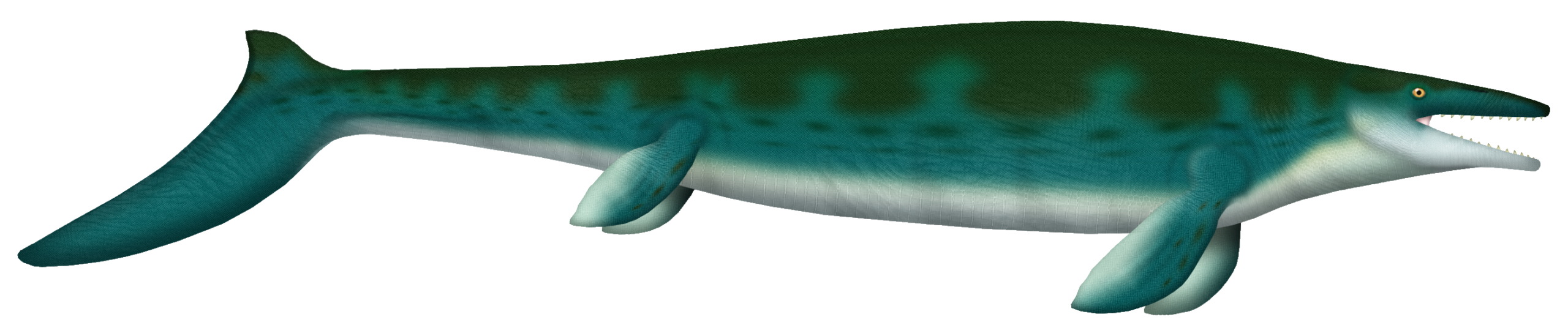
The movie’s Mosasaurus has thick, bumpy, almost armor-plated skin that looks more like a saltwater crocodile than an ancient sea lizard – and that’s a major departure from the fossil evidence.
Actual skin impressions tell a completely different story. Rare, exceptional fossilized skin impressions reveal that mosasaurs had small, overlapping, diamond-shaped scales, giving them a sleek, hydrodynamic, and somewhat shark-like or snake-like texture, rather than the rough, scaly hide often imagined. These weren’t decorative – the scales revealed similarities to both snakes and shark denticles, and would have reduced drag as the animal swam, making it a powerful ambush hunter.
Interestingly, even the franchise itself seems to have quietly acknowledged this mistake. A newer InGen-attributed clone shown in the most recent film **lacks the crocodile-like osteoderm armor** of the original movie version, instead retaining a smooth skin better suited for hydrodynamism, and even sports a visible tail fluke, which is the most accurate design. That’s a quiet admission that the original design missed the mark from the very beginning.
#7 – The Swimming Style Is Decades Out of Date
The way the movie Mosasaurus moves – that long, whipping, side-to-side undulation of its entire body – was actually considered accurate science… about 30 years ago.
In the film, the Mosasaurus is depicted with a flat, paddle-shaped tail bearing some sort of fin-like spines along it, which would have been considered accurate a few decades ago, when it was thought that mosasaurs swam like giant eels, with undulating tail strokes. **That entire theory has since been overturned by fossil evidence paleontologists didn’t have when the “classic” mosasaur look was established.**
Exceptionally preserved specimens changed everything. New evidence shows that many advanced mosasaurs had large, crescent-shaped tail flukes, similar to those of sharks and some ichthyosaurs. Instead of whipping their whole body, real mosasaurs likely kept their body held stiff to reduce water resistance, using only their tails for locomotion to swim with considerable speed, relying more on ambush to capture prey. That’s a fundamentally different hunting style than the eel-like thrashing shown on screen.
#6 – Its Color Scheme Is Basically a Guess, and Probably Wrong
The film gives its Mosasaurus a moody, uniform gray-blue coloring – dramatic for a movie poster, but not what the fossil evidence actually suggests.
For most of scientific history, mosasaur color was a total mystery. That changed in 2014 when researchers made a breakthrough discovery. The coloration of mosasaurs was unknown until then, when the findings of Johan Lindgren of Lund University and colleagues revealed the pigment melanin in the fossilized scales of a mosasaur. **This was the first time anyone had actual chemical evidence of prehistoric marine reptile pigmentation.**
Fast Facts
- Breakthrough pigment discovery: 2014
- Led by Johan Lindgren, Lund University
- Pigment identified: melanin, preserved in fossilized scales
- Likely pattern: countershaded, dark back and light belly
The result overturned the “generic gray monster” image entirely. Mosasaurs were likely countershaded, with dark backs and light underbellies, much like a great white shark or leatherback sea turtle. That’s a very specific, functional camouflage pattern – similar to what we see in sharks and whales, and a handy form of marine camouflage – not the flat, single-tone hide Hollywood imagined.
#5 – The Real Mosasaurus May Have Been Warm-Blooded, Not a Sluggish Reptile
Movies tend to treat ancient reptiles as cold, slow, and sluggish unless they’re actively attacking something. Real mosasaur biology suggests the opposite was true.
Multiple independent studies point the same direction. Mosasaurs – an extinct group of aquatic reptiles that thrived during the Late Cretaceous period – possibly were “endotherms,” or warm-blooded creatures. That’s a genuinely **shocking finding for a reptile,** since true warm-bloodedness is exceptionally rare outside birds and mammals. Researchers compared mosasaur bone chemistry directly against known cold-blooded and warm-blooded animals from the same era to reach that conclusion.
The evidence keeps stacking up. Analysis of its bones indicates that Mosasaurus would have been able to keep its body temperature fixed several degrees above that of the surrounding sea water, meaning it was warm-blooded. This gave mosasaurs a real evolutionary edge over cold-blooded competitors, allowing them to sustain higher activity levels, though it also meant they had to eat more often to fuel that engine. That’s a metabolism the movie never even hints at.
#4 – It Didn’t Lay Eggs. It Gave Birth to Live Young in the Open Ocean
If you assumed a giant sea reptile laid eggs like a turtle, you’re following outdated logic – and so, apparently, is the movie, which never addresses reproduction at all.
Fossil evidence resolved this debate directly. Although live-bearing (viviparity) has evolved around 100 times within reptiles, evidence of it is almost never preserved in the fossil record – but researchers reported viviparity in mosasauroids, the only known fossil record of live-bearing in squamates, and possibly the oldest occurrence of the trait in this diverse group. **That makes mosasaurs one of the only fossil reptile groups where scientists have direct physical proof of live birth**, not just an educated guess.
Worth Knowing
- Viviparity (live birth) has evolved roughly 100 times across reptile history
- Mosasaurs offer the only confirmed fossil proof of live-bearing in squamates
- Baby mosasaur fossils have turned up far out in the open ocean, not near shorelines
- No nesting beaches means no egg-laying – the biology simply doesn’t fit
This wasn’t a minor side note for their biology – it shaped where they lived. Because baby mosasaur fossils were found in the open ocean where egg-laying is not possible, the circumstances suggest that mosasaurs may have been viviparous. That means mosasaur babies were born far from shore and had to fend for themselves immediately – a world away from the sheltered, single-lagoon life the movie gives its creature.
#3 – Real Mosasaurs Weren’t Confined to One Lagoon – They Ruled Entire Oceans
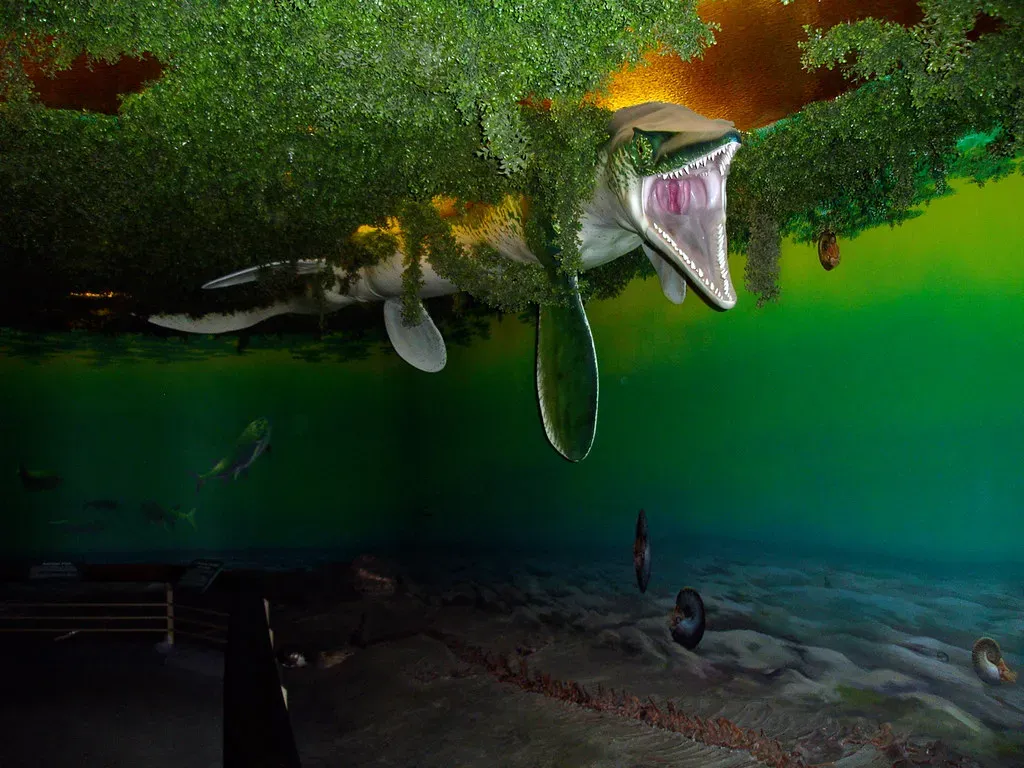
The movie’s Mosasaurus lives its entire life in a single park lagoon, surfacing on cue for a scheduled feeding show. Real mosasaurs had a drastically bigger – and stranger – range.
These animals weren’t a niche species; they were the dominant force in Late Cretaceous seas worldwide. Mosasaurs originated roughly 95 million years ago and would go on to become the dominant large marine predators of the era, some of the largest marine organisms of the time, and some of the largest predatory reptiles, period. **They spread across nearly every ocean on the planet**, not one man-made enclosure.
Even more surprising: not every mosasaur even lived in saltwater. For a long time, experts believed mosasaurs lived only in marine environments – until scientists in Hungary collected over 100 bones of a new freshwater mosasaur species from a site that produced no other marine or brackish-water animals or plants, dubbed Pannoniasaurus inexpectatus. That single discovery rewrote the textbook idea that mosasaurs were exclusively ocean animals – something the franchise’s single-habitat lagoon monster completely ignores.
#2 – The “Trained Show Predator” Behavior Is Pure Hollywood Invention
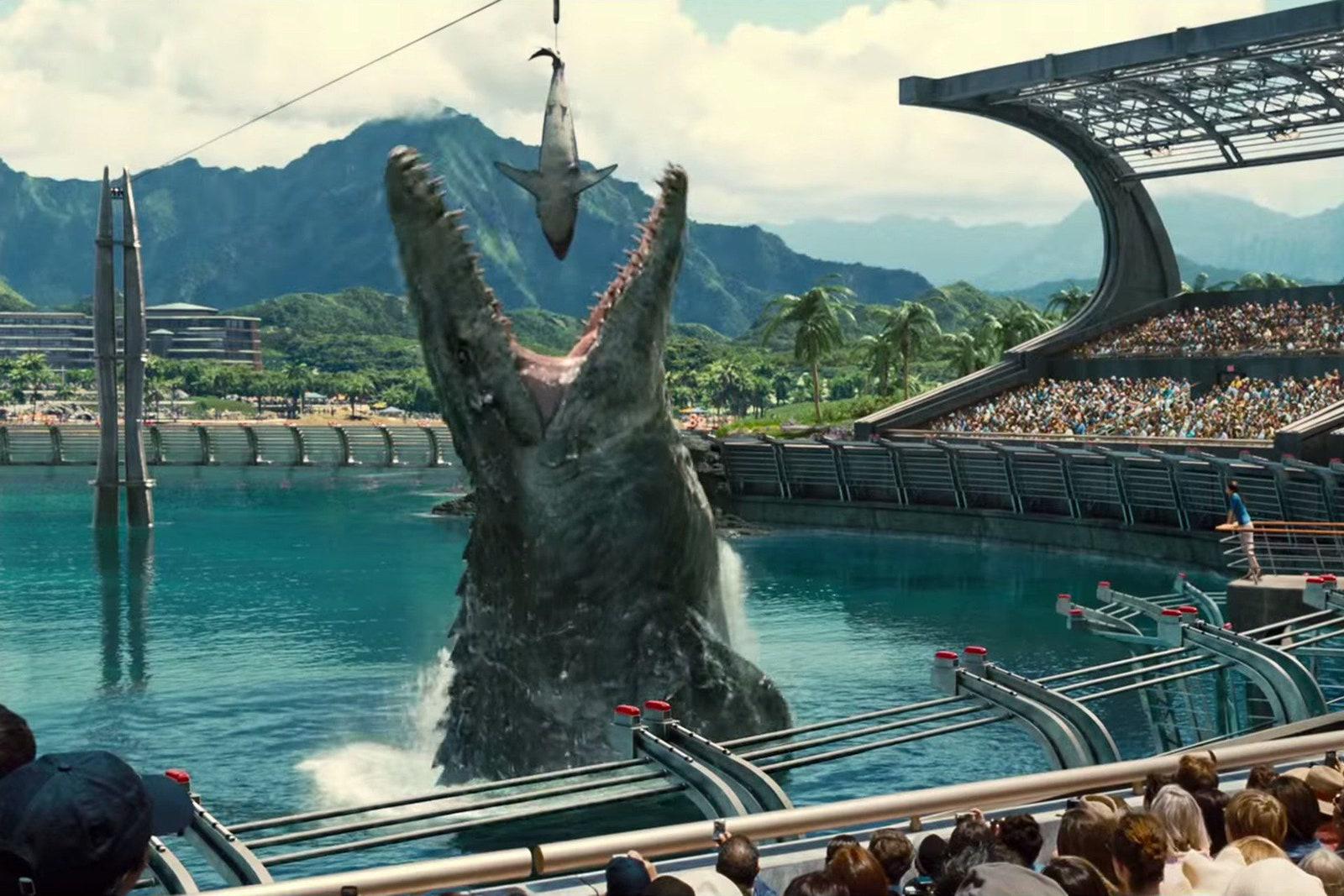
Few movie scenes are more iconic than the Mosasaurus feeding show – the creature leaping on command, timed to a trainer’s signal like a killer whale at a marine park. There’s zero scientific basis for that behavior.
That entire sequence was a creative invention from the ground up. Jurassic World director Colin Trevorrow came up with the idea of the Mosasaurus Feeding Show during one of his first meetings with Steven Spielberg and Frank Marshall, and even envisioned a separate facility that mass-produces the sharks the Mosasaurus eats via cloning. **In other words, the entire “trained predator” spectacle exists because it made for a great trailer moment – not because real mosasaurs displayed anything resembling trainable, performance-style behavior.**
Real mosasaurs were solitary ambush predators, not show animals responding to cues. Their biology points toward opportunistic, wide-ranging hunting across open water rather than any kind of predictable, scheduled surfacing behavior. It’s arguably the most theatrical liberty the franchise takes with the species – a choice that has shaped public perception of mosasaurs more than any single piece of actual fossil evidence.
#1 – It’s Not a Dinosaur at All, and That Might Be the Biggest Myth of All
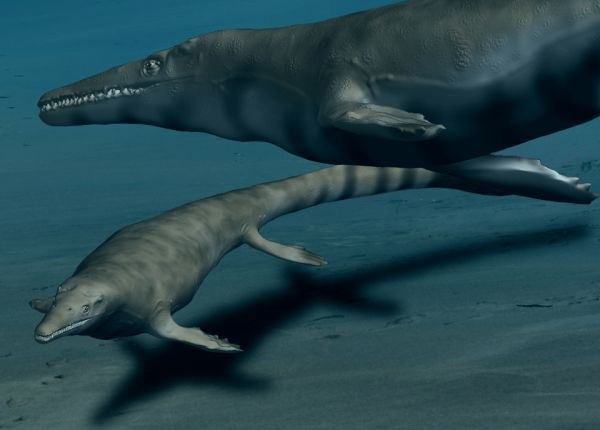
Here’s the detail that undoes almost everything casual fans assume: the Mosasaurus was never a dinosaur, and it isn’t even closely related to one.
This gets confused constantly because the film markets it alongside dinosaurs as another “prehistoric monster” attraction. But the science is unambiguous. Importantly, mosasaurs were not dinosaurs, they were an entirely different class of reptile, in the squamate group. **Squamates are the same group that includes modern snakes and lizards** – which makes the Mosasaurus, biologically speaking, a distant cousin of a Komodo dragon, not a relative of a T. rex.
Why It Stands Out
- Mosasaurs belong to Squamata – the same group as snakes and lizards
- Closest living relatives: monitor lizards, including the Komodo dragon
- No direct relation to T. rex, Velociraptor, or any true dinosaur lineage
- Essentially a giant lizard fully re-engineered for ocean life
Its actual family tree makes this even clearer. Mosasaurs were actually a variety of lizard that had adapted for an oceanic lifestyle, and modern monitor lizards, such as the infamous Komodo dragon, are the closest living relatives of the Mosasaurus. That single fact undercuts the entire premise of grouping it with dinosaurs in the first place – it’s a giant sea lizard wearing a “dinosaur park” name tag it never earned.
The Bottom Line
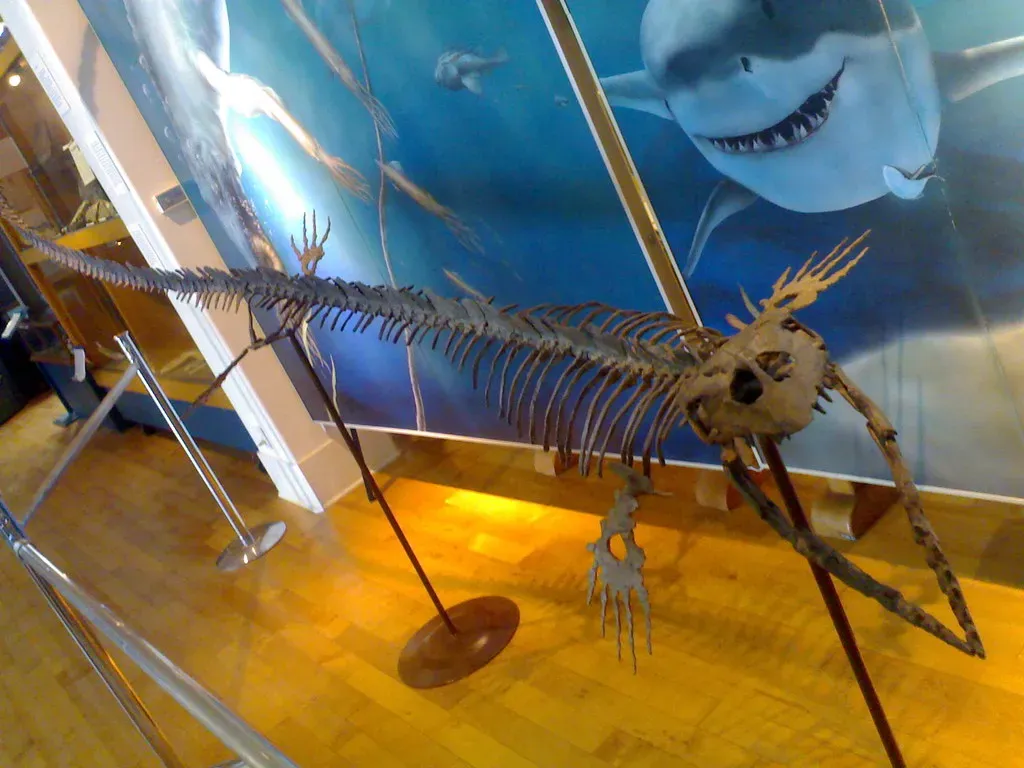
The gap between movie monster and real mosasaur isn’t a minor detail here or there – it’s nearly total. The real animal was **smaller, warm-blooded, countershaded like a shark, gave live birth in open water, swam with a stiff-bodied shark-like tail, and wasn’t a dinosaur at all.**
Hollywood didn’t just exaggerate one fact; it rebuilt the species almost from scratch for spectacle. And honestly, that’s the part that bugs me – because the real Mosasaurus didn’t need the upgrade. A warm-blooded, live-birthing, shark-tailed ocean giant that ruled every sea on Earth is already a better monster than anything the trailer gave us. Hollywood traded the truth for a bigger jaw, and the truth was the more terrifying story all along.