Northern Italy – Scientists have uncovered one of the largest collections of prehistoric footprints in the Alps, hidden high on near-vertical rock faces in Stelvio National Park. The tracks, numbering up to 20,000 and stretching across several kilometers, date to the Late Triassic Period around 210 million years ago. This remarkable find near the mountain town of Bormio adds a layer of ancient wonder to a region that hosted key events at the recent Milan-Cortina 2026 Winter Olympics.
A Chance Encounter Leads to Paleontological Breakthrough
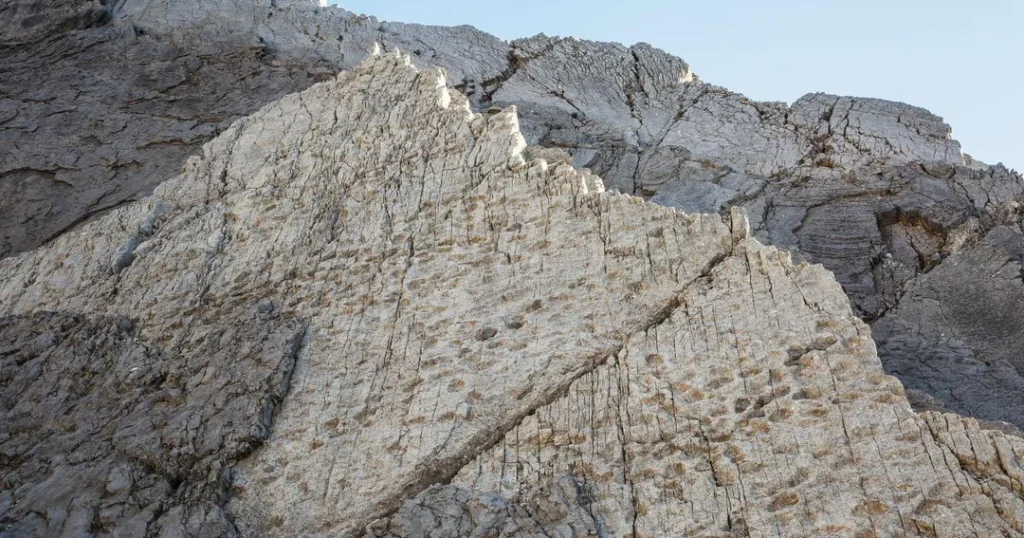
A Chance Encounter Leads to Paleontological Breakthrough (Image Credits: Reddit)
Wildlife photographer Elio Della Ferrera spotted the unusual patterns while scouting for deer and vultures in the Fraele Valley during September 2025. From a distance, his camera lens captured what appeared to be strange markings on a towering north-facing wall. He scaled the sheer cliff, roughly 600 meters above the nearest road, and confirmed the impressions as dinosaur footprints.
Della Ferrera contacted experts at Milan’s Natural History Museum, sparking a detailed investigation. Paleontologist Cristiano Dal Sasso described the moment: “This time reality really surpasses fantasy.” The site, at elevations between 2,400 and 2,800 meters, lies between Bormio and Livigno in Lombardy, close to the Swiss border.
Preserved Relics from a Lost Coastal World
The footprints adorn dolomite walls that once formed soft tidal flats along the ancient Tethys Ocean. Tectonic forces later tilted these sediments into near-vertical positions as the African plate shifted northward. Researchers noted tracks up to 40 centimeters wide, complete with toe and claw marks, preserved in remarkable detail despite the harsh alpine exposure
Ichnologist Fabio Massimo Petti from the MUSE museum in Trento explained, “The footprints were impressed when the sediments were still soft… The muds, now turned to rock, have allowed the preservation of remarkable anatomical details.” Drones and remote sensing now map the expanse, as the remote terrain defies traditional trails.
Parallel rows suggest methodical travel, with some clusters forming circles – possibly defensive huddles. Dal Sasso observed, “There are very obvious traces of individuals that have walked at a slow, calm, quiet rhythmic pace, without running.”
Prosauropod Herds Roam the Triassic Landscape
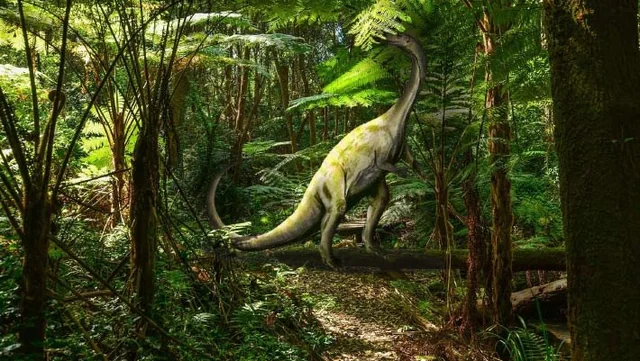
Analysis points to prosauropods, early relatives of giant sauropods like Brachiosaurus. These bipedal herbivores featured long necks, small heads, and reached lengths of 10 meters and weights up to four tons – think a smaller Plateosaurus. The sheer volume indicates massive herds traversing warm lagoons.
This marks the first such discovery north of the Insubric Line in Lombardy, expanding knowledge of prosauropod distribution beyond central Europe. The site rivals the world’s richest Triassic ichnosites, offering clues to their social behavior and evolutionary path.
- Tracks span 3 to 5 kilometers across multiple walls.
- Visible claws and toes reveal foot anatomy.
- Herd patterns hint at group dynamics.
- Age aligns with dinosaurs’ early dominance.
- No prior fossils from this prehistoric coastal zone.
Timing Aligns with Olympic Spotlight
Bormio hosted men’s alpine skiing and ski mountaineering at the Milan-Cortina Games from February 6 to 22, 2026. Livigno managed freestyle and snowboarding nearby. Officials celebrated the revelation as timely publicity.
Lombardy Governor Attilio Fontana called it a “gift for the Olympics.” Milano Cortina 2026 President Giovanni Malagò added, “The natural sciences deliver to the Milan-Cortina 2026 Games an unexpected and precious gift from remote eras.” Milan Mayor Giuseppe Sala remarked, “This discovery sheds an unexpected and fascinating light on the mountains of Lombardy.”
Though inaccessible in winter, the find elevates the region’s profile. Stelvio National Park officials, including Elia Vitalini, coordinated with Carabinieri for documentation.
Legacy of the Alps’ Hidden Past
Della Ferrera captured the scale: “The huge surprise was not so much in discovering the footprints, but in discovering such a huge quantity. There are really tens of thousands of prints up there, more or less well-preserved.” Dal Sasso hailed it as “one of the largest and oldest footprint sites in Italy, and among the most spectacular I’ve seen in 35 years.”
Key Takeaways
- Up to 20,000 tracks from prosauropod herds illuminate Triassic life in the Alps.
- Preservation on vertical cliffs stems from ancient tidal flats and tectonics.
- The discovery boosts cultural heritage near Olympic venues like Bormio.
These ancient steps remind us of the deep history beneath modern spectacles. What do you think about this prehistoric surprise in the heart of the Alps? Tell us in the comments.