Richards Spur, Oklahoma – Mummified remains of a small, lizard-like reptile from the early Permian period have offered scientists an unprecedented view into the evolution of breathing among early land vertebrates. Discovered in ancient cave deposits, these fossils of Captorhinus aguti preserve not only bones but also skin, cartilage, and traces of original proteins. Researchers revealed how the ribcage and shoulder girdle worked together to power respiration, marking a pivotal adaptation that propelled amniotes toward dominance on land.
A Treasure Trove in Permian Caves
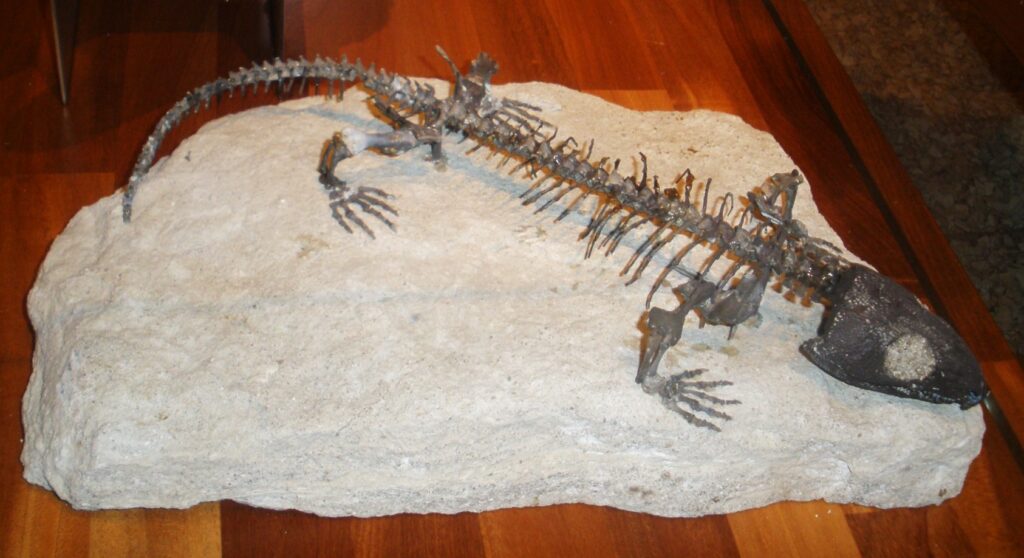
A Treasure Trove in Permian Caves (Image Credits: Wikimedia)
Three exceptionally preserved specimens emerged from the hydrocarbon-rich cave systems near Richards Spur, a site renowned for its early Permian vertebrate fossils. Dated to approximately 289 million years ago, these mummified Captorhinus aguti skeletons captured the attention of paleontologists due to their completeness. One standout example, housed at the Royal Ontario Museum as ROMVP 88565, featured an articulated pose with an arm tucked beneath the body, hinting at rapid mummification.
The unique environment – fine clays, oil seeps, and oxygen-poor conditions – shielded the remains from decay, allowing soft tissues to mineralize while retaining organic signatures. Ethan Mooney, who co-led the study, described the find as transformative. “I started to see all these structures wrapped around the bones,” he recalled. This preservation pushed back the record for protein remnants in terrestrial vertebrates by tens of millions of years.
Unrivaled Soft Tissue Preservation
High-resolution neutron computed tomography unveiled details invisible to the naked eye, including three-dimensional skin with scaly, accordion-like textures and keratinous bands extending from torso to neck. Cartilaginous elements such as the segmented sternum, sternal ribs, and epicoracoids appeared intact, alongside intermediate ribs and extensions. Synchrotron infrared spectroscopy confirmed native proteins, like collagen-like structures, in bones, cartilage, and skin – the oldest such traces in a Paleozoic fossil.
Histological analysis revealed calcified cartilage rich in chondroitin sulfate, while X-ray fluorescence mapped phosphorus concentrations in skeletal parts. These features surpassed prior expectations for deep-time soft tissue survival. The fossils also preserved the full shoulder girdle, with clavicles, cleithra, and scapulocoracoids, providing a blueprint of early amniote anatomy.
The Mechanics of Ancient Respiration
Reconstruction of the thoracic skeleton exposed a sophisticated breathing system reliant on ribcage musculature, known as costal aspiration. Intercostal muscles pulled ribs outward to expand the chest cavity, drawing air into the lungs – a stark upgrade from the skin and throat-pumping methods of amphibians. The ribcage pivoted in tandem with the shoulder girdle, balancing efficient ventilation and locomotion.
Sternal ribs anchored to the cartilaginous sternum, while epicoracoids linked girdle to ribs, optimizing muscle leverage. Robert R. Reisz, co-author and paleontology professor, noted, “We propose that the system found in Captorhinus represents the ancestral condition for the kind of rib-assisted respiration present in living reptiles, birds, and mammals.” This integration marked an evolutionary innovation, predating prior evidence by 35 to 100 million years.
From Aquatic Roots to Terrestrial Triumph
Prior to amniotes, early tetrapods relied on less effective buccal pumping, limiting activity on land. The Captorhinus apparatus enabled greater oxygen intake and carbon dioxide expulsion, fueling a more dynamic lifestyle. Comparisons to modern lizards and crocodiles confirmed conserved kinematics, while contrasts with salamanders highlighted the shift.
Here is a breakdown of key preserved structures:
- Segmented cartilaginous sternum for rib attachment.
- Sternal and intermediate ribs with extensions.
- Epicoracoids connecting shoulder girdle to thorax.
- Three-dimensional skin with keratinous scales.
- Native protein remnants in multiple tissues.
This system underpinned the amniote radiation, influencing everything from reptiles to mammals.
| Breathing Method | Ana mniotes (e.g., Amphibians) | Amniotes (e.g., Captorhinus) |
|---|---|---|
| Primary Mechanism | Skin diffusion + buccal pumping | Ribcage musculature (costal aspiration) |
| Efficiency | Low; limits activity | High; supports active life |
| Fossil Evidence | Common in early tetrapods | Oldest in 289 Ma Captorhinus |
Key Takeaways
- The fossils preserve the oldest rib-powered breathing system, ancestral to all amniotes.
- Soft tissue details rewrite timelines for protein preservation in vertebrates.
- This adaptation drove amniote success on land 289 million years ago.
These mummified relics from Oklahoma’s depths not only illuminate a critical evolutionary leap but also challenge notions of fossil preservation. They remind us how fragile ancient innovations paved the way for life’s terrestrial dominance. What do you think about this glimpse into prehistoric breath? Tell us in the comments.