You might think extinction is a rare phenomenon in our planet’s history. Yet over the past 500 million years, Earth has witnessed catastrophic events that wiped out the vast majority of life not once, but five separate times. These aren’t minor setbacks in evolution, they’re complete reshuffling of life’s entire playbook.
Scientists have documented five major mass extinction events throughout Earth’s history since around 500 million years ago, each eliminating more than three-quarters of estimated species within a relatively brief geological timeframe. These catastrophes didn’t just remove individual creatures, they fundamentally altered the trajectory of life itself, creating opportunities for entirely new forms of existence to emerge from the ashes of devastation. So let’s dive into these five monumental disasters that literally changed everything.
The First Catastrophe: Ordovician-Silurian Extinction

Occurring about 443.8 million years ago, the Ordovician-Silurian extinction stands as the opening act in Earth’s series of mass die-offs. This event was particularly brutal because life at the time was almost entirely confined to the oceans.
The extinction eliminated roughly 49 to 60 percent of marine genera and nearly 85 percent of marine species. It ranks as the second-largest extinction event in terms of the percentage of genera that became extinct, trailing only the later Permian catastrophe. Imagine entire oceanic ecosystems vanishing almost overnight.
The culprit behind this devastation was a complex climate disaster. The extinction was driven by climate and habitat disruptions caused by the onset of glaciation in Gondwana, the associated fall in sea level, and a subsequent warming period which melted ice and brought about rising sea levels. The drift of the large southern continent, Gondwana, over the South Pole caused the onset of a brief but extensive glaciation, with subsequent ice mass accumulation cooling the southern oceans and lowering sea levels globally.
What made this extinction particularly insidious was its two-pulse nature. The second pulse occurred in the later half of the Hirnantian as glaciation abruptly receded and warm conditions returned, associated with intense worldwide anoxia and euxinia. Life couldn’t catch a break, getting hammered first by cooling and ice, then by warming and oxygen depletion when conditions reversed.
The Plant Killers: Late Devonian Extinction

Starting 383 million years ago, this extinction event eliminated about 75 percent of all species on Earth over a span of roughly 20 million years. Unlike other mass extinctions that struck quickly, the Late Devonian event was more like a slow-motion disaster that unfolded over an extended period.
About 75 percent of species and 35 percent of genera went extinct, making it one of the less severe major extinctions. Yet it still reshaped life dramatically. Those awesome-looking armored fish known as placoderms were wiped out, ending an entire lineage of ferocious marine predators that had ruled the seas.
Ironically, plants may have been the unlikely killers in this scenario. As plants evolved roots, they inadvertently transformed land into soil, and this nutrient-rich soil ran into the world’s oceans, causing algae to bloom on an enormous scale and creating giant “dead zones” where algae stripped oxygen from the water. The very organisms that were making land habitable were simultaneously making oceans lethal.
The End-Devonian consisted of a series of pulses in climate change over 20 million-plus years that led to periodic drops in biodiversity, possibly the result of significant volcanic activity in Siberia that reduced oxygen levels. This extended timeline meant that ecosystems had time to partially recover between pulses, only to be knocked down again.
The Great Dying: Permian-Triassic Extinction

Occurring approximately 251.9 million years ago, the Permian-Triassic extinction event is Earth’s most severe known extinction event, eliminating 57% of biological families, 62% of genera, 81% of marine species, and 70% of terrestrial vertebrate species. The event earned the nickname “Great Dying” because of its devastating significance.
Roughly 9 in 10 marine species and 7 in 10 land species vanished, bringing life on Earth closer to complete annihilation than any other event in our planet’s history. It was also the greatest known mass extinction of insects, which shows just how comprehensive the devastation was.
The primary villain was volcanic activity on an almost incomprehensible scale. The scientific consensus is that the main cause was flood basalt volcanic eruptions that created the Siberian Traps, releasing sulfur dioxide and carbon dioxide, resulting in euxinia, elevated global temperatures, and acidified oceans. Analyses showed that volcanism released more than 100,000 billion tonnes of carbon into the atmosphere, more than 40 times the amount of all carbon available in modern fossil fuel reserves.
The extinction created a cascade of environmental disasters. Oceans lost about 80 percent of their oxygen, with about half of the seafloor becoming completely oxygen-free. It took 30 million years for vertebrates to fully recover from this catastrophe, fundamentally reshaping the course of evolution.
The End-Triassic Transition

The End Triassic extinction occurred around 200 million years ago, marking another significant reshuffling of life on Earth. While often overshadowed by its more famous cousins, this extinction played a crucial role in setting the stage for the age of dinosaurs.
This event eliminated numerous species and opened ecological niches that would soon be filled by dinosaurs and other archosaurs. The extinction particularly affected marine ecosystems, with many reef-building organisms disappearing from the fossil record. Early crocodile relatives and various marine reptiles suffered significant losses.
The causes of the End-Triassic extinction mirror those of other major events, with volcanic activity playing a central role. Massive volcanic eruptions in what would become the Atlantic Ocean basin released enormous quantities of greenhouse gases and toxic compounds into the atmosphere. These eruptions were associated with the initial breakup of the supercontinent Pangaea.
Climate change driven by volcanism created conditions hostile to many existing life forms. Ocean acidification and warming eliminated marine ecosystems that had thrived during the Triassic period. The extinction created opportunities for dinosaurs to diversify and eventually dominate terrestrial ecosystems for the next 135 million years.
The Asteroid’s Kiss of Death: Cretaceous-Paleogene Extinction
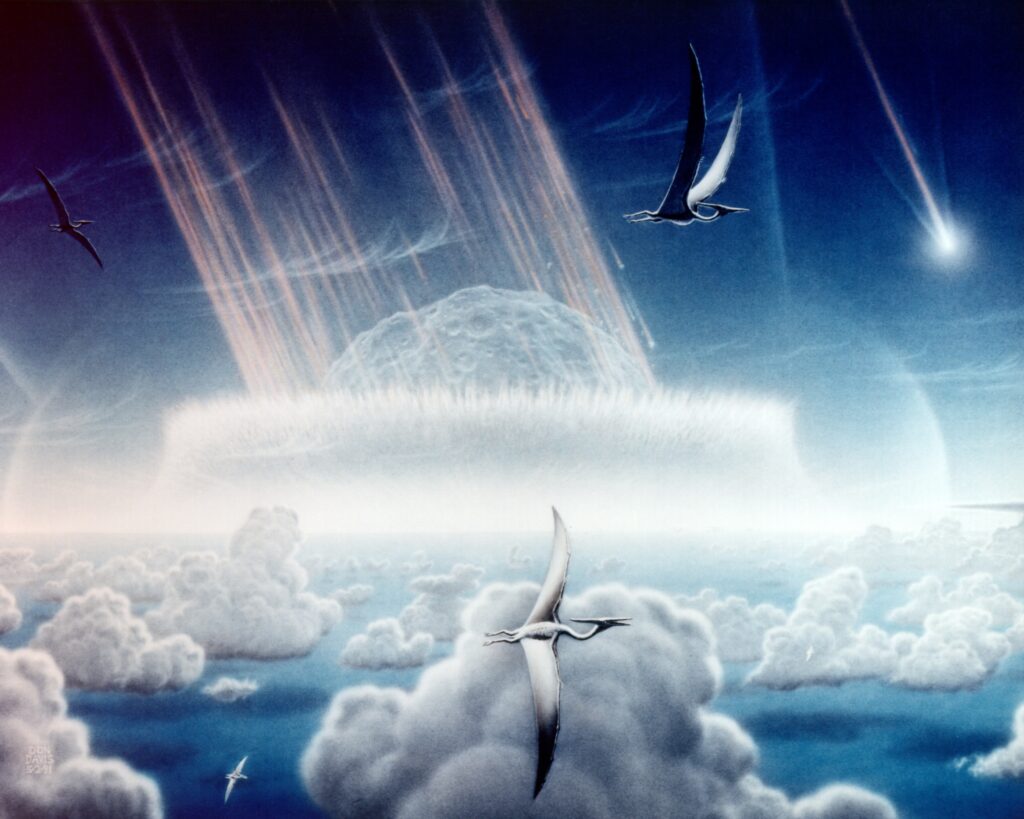
Perhaps the most famous of the major mass extinctions is the Cretaceous-Paleogene, or K-Pg, extinction, which occurred some 66 million years ago. It marked the end of about 67 percent of all species living immediately beforehand, including the non-avian dinosaurs.
This extinction stands apart from the others because of its cause. The overwhelming scientific consensus holds that the impact of a giant extraterrestrial object was the primary cause, with an asteroid fragment of an estimated 10 kilometers diameter striking Earth. The asteroid slammed into waters off what is now Mexico’s Yucatan Peninsula at 45,000 miles per hour, leaving a crater more than 120 miles wide and flinging huge volumes of dust, debris, and sulfur into the atmosphere.
The airborne soot blocked sunlight, forcing ecosystems to collapse. Wildfires ignited any land within 900 miles of the impact, a huge tsunami rippled outward, and overnight, the ecosystems that supported non-avian dinosaurs began to collapse. The impact winter that followed created conditions that large animals simply couldn’t survive.
As a result, mammals and birds were able to gain dominance on land. This single catastrophic event paved the way for mammalian evolution to explode into the diverse forms we see today, ultimately leading to the rise of our own species.
Conclusion

These five mass extinctions reveal a sobering truth about life on Earth. About 99 percent of the estimated 4 billion species that ever evolved are no longer around, with most losses occurring during these catastrophic events rather than through gradual background extinction.
Yet these disasters also demonstrate life’s remarkable resilience and creativity. Mass extinctions topple ecological hierarchies, and in that vacuum, surviving species often thrive, exploding in diversity and territory. Each extinction cleared the stage for entirely new evolutionary experiments, from the rise of complex marine ecosystems after the Ordovician event to the mammalian radiation following the demise of dinosaurs.
Right now, humans find themselves at the beginning of what scientists consider the sixth mass extinction, which is moving much faster than any of the others, with vertebrate species populations declining by an average of 68% since 1970. Understanding these ancient catastrophes isn’t just academic curiosity. They’re blueprints for understanding how our planet’s life support systems can collapse and recover. What do you think about our role in potentially writing the next chapter of this ongoing story?