Dinosaurs have never stopped surprising us. Just when you think science has mapped out the ancient world well enough, a single bone jutting from a hillside in Montana or a chunk of rock in the Gobi Desert upends decades of accepted knowledge. It’s almost humbling, honestly. Entire chapters of textbooks become obsolete overnight.
What’s remarkable is that you don’t need a new planet to find alien-level surprises. You just need a paleontologist with a good eye and a lot of patience. The discoveries on this list didn’t just add a new species name to a dusty catalog. They cracked the entire foundation of what we thought we knew, forcing scientists, museums, and curious minds everywhere to start asking bigger questions. Be surprised by what awaits you.
Deinonychus: The “Terrible Claw” That Sparked a Scientific Revolution
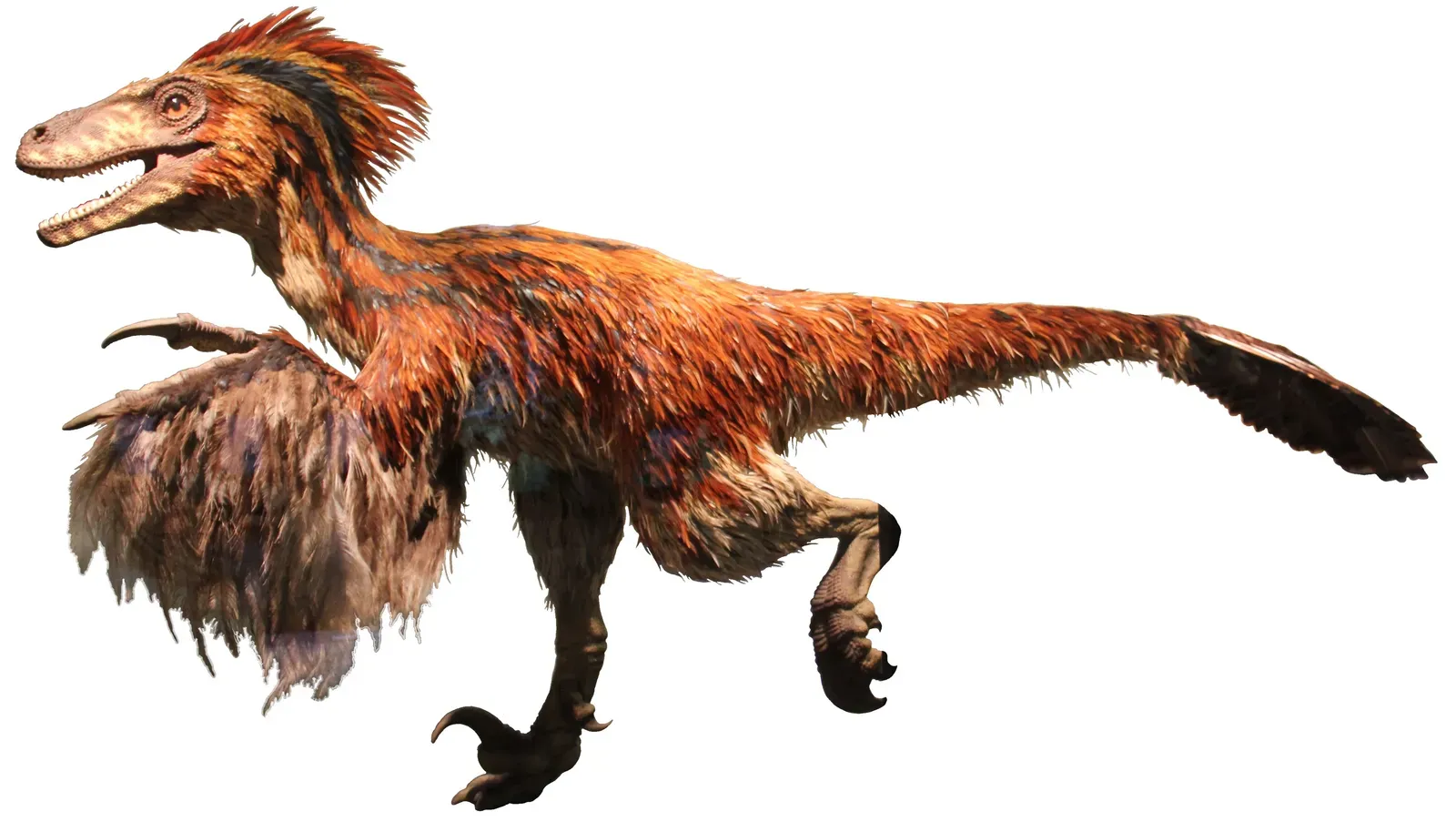
Here’s a question worth sitting with: what if everything paleontologists believed about dinosaurs for over a century was completely wrong? That’s essentially what happened when John Ostrom, beginning with the discovery of Deinonychus in 1964, challenged the widespread belief that dinosaurs were slow-moving lizards. Before that single Montana find, scientists pictured dinosaurs as dim-witted, sluggish reptiles barely one step above a crocodile in temperament.
Ostrom’s description of Deinonychus in 1969 has been described as the most important single discovery of dinosaur paleontology in the mid-20th century. The discovery of this clearly active, agile predator did much to change the scientific and popular conception of dinosaurs and opened the door to speculation that some dinosaurs may have been warm-blooded. This development became known as the dinosaur renaissance. Think of it like finding out your dull, predictable neighbor was secretly a world-class athlete. The whole neighborhood had to rethink everything.
The dinosaur renaissance rapidly influenced cultural perceptions of dinosaurs. Ostrom’s work on Deinonychus influenced the “Velociraptor” portrayal in the Jurassic Park novel. So in a very real sense, every movie scene that made your heart pound with those razor-clawed hunters chasing terrified kids through a kitchen? You can trace that back to one man’s field season in Montana. Not bad for a couple of bones in the dirt.
Patagotitan Mayorum: When the Earth Had a True Giant
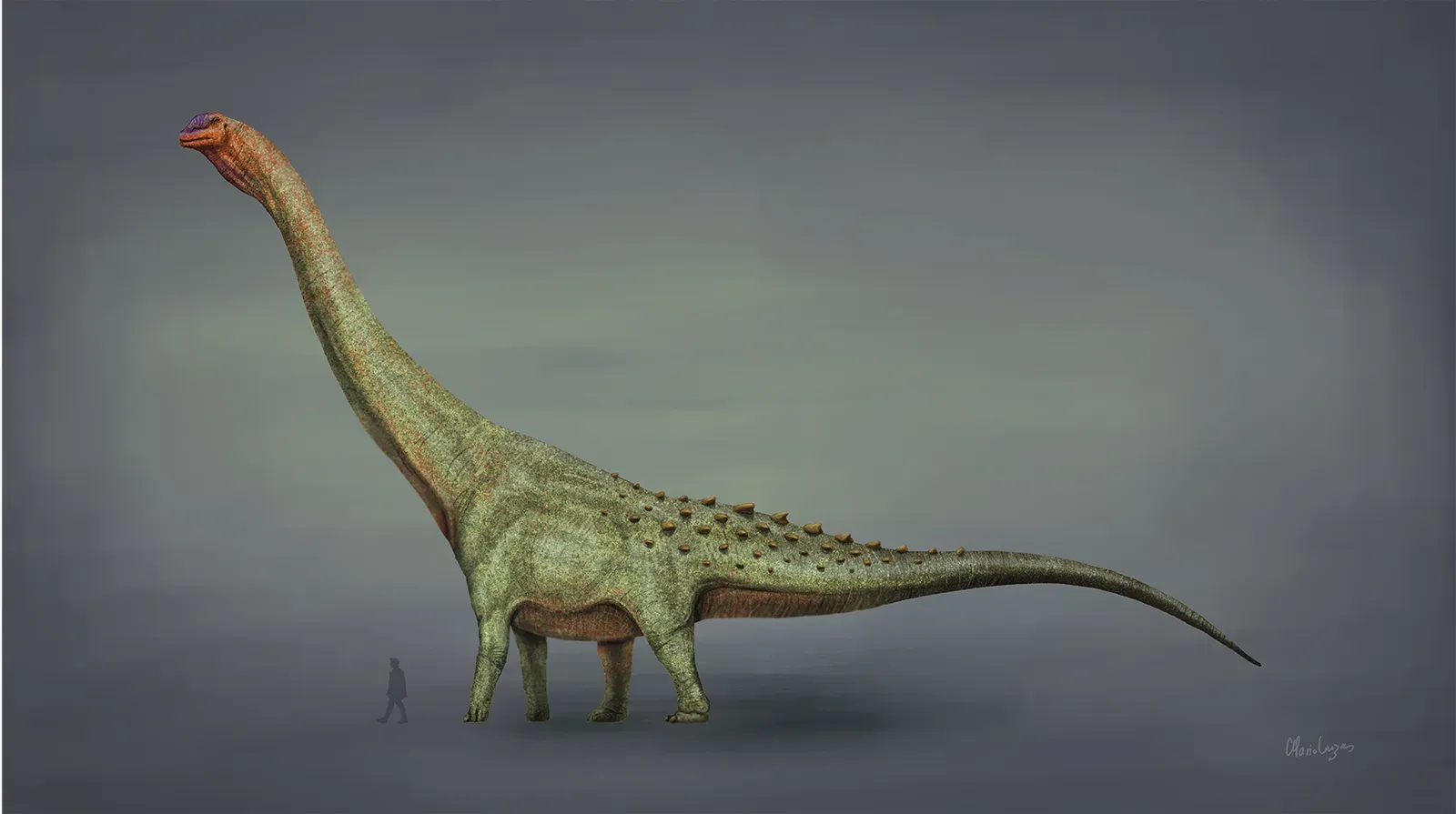
Patagotitan is a genus of titanosaurian sauropod dinosaur from the Early Cretaceous Cerro Barcino Formation in Chubut Province, Patagonia, Argentina. The genus contains a single species known from at least six young adult individuals, Patagotitan mayorum, which was first announced in 2014 and then named in 2017. The story of how it was found is almost as staggering as the creature itself. It all started with a farm worker noticing an enormous bone sticking out of the desert ground.
Paleontologists excavated over 130 fossils from at least six different individual dinosaurs, all the same type of enormous sauropod, including an eight-foot-long femur and most parts of a very long spine. Honestly, an eight-foot femur. That’s taller than most doorways. Patagotitan lived about 102 million years ago and was likely more than 120 feet long and weighed 69 tons, or about the same as 12 African elephants.
For decades, paleontologists had debated the theoretical upper limits of terrestrial animal size: how large could an animal get before its own weight crushed its bones, before its heart couldn’t pump blood effectively, or before it simply couldn’t find enough food? Patagotitan doesn’t just nudge these limits, it shoves them, providing tangible evidence that creatures of truly astronomical proportions roamed the Earth. It’s hard to fully process that kind of scale, but standing next to the cast on display at the American Museum of Natural History might get you close.
The Nanotyrannus Debate Is Finally Over – And It’s a Bombshell
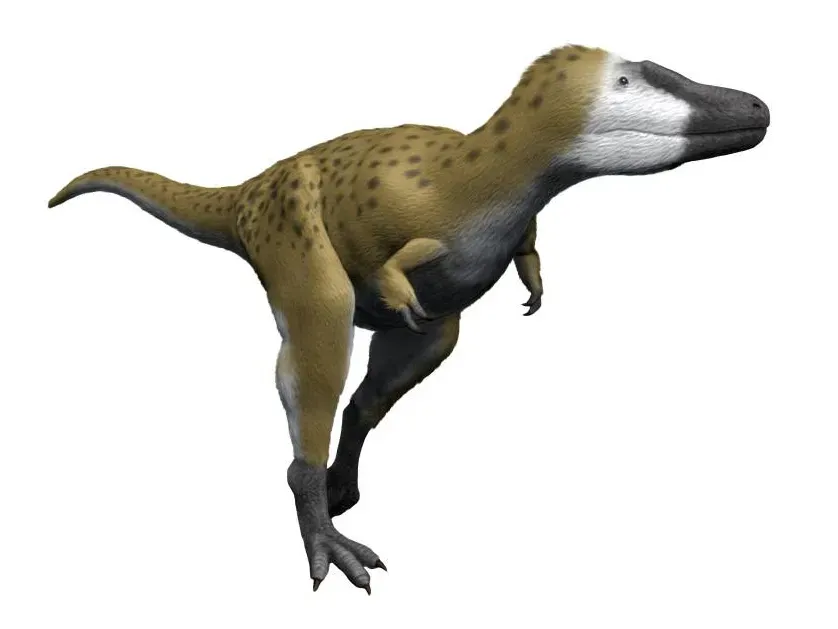
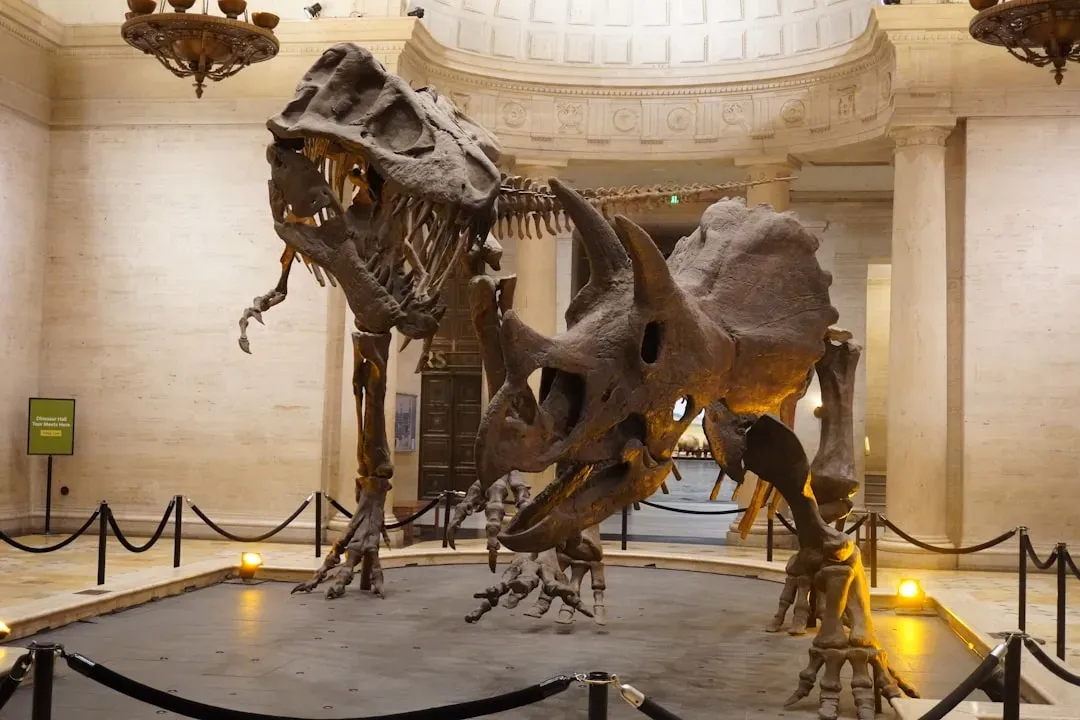
For decades, one of paleontology’s most heated arguments boiled down to a surprisingly simple question: was Nanotyrannus its own species, or just a teenage T. rex? Turns out, scientists were arguing about two completely different animals without realizing it. A complete tyrannosaur skeleton has ended one of paleontology’s longest-running debates. The fossil, part of the legendary “Dueling Dinosaurs” specimen unearthed in Montana, contains two dinosaurs locked in prehistoric combat: a Triceratops and a small-bodied tyrannosaur. That tyrannosaur is now confirmed to be a fully grown Nanotyrannus lancensis, not a teenage T. rex, as many scientists once believed.
The skeleton’s fusing spinal sutures and growth rings show it was fully grown when it died at approximately 20 years of age. Its anatomy reveals traits that form early in development and don’t change with age, including fewer tail vertebrae, more teeth, larger hands, and different skull nerve and sinus patterns. This is the equivalent of realizing that what you thought was a child’s shoe actually belonged to a completely different species of human.
This discovery completely reframes the idea that T. rex was the lone predator of its time, challenging long-held assumptions about late Cretaceous ecosystem dynamics. We now know multiple tyrannosaur species coexisted in the last million years before the asteroid impact, suggesting a richer, more competitive ecosystem than previously imagined. The textbooks on Cretaceous predator ecology? They need a significant rewrite, and fast.
Ahvaytum Bahndooiveche: The Find That Moved Dinosaur Origins North
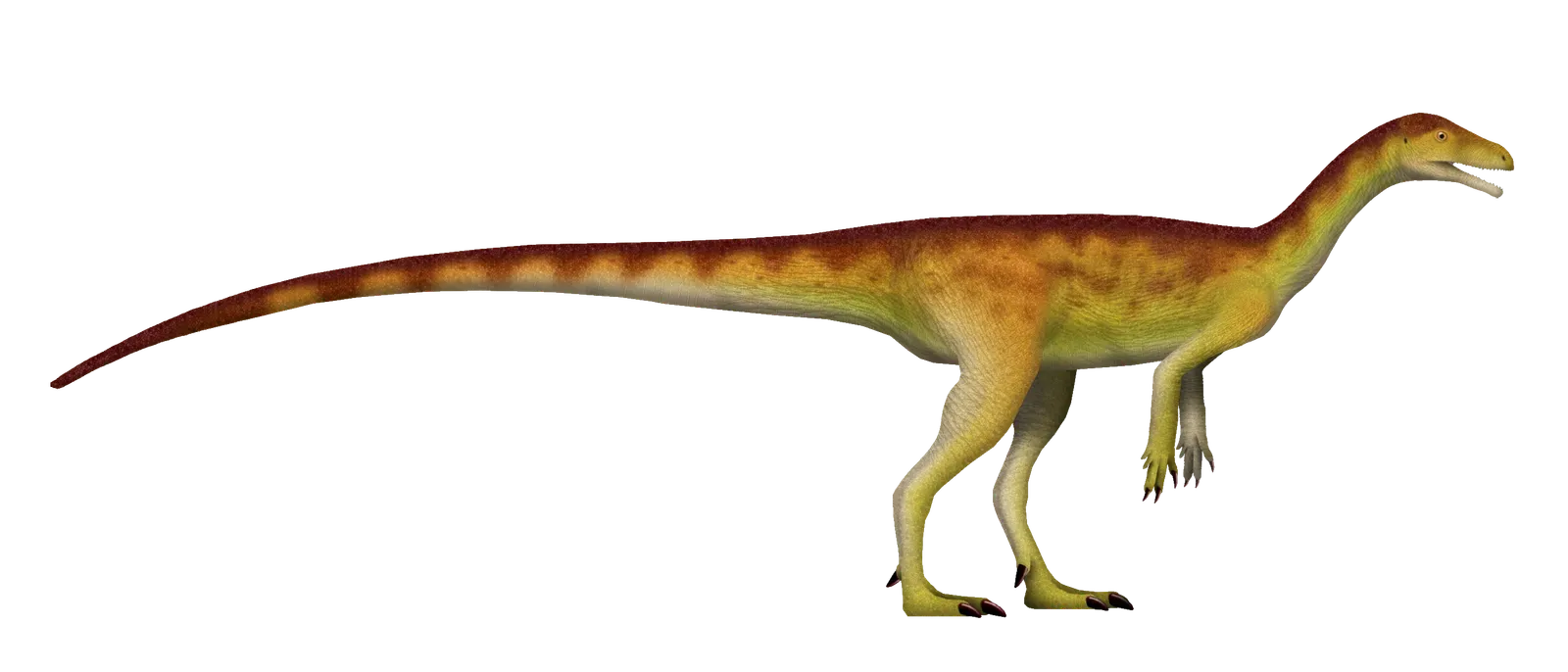
You might not have heard this name yet, but you probably should. With a recent radioisotopic analysis dating the remains to around 230 million years old, this tiny ‘terrible lizard’ named Ahvaytum bahndooiveche is now the oldest-known dinosaur from Laurasia, the Northern Hemisphere land mass of the late Paleozoic supercontinent Pangea. Its discovery upended the long-held scientific narrative that dinosaurs originated entirely in the southern hemisphere and slowly migrated north millions of years later.
Until this discovery, the origin of dinosaurs was thought to be deeply rooted in the high-latitude southern hemisphere, the supercontinent Gondwana. Gondwanan dinosaur faunas and the oldest known dinosaur occurrence in the northern hemisphere were separated by 6 to 10 million years. However, the newly described Laurasian species lived at the same time as the oldest known southern dinosaurs. This is roughly as surprising as discovering that two ancient civilizations you thought were separated by thousands of miles were actually neighbors all along.
Members of the Eastern Shoshone Tribe, whose ancestral lands include the site where these fossils were found, were involved in conducting the field work and in choosing the species’ name, which translates broadly to ‘long ago dinosaur’ in the Shoshone language. There’s something genuinely moving about that kind of collaboration, bridging ancient Indigenous land stewardship with cutting-edge science. It’s the kind of story that makes the discovery feel even more alive.
Haolong Dongi: A 125-Million-Year-Old Dinosaur With Spikes No One Saw Coming
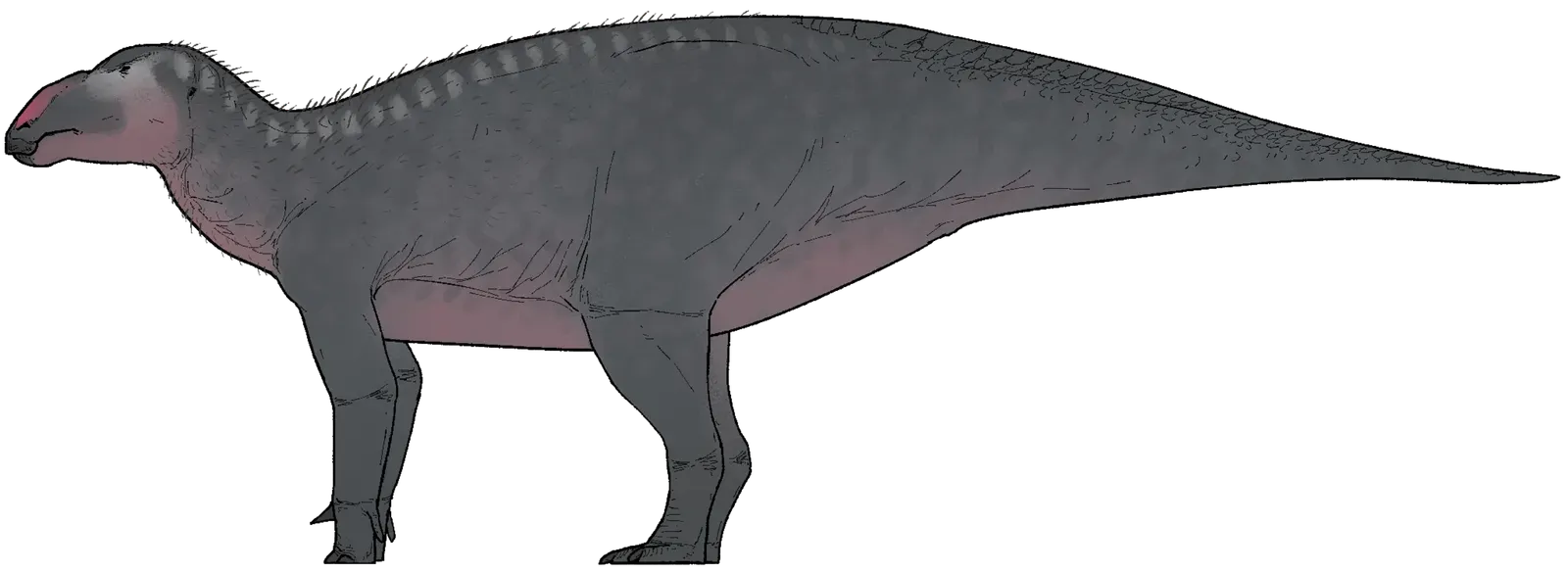
I’ll be honest, this one genuinely floored me. A 125-million-year-old dinosaur just rewrote what we thought we knew about prehistoric life. Scientists in China uncovered an exceptionally preserved juvenile iguanodontian with fossilized skin so detailed that individual cells are still visible. Even more astonishing, the plant-eating dinosaur was covered in hollow, porcupine-like spikes, structures never before documented in any dinosaur. Never. In any dinosaur. Ever found.
The spikes were not decoration or damage from fossilization. They had a clear biological structure, one that suggested purpose and function. Their discovery marked the first known evidence of such spines in dinosaurs, an entirely new category of skin appendage preserved across deep time. Scientists named this remarkable creature Haolong dongi. Despite its formidable appearance, Haolong dongi was a herbivore. It lived under constant threat from small carnivorous dinosaurs, and the spikes may have been its answer to that danger, comparable in deterrent function to the spines of porcupines.
The findings, published in Nature Ecology and Evolution in February 2026, introduce an entirely new feature to the known diversity of dinosaur anatomy. This discovery not only adds a new species to the Iguanodontia group, but also reveals that dinosaur skin and body coverings were more varied and innovative than previously understood. In other words, the more you look, the stranger these creatures become. It’s a reminder that the past is not nearly as settled as we assume.
Spinosaur Origins Rewritten: Europe, Not Africa, Started It All
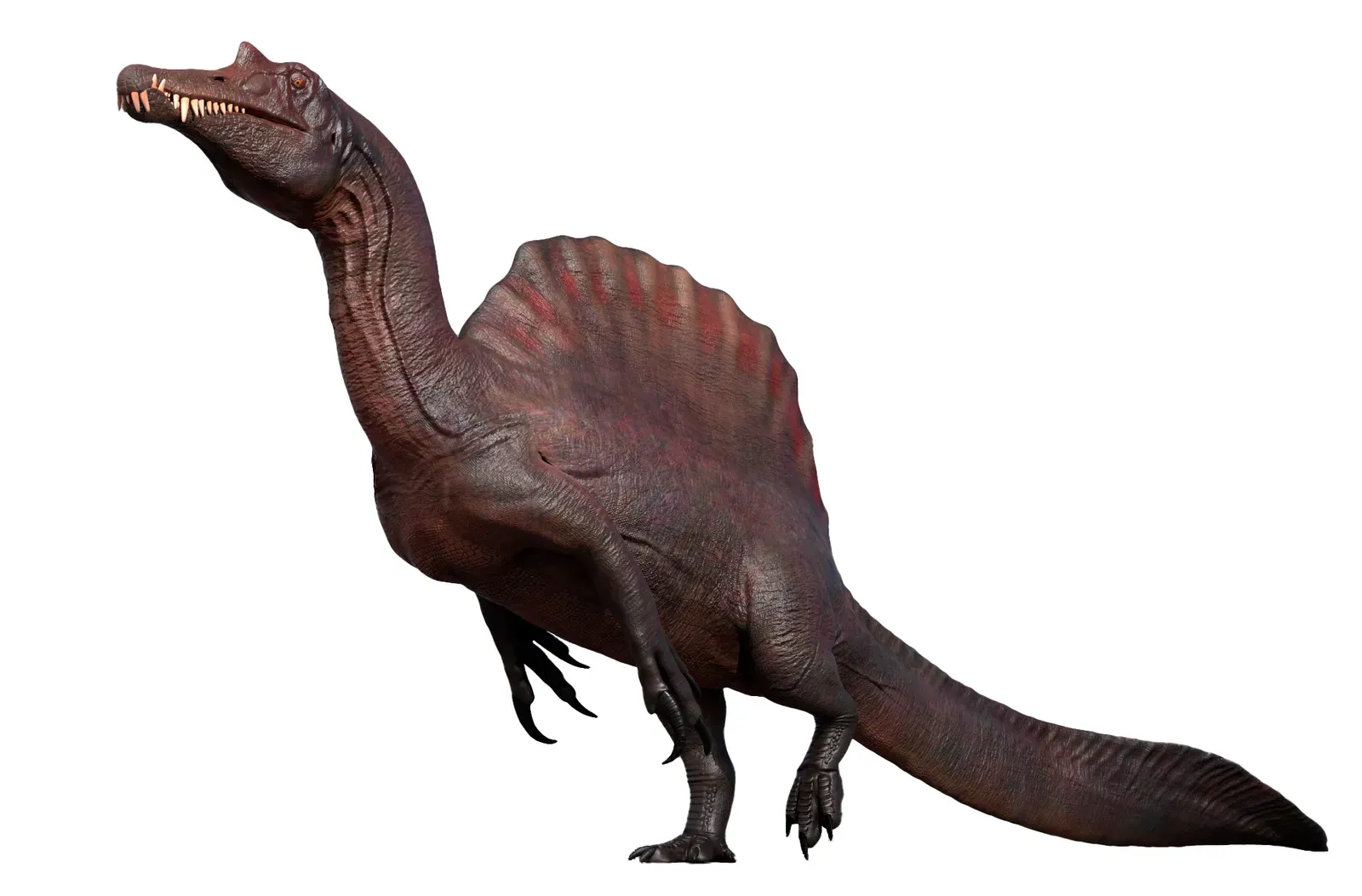
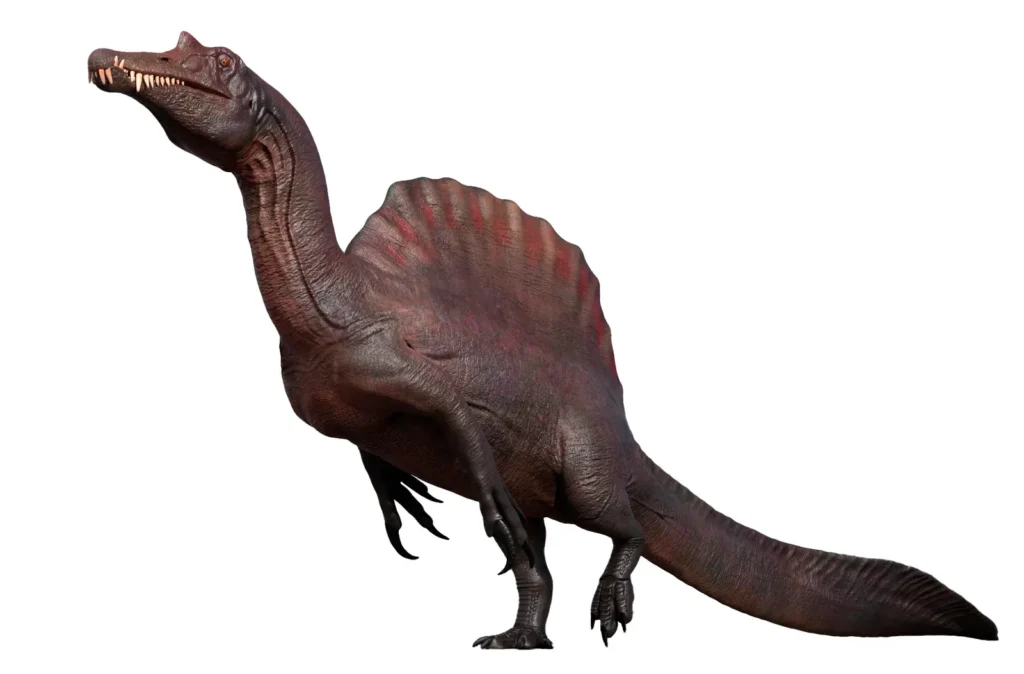
In 2021, paleontologists identified two new spinosaurid species, Ceratosuchops inferodios and Riparovenator minerae, from sediments on the Isle of Wight in the United Kingdom. These semi-aquatic predators, adapted for hunting fish, expanded the known diversity of spinosaurs in Early Cretaceous Europe. Their discovery challenged the assumption that spinosaurs originated primarily in Africa, suggesting that the group may have evolved first in Europe before dispersing to other continents. Let’s be real, finding major spinosaurs on a small British island when the whole world was convinced Africa was their homeland is the paleontological equivalent of a plot twist in a thriller novel.
Both species revealed unique anatomical traits suited to life along waterways, highlighting the ecological variety within this enigmatic family of predators. Then, more recently, the Sahara delivered its own bombshell. A new paper published in Science describes expeditions to find Spinosaurus mirabilis, the first new spinosaurid species discovered in more than a century. A large, fish-eating predator, S. mirabilis adds important new fossil finds to the closing chapter of its genus’s evolution. Two continents, two game-changing discoveries. Spinosaurs, it turns out, have been hiding in plain sight for a very long time.
What makes this especially fascinating is the picture it paints of a world where these enormous fish-hunting predators spread across ancient coastlines and rivers in ways no one predicted. Paleontologists had long wondered why no non-avian dinosaurs seemed to have bodies well-suited for swimming. The answer, it turns out, is that paleontologists just hadn’t found them yet. Every time we assume the map is complete, the earth offers another corner we missed.
Zavacephale Rinpoche: The Gobi Desert Find That Pushed Dino Evolution Back 15 Million Years
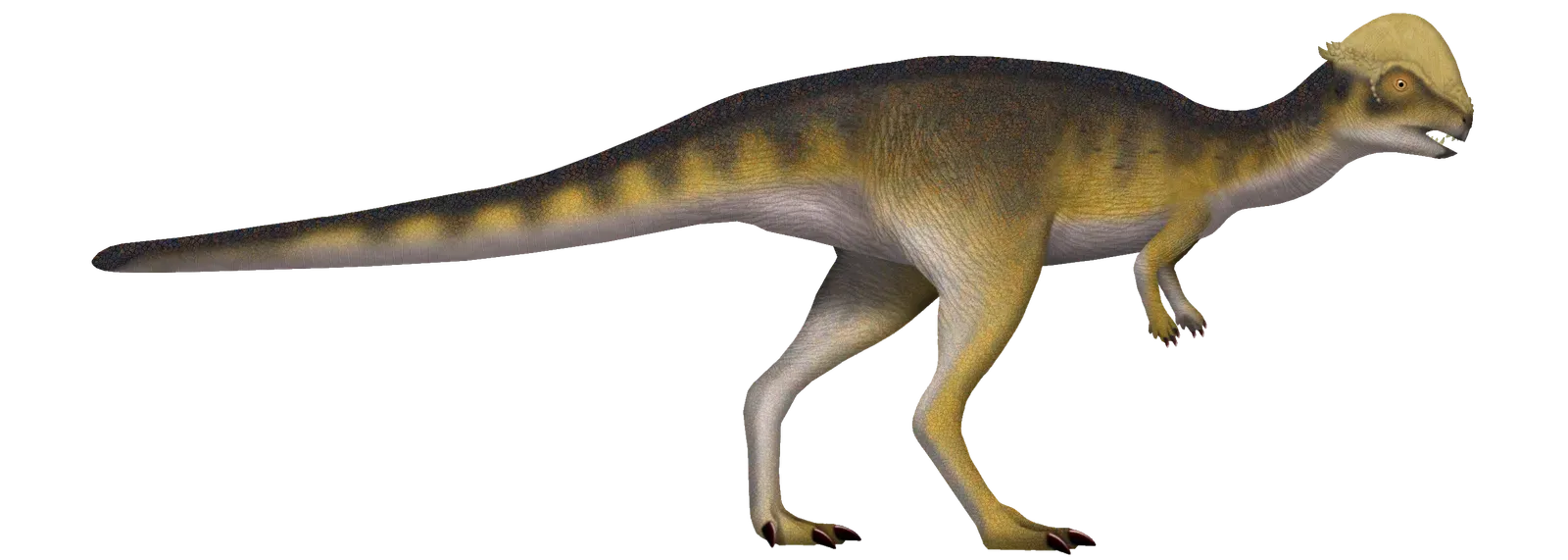
The Gobi Desert has a long reputation for surprising paleontologists. But even by its own extraordinary standards, this find stands apart. A “teenaged” pachycephalosaur from Mongolia’s Gobi Desert may provide answers to lingering questions around the dinosaur group, according to research published in Nature. The fossil represents a new species of pachycephalosaur and is both the oldest and most complete skeleton of this dinosaur group found to date. It’s the kind of completeness that scientists spend careers hoping to stumble upon.
It is remarkable for being the oldest definitive pachycephalosaur, pushing back the fossil record of this group by at least 15 million years, but also because of how complete and well-preserved it is. Think of it this way: if you thought your family history started in 1800 and suddenly discovered a fully documented ancestor from 1650, you’d need to rewrite your entire family tree. That’s roughly the scale of what happened here. Zavacephale rinpoche is an important specimen for understanding the cranial dome development of pachycephalosaurs, which has been debated for a long time due to the absence of early diverging or pre-Late Cretaceous species and the fragmentary nature of nearly all pachycephalosaurian fossils.
Zavacephale rinpoche gives us an unprecedented glimpse into the anatomy and biology of pachycephalosaurs, including what their hands looked like and that they used stomach stones to grind food. Stomach stones. Used to grind food. It’s a detail so specific and so strange that it almost feels like a message from the deep past. These were not just slow-brained creatures wandering ancient plains. They were complex, adapted, and apparently full of surprises we are only now uncovering.
Conclusion
What these seven discoveries share is a kind of intellectual courage. The courage of a farm worker stooping down to look more closely at a strange bone. The courage of scientists willing to say that everything we thought we knew is wrong. Paleontology is not a finished science. It is alive, restless, and perpetually on the edge of its next revolution.
Over the past decade, paleontology has entered a new era of rapid discovery and scientific transformation. Breakthrough fossils unearthed across Asia, South America, North America, and Europe have dramatically expanded our understanding of dinosaur evolution, biology, and behavior. Every shovel-full of earth is a potential plot twist. Every rock face a potential library.
Honestly, the most exciting part of all this? We are almost certainly still wrong about a great many things. The next world-altering fossil might already be sticking out of a hillside somewhere, waiting for someone curious enough to look down. Which of these seven discoveries surprised you the most? Drop your thoughts in the comments below.