Picture the American West – vast deserts, ancient canyon walls, wind-swept plains stretching to the horizon. You probably imagine cowboys, eagles, maybe a rattlesnake or two. But rewind the clock tens of thousands of years, and you’d be standing in the middle of a wildlife spectacle that would make the African savanna look tame. Mammoths thundering across open grasslands. Giant bears capable of outrunning a horse. Saber-toothed cats lurking in woodland shadows. Honestly, it sounds like something a screenwriter dreamed up on too much coffee.
The American West was once one of the most biodiverse places on the planet during the Pleistocene epoch, a chapter of Earth’s history running from about 2.6 million to nearly 12,000 years ago. When the glaciers receded in the late Pleistocene, North America was home to dozens of thriving species of extra-large mammals known as megafauna. What lived here, how it vanished, and what clues remain in the rock and tar pits of the West make for a story you won’t forget. Let’s dive in.
1. Smilodon Fatalis: The Saber-Toothed Cat That Ruled the West Coast
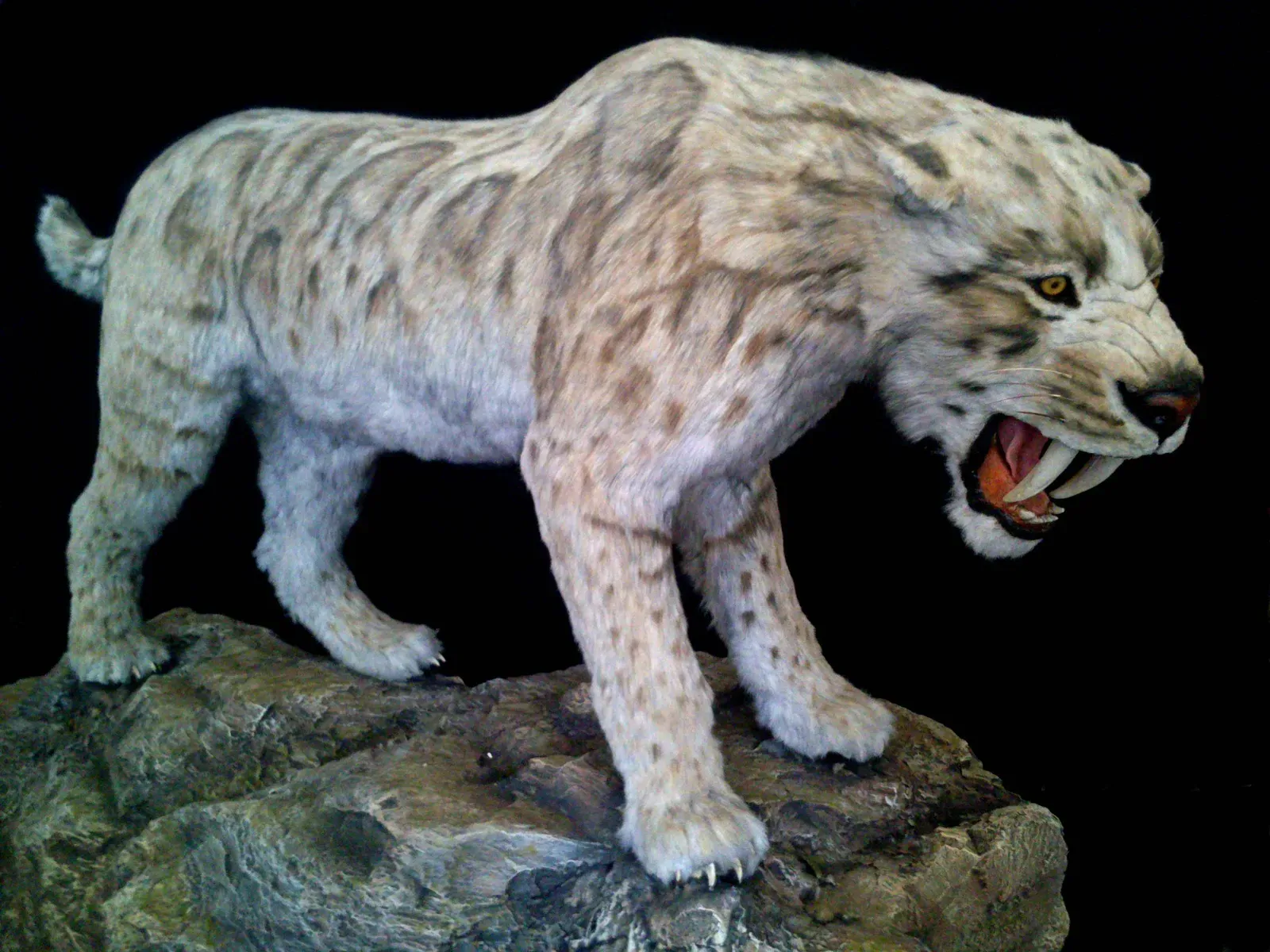
You know this one. Everyone knows this one. The saber-toothed cat is basically the rock star of prehistoric megafauna, except the reality is even more impressive than the pop culture version suggests. Although commonly known as the saber-toothed tiger, it was not closely related to the tiger or other modern cats, belonging to the extinct subfamily Machairodontinae. Think of it less like a super-sized tiger and more like a completely unique evolutionary experiment in lethal weaponry.
Saber-toothed cats were powerful predators, weighing between 350 to 600 pounds, comparable to a modern Siberian tiger. Their most distinctive feature was their elongated, narrow upper canines, which could grow up to 11 inches. You wouldn’t want to meet this animal on a quiet evening stroll. Fossils tell scientists that saber-toothed cats were ambush predators who waited for the right moment to surprise their prey, then used their strong front limbs to hold it down. Over 2,500 Smilodon have been uncovered from the asphaltic deposits at La Brea Tar Pits, giving researchers a remarkably detailed picture of this legendary creature.
2. The Woolly Mammoth: A Giant in a Frozen Land
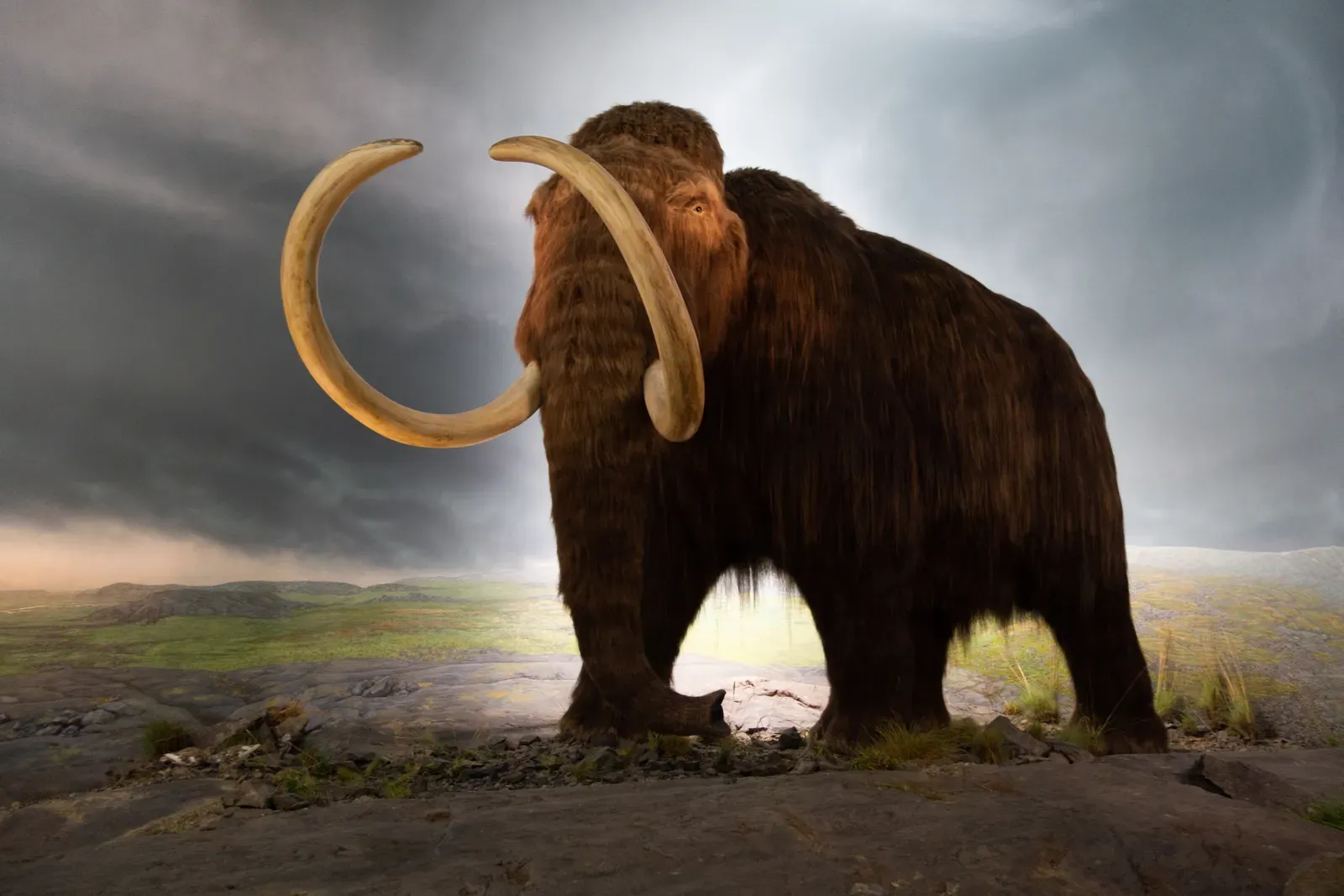
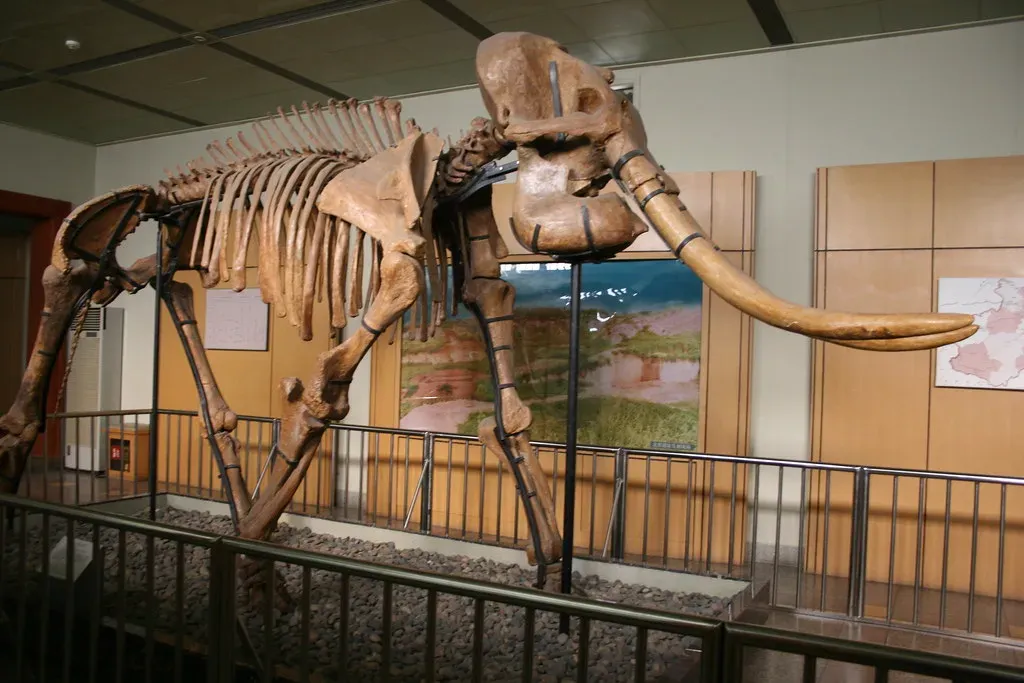
Few prehistoric animals capture the imagination quite like the woolly mammoth. There is something almost heartbreaking about them – enormous, shaggy, intelligent creatures that vanished in what amounts to a geological eyeblink. The woolly mammoth is one of the most famous extinct Ice Age megafauna. Standing 12 feet tall at the shoulders and weighing six to eight tons, the woolly mammoth grazed the northern steppes of Ice Age North America using its colossal, 15-foot curved tusks to dig under the snow for food and defend itself against predators.
As recently as 500,000 years ago, the woolly mammoth arrived in North America. Mammoths spread everywhere in Ice Age North America, ranging from Canada down to Honduras. Here’s the part that genuinely blew my mind: nearly all mammoths and mastodons were wiped out in the great megafauna extinction 10,000 years ago, but archeologists have dug up remains showing that lone bands of mammoths still roamed arctic islands as recently as 4,500 years ago. That means mammoths were still alive while the ancient Egyptians were building their pyramids.
3. The Short-Faced Bear: The Largest Land Carnivore You’ve Never Heard Of
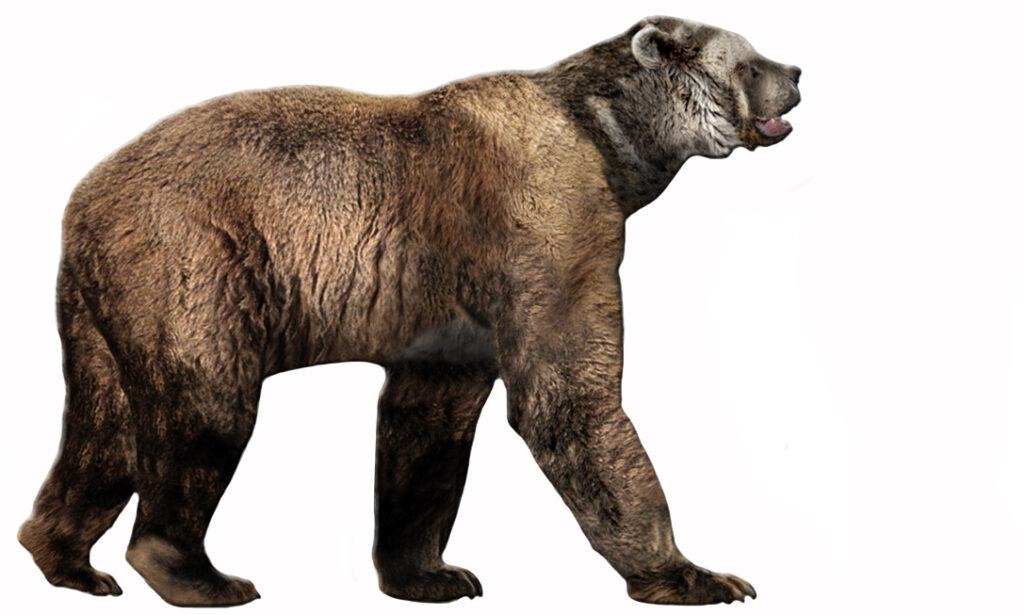
Here’s the thing – most people think of the woolly mammoth when they picture Ice Age mega-predators. But the creature that should truly haunt your dreams is the short-faced bear. In prehistoric North America, the short-faced bear ruled the land. It was one of the biggest and most powerful predators the world has seen, weighing an immense 900 kilograms and standing 2 metres at the shoulder. For reference, that is closer in size to a small car than to anything you’d encounter in a modern national park.
Short-faced bears were among the largest terrestrial mammalian carnivores to ever live in North America, with males potentially standing up to 12 feet tall on their hind legs. Their lean, long-legged build suggested they were capable runners, possibly reaching speeds over 40 miles per hour. These bears, with their powerful jaws and shearing teeth, were carnivorous, preying on large herbivores like bison, muskoxen, and ground sloths across western North America. The short-faced bear was the most powerful predator of the American Pleistocene and was probably replaced by the grizzly bear, which came from Asia at that time.
4. The American Mastodon: The Elephant That Actually Called America Home First
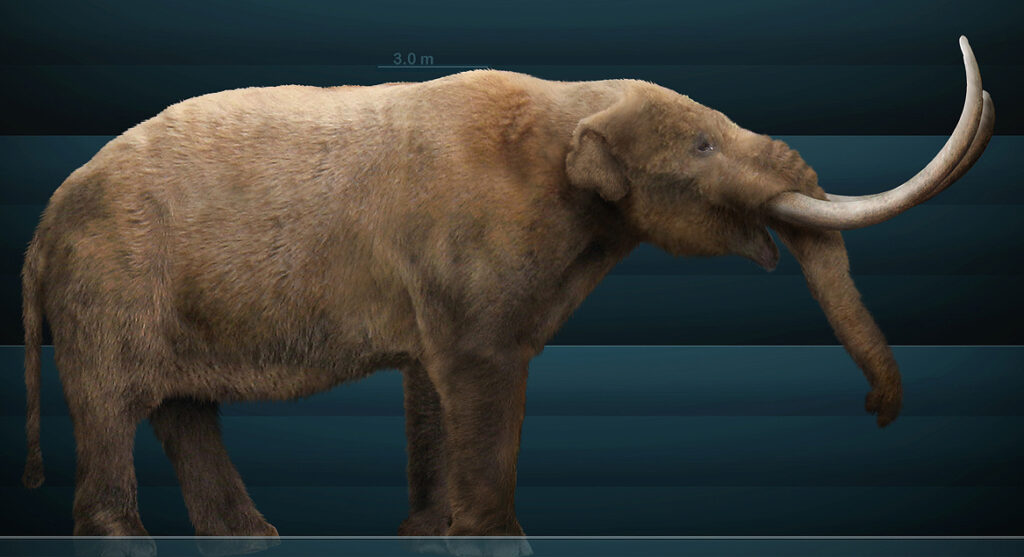
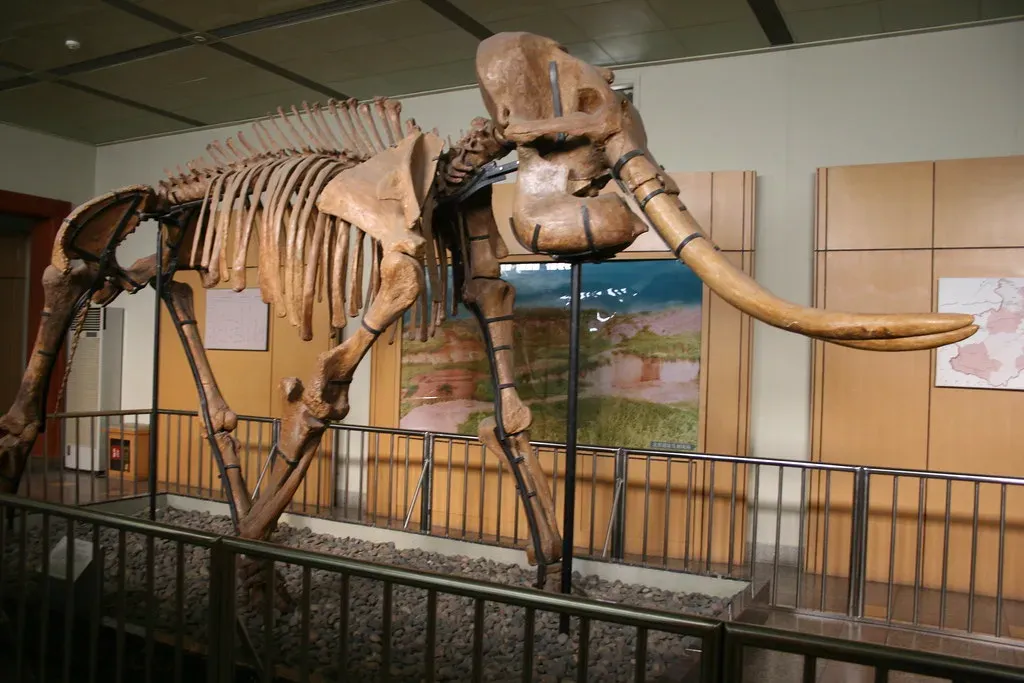
People tend to mix up mastodons and mammoths, and honestly, the confusion is understandable. They are both enormous, hairy, elephant-like creatures that trampled across prehistoric North America. The American mastodon is the most ancient of the North American “elephants.” Its ancestors crossed the Bering Strait from Asia roughly 15 million years ago and evolved into the American mastodon 3.5 million years ago. The mastodon was shorter and stockier than the later mammoths, and the shape of its teeth indicate that mastodons didn’t graze on grass like mammoths, but ripped off leaves and entire tree branches for food.
Like woolly mammoths, mastodons also had thick coats of shaggy hair that kept them warm in Pleistocene North America. They were less sophisticated than their mammoth cousins. Mastodons had molars with cone-shaped cusps that helped them crunch leaves, twigs, and branches from deciduous and coniferous trees. In a world full of giants, the mastodon stood apart as a true forest browser rather than a plains grazer – a different lifestyle carved out by millions of years of specialized evolution. In western North America, mastodons were rare and preferred conifer woodlands.
5. Camelops: The Western Camel That Most People Don’t Know Existed
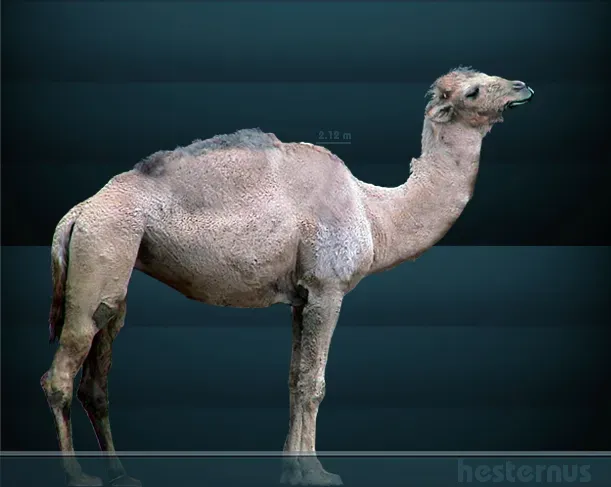
Let’s be real – when someone mentions camels, your brain probably travels to the Sahara or the Middle East, not the American West. Yet camels are, in one of prehistory’s greatest plot twists, an entirely American invention. The very first camels on the planet evolved in North America around 44 million years ago. Those ancient camels migrated westward over the Bering land bridge around 7 million years ago, later becoming the one-humped dromedary and two-humped Bactrian camels of North Africa and Asia.
Camelops was an extinct genus of large camels that existed from the Late Pliocene Epoch to the end of the Pleistocene Epoch, between 3.6 million and 11,700 years ago, in western North America from Mexico to Alaska. The ancient camels found at La Brea Tar Pits were a foot taller than modern dromedary camels, measuring around 7 feet from the shoulder, and had longer necks. Their long legs suggest they were capable of running 40 mph, around the same speed as modern camels. It is unclear whether Camelops shared the characteristic hump of modern camels. Soft tissue is not preserved well in the fossil record, and the animal’s vertebrae show no signs of supporting a fatty hump.
6. The Dire Wolf: The Real Beast Behind the Legend
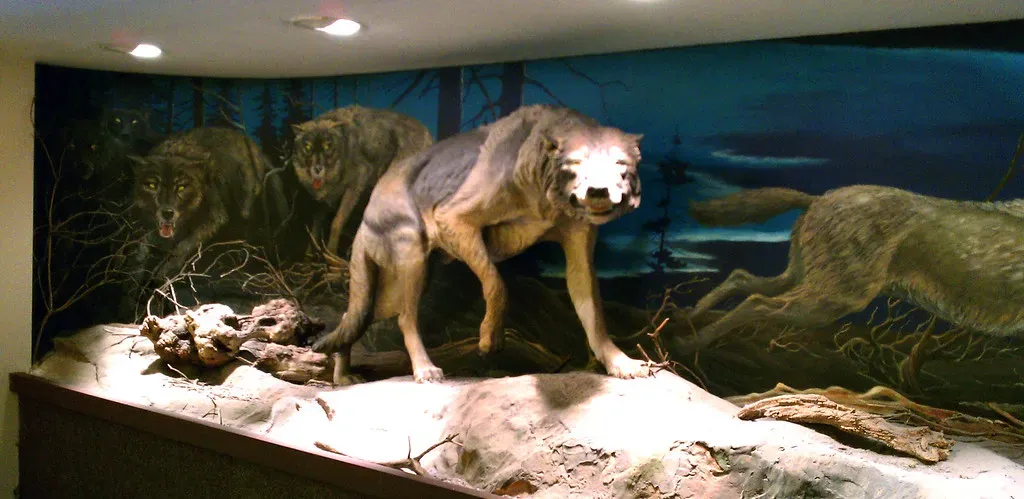
Before the fantasy TV shows got their hands on the name, dire wolves were already extraordinary enough on their own. Dire wolves were larger and more robust than modern gray wolves, weighing between 125 and 175 pounds. They possessed a broad skull, large teeth, and powerful jaws capable of crushing bones, indicating adaptation for both hunting large prey and scavenging carcasses. Imagine a creature built like a tank with the instincts of a wolf and the jaw strength of something twice its size.
Dire wolf fossils are abundant across North America, from Alaska to Mexico, suggesting their adaptability to various habitats, including boreal grasslands, open woodlands, and tropical wetlands. Dire wolves went extinct about 13,000 years ago, and their bones are abundant in California’s La Brea Tar Pits and Wyoming’s Natural Trap Cave. About 5.7 million years ago, dire wolves split from wolves, making them distant relatives of today’s wolves on the canid family tree. Highly specialized prey preferences are what likely doomed species such as dire wolves, while coyotes managed to survive the ecological shift by being highly flexible and taking prey as small as rats or rabbits, in addition to scavenging.
7. The American Horse: The Original Wild West Rider
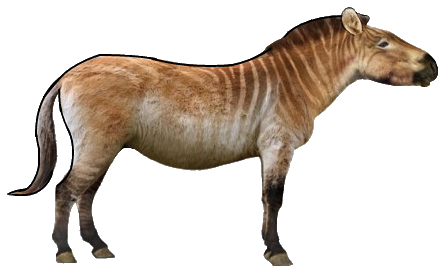
The story of the American horse is one of the strangest comebacks in natural history. You probably grew up thinking of the horse as a European import, brought over by Spanish conquistadors. Technically that is true, but the longer story is far more surprising. Indigenous horses roamed North America for 55 million years before going extinct along with other Ice Age megafauna roughly 10,000 years ago. One of the oldest and most widespread ancient horse species in North America was the American zebra, also known as the Hagerman horse. The American zebra is the oldest known member of the genus Equus, which includes all modern horses, both wild and domesticated.
The American zebra stood around five feet tall at the shoulders, had a stocky build, and faint stripes along its neck and flank. Around 2 to 3 million years ago, herds of American horses traveled west over the land bridge into Asia, eventually spreading to Africa. Those ancient horses were the distant ancestors of the domesticated horses that the Spanish re-introduced to North America. So in a poetic way, when European explorers brought horses back to the American West, they were completing a full circle – returning a creature that had evolved right here on this land millions of years before.
8. The Giant Ground Sloth: Nature’s Most Unlikely Monster
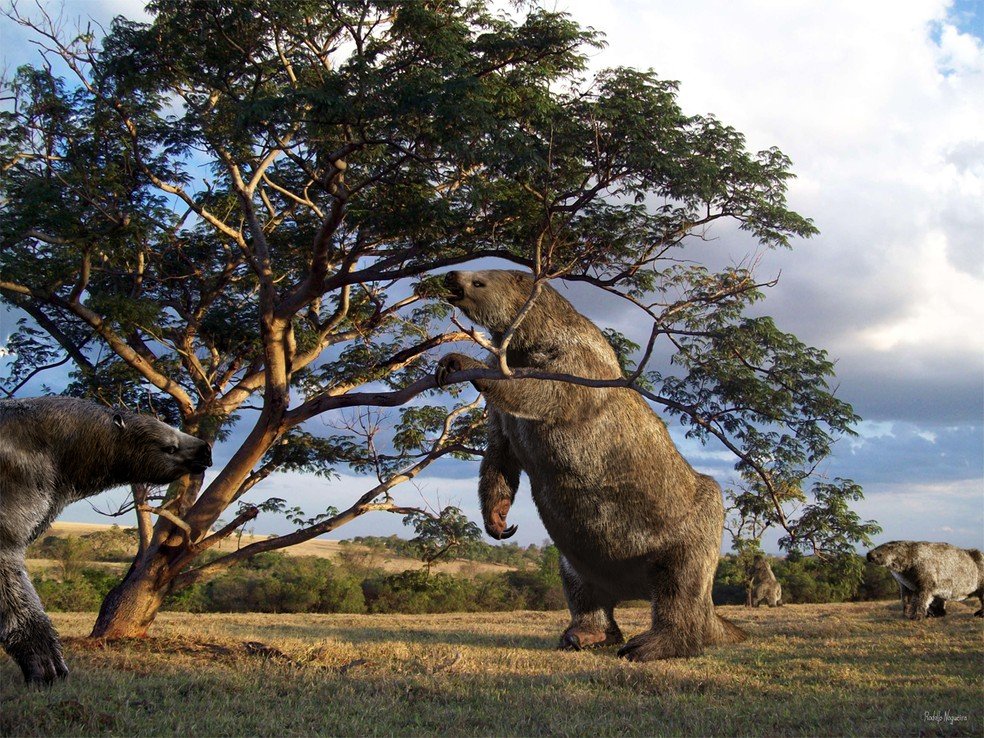
Sloths, in the modern day, are the internet’s favorite sleepy goofball. Slow, gentle, and about the size of a medium dog, they are basically living stuffed animals. Their Pleistocene ancestors, however, were something else entirely. In Ice Age North America, sloths were an entirely different beast. The giant ground sloths of the late Pleistocene were bear-sized herbivores that stood 12 feet on their hind legs and weighed up to 3,000 pounds. I know it sounds crazy, but picture a creature the size of an elephant, shuffling across the ancient plains of what is now California, Nevada, and the desert Southwest.
DNA analysis indicates that all extinct North American ground sloths, including the massive Harlan’s ground sloth, originated in South America and migrated north. One giant sloth species, the Jefferson ground sloth, was named for Thomas Jefferson, who initially believed that sloth fossils were a type of colossal cat that he dubbed the Megalonyx, meaning “giant claw.” Researchers uncovered a 4.8 million-year-old Megalonyx fossil in Mexico, and later specimens were found in present-day America, especially in areas that used to have forests, lakes and rivers. During warmer periods, Megalonyx made it as far north as the Yukon and Alaska. The giant ground sloth was an ecological titan, reshaping vegetation across enormous territories simply by existing.
What Silenced the Giants of the American West
After meeting all eight of these extraordinary creatures, you are probably wondering the same thing: what happened to them? The end of the Pleistocene was marked by the extinction of many genera of large mammals, including mammoths, mastodons, ground sloths, and giant beavers. The extinction event is most distinct in North America, where 32 genera of large mammals vanished during an interval of about 2,000 years.
The cause of the extinctions has been vigorously debated, with two main hypotheses: the extinctions were either the result of overpredation by human hunters, or they were the result of abrupt climatic and vegetation changes during the last glacial to interglacial transition. It’s hard to say for sure which force was more decisive, and the honest answer is probably both played a role. The timing and severity of the extinctions varied by region and are generally thought to have been driven by humans, climatic change, or a combination of both.
The American West we know today – the canyon country, the desert basins, the sweeping grasslands – was once something almost unrecognizable. A world full of creatures that make our largest living animals seem modest by comparison. Walking across the same ground where mammoths grazed and saber-toothed cats hunted is an almost otherworldly thought. These animals are gone, but the land still carries the memory of them in fossil beds, tar pits, and ancient exposed stone. Perhaps the most haunting takeaway is this: every modern landscape is the ghost of a richer, wilder world.
What creature from this list surprised you the most? Drop your answer in the comments below.