
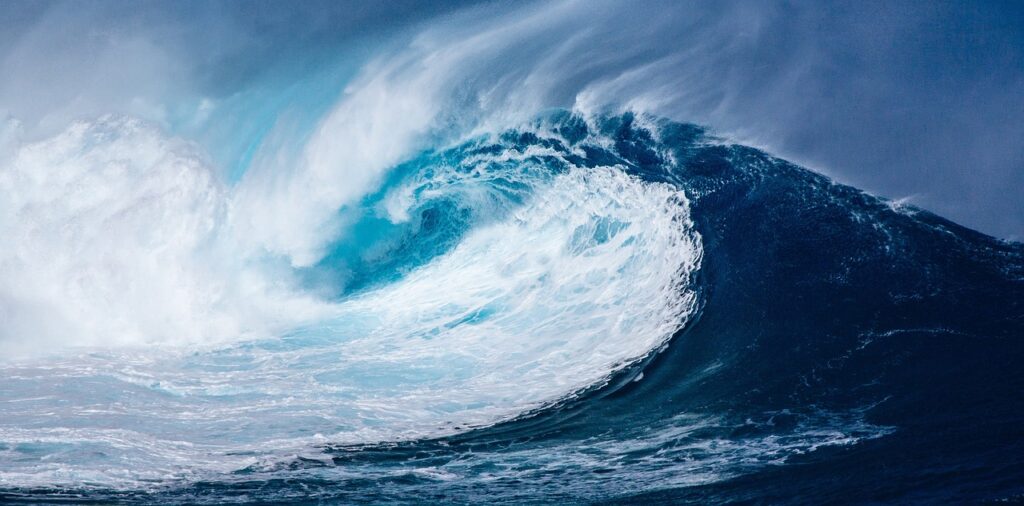
About 66 million years ago, a massive asteroid smashed into Earth at what is now the Yucatán Peninsula in Mexico. That event — the Chicxulub impact — is widely credited with triggering the end-Cretaceous mass extinction, wiping out the non-avian dinosaurs and about three-quarters of Earth’s species. But beyond the dramatic blast and global climate chaos, one of the most brutal consequences was a global scale megatsunami. Recent numerical simulations and sedimentary evidence show this tsunami dwarfing any modern comparable event. The waves generated immediately after the impact raced across oceans, scouring seafloors and redistributing sediments thousands of kilometres away. This is arguably the deadliest tsunami in Earth’s history, not just in height but in global reach and destructive power. In the sections below we explore how it formed, how big it was, how it spread, and how scientists know about it.
The moment of impact — creating a curtain of debris and water

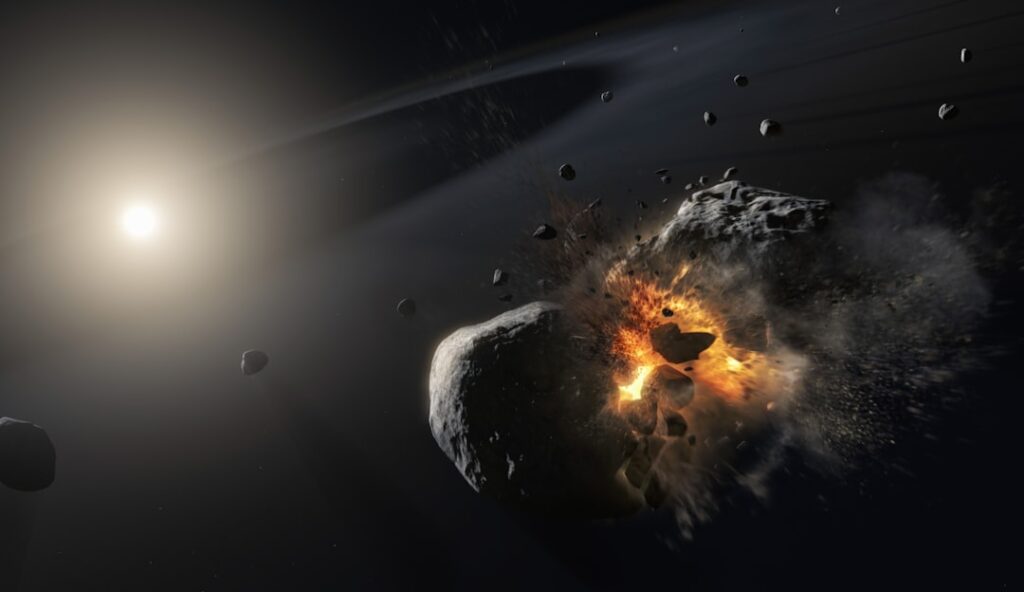
Within minutes of the asteroid strike, the impact violently displaced vast amounts of rock, water and debris. Simulations show a “curtain” of ejected material rising from the crater, which then pushed outward a massive wall of water. For example, around 2½ minutes after impact, the simulated wave reached about 4.5 kilometres (2.8 miles) high.
This initial wave was extremely short-lived, but its energy set the stage for the far-reaching tsunami that followed.
Global wave propagation — the 1.5 km high ring wave
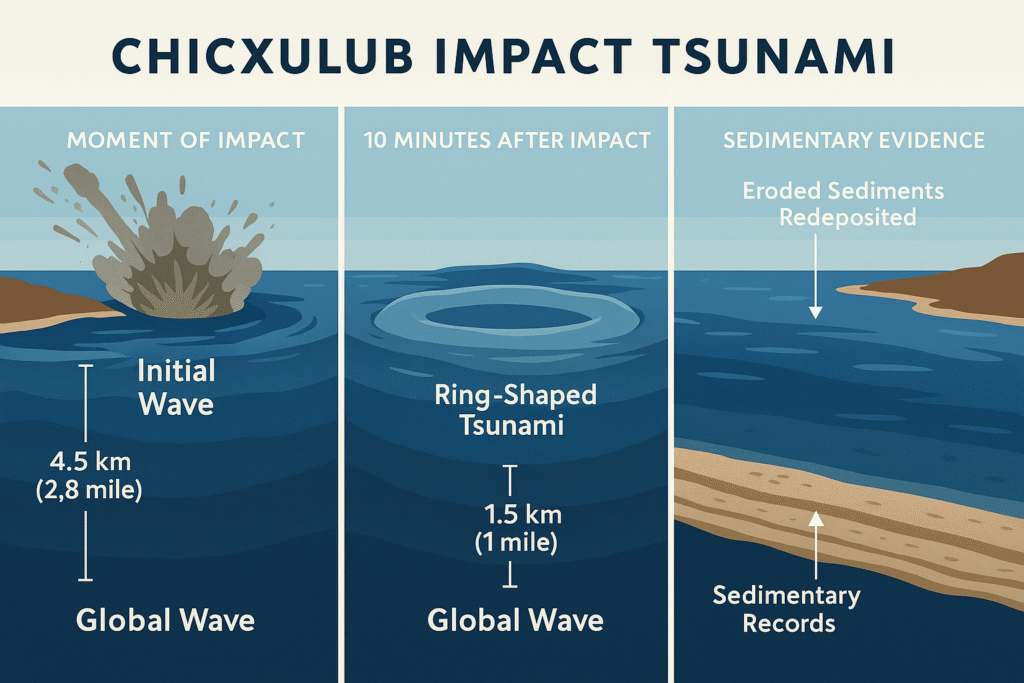
About ten minutes after impact, a ring-shaped tsunami wave of roughly 1.5 kilometres (nearly 1 mile) high began to propagate outward across the ocean from the impact site.
This wave travelled through the global ocean system, forming one of the largest tsunami waves ever modelled. The simulation work by NOAA and other teams used hydrocode and deep-ocean modelling to reproduce this behaviour.
Global devastation — scouring seafloors and reaching every coast
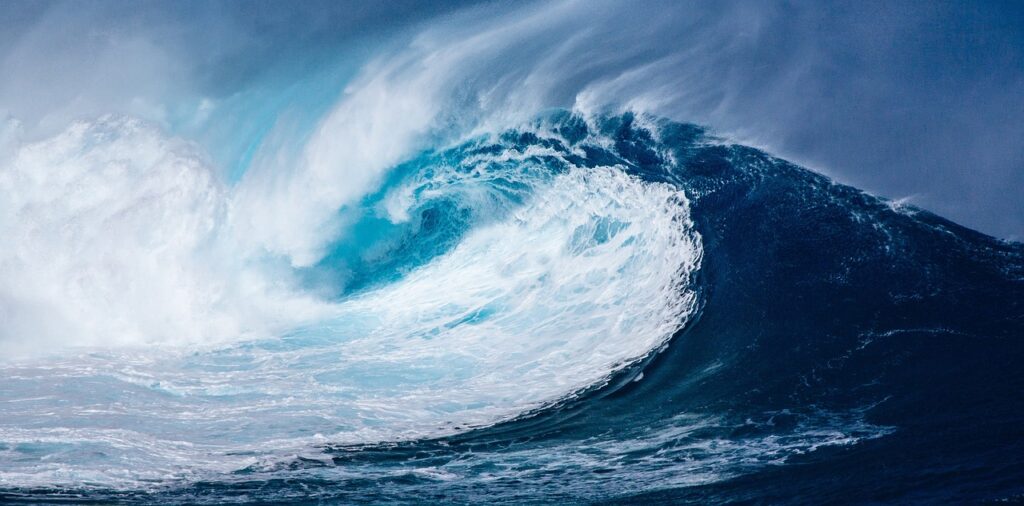
This wasn’t just a local event. The tsunami’s amplitude and reach were immense. For instance, flow velocities in the model exceeded thresholds that could scour the seafloor thousands of kilometres from the impact site.
In the North Atlantic and parts of the South Pacific, wave amplitudes of over 10 metres (33 feet) have been inferred from sedimentary evidence.
The energy released was estimated to be up to 30,000 times more than that of the 2004 Indian Ocean tsunami.
Geological evidence — sediment records from around the world
How do we know this tsunami happened and was so big? Sedimentary records at more than 100 worldwide sites show erosion, sediment redeposition, and disrupted seabed layers consistent with the models. In one striking example, fossilised “megaripples” were found in subsurface formations under Louisiana, linked to the tsunami’s action.Another site in the Gulf of Mexico (Arroyo el Mimbral) shows plant debris deposited seaward from an offshore site, interpreted as backwash from the tsunami.
Distance travelled — from Mexico to New Zealand and beyond
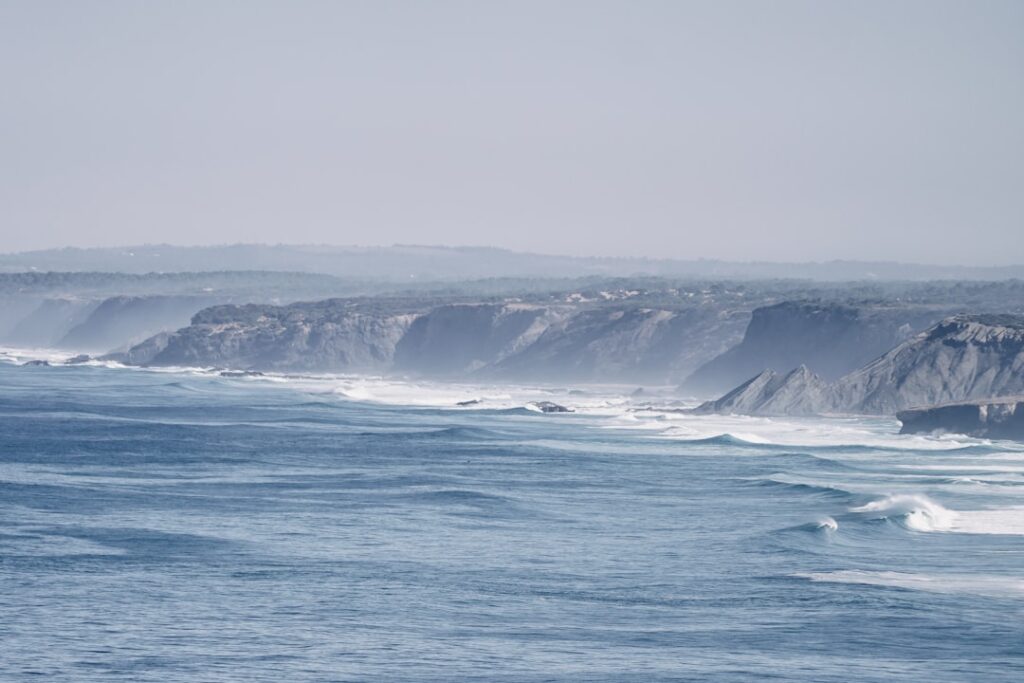
The wave’s global reach is astonishing. Some sediments show re-deposition of material as far away as what is now New Zealand — more than 12,000 kilometres from the impact. The models show flow velocities and energy capable of disturbing deep-sea sediments in multiple ocean basins. Thus, the tsunami wasn’t just a regional coastal disaster, it was a planetary-scale wave event.
Comparison to modern tsunamis — why this was in a class of its own
To appreciate how extreme this event was, consider modern tsunamis: the 2004 Indian Ocean event, for example, generated waves tens of metres high locally. The Chicxulub tsunami, by contrast, reached kilometer-scale heights initially, and hundreds of metres, even kilometres, in propagation. Simulations show this impact-generated wave was massively more energetic.
It swept across ocean basins, scoured seabeds, and left geological signatures unmatched in our recent recorded history. Hence it stands as arguably the deadliest tsunami Earth has ever experienced — combining height, energy, range and speed.
Biological and ecological consequences — more than just waves
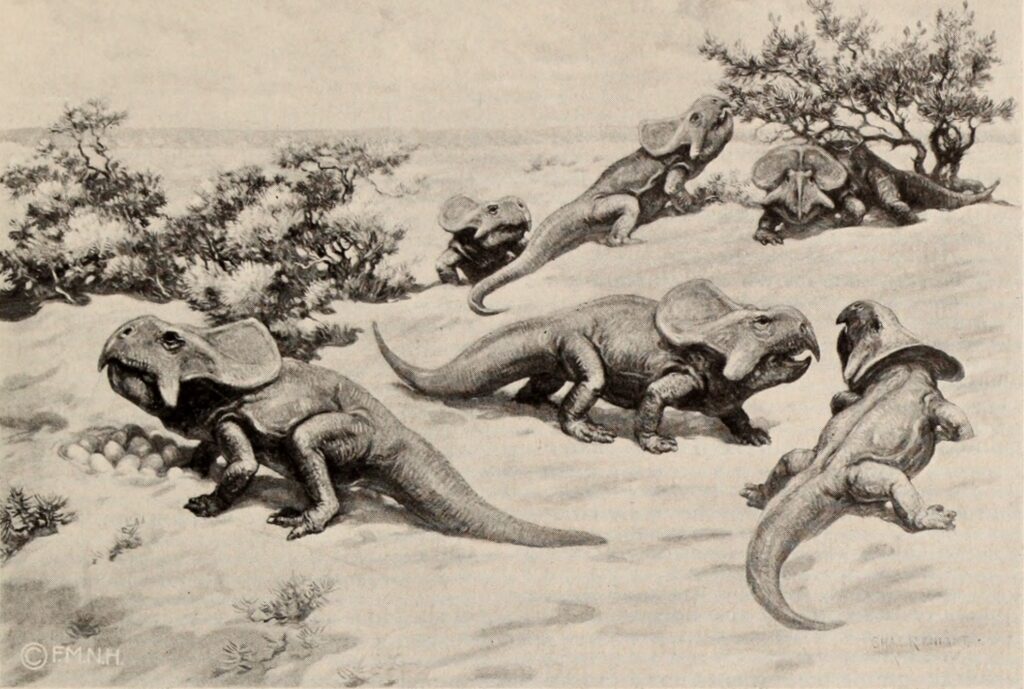
The tsunami itself would have wiped out coastal ecosystems around the globe, but its devastation was only part of the chain of destruction. The impact also triggered mega-earthquakes, wildfires, and injected sulfur and dust into the atmosphere, leading to darkness, cooling and collapse of photosynthesis.
Combined with the tsunami’s upheaval, the event severely disrupted life on land, in shallow seas, and across the oceanic environment — contributing to the mass extinction of the non-avian dinosaurs and many other species.
What this means for understanding Earth’s risk and ancient catastrophes
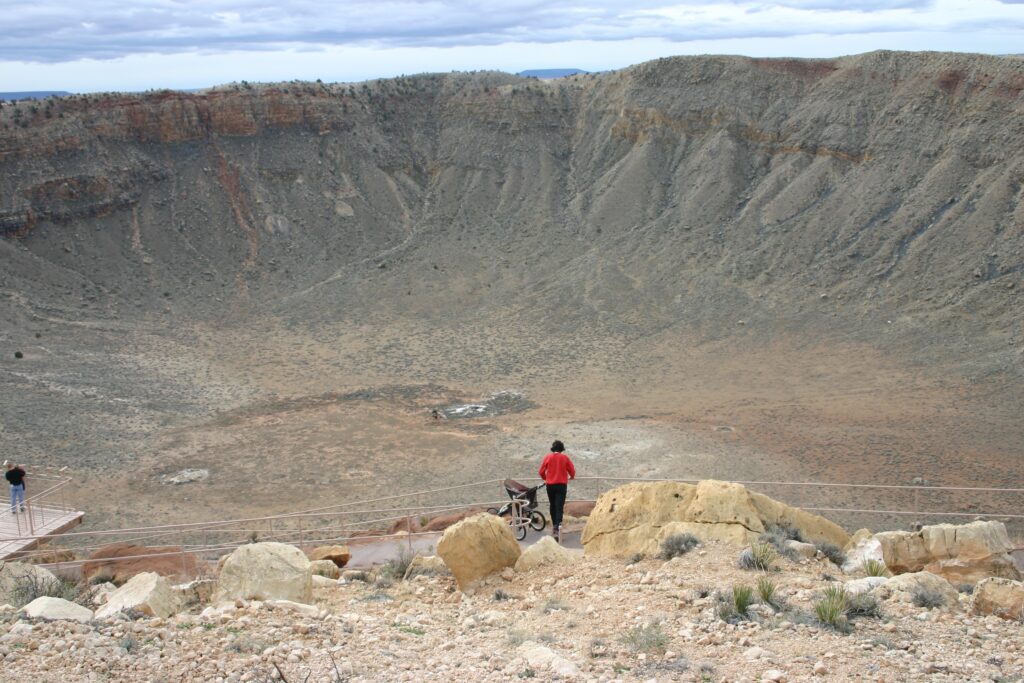
Studying this ancient tsunami is not only about the past — it helps us understand Earth’s vulnerability to extreme events. The Chicxulub catastrophe serves as a real-world example of how an asteroid impact into the ocean can trigger global waves and devastation. It reminds us that Earth has experienced events far beyond human history. Understanding the mechanics, the sedimentary signatures and the propagation dynamics improves our ability to interpret ancient records and assess existential risks to our own planet.
The tsunami unleashed by the Chicxulub impact was not just astonishing in size — it was a global catastrophe that rewrote ocean basins, reshaped coastlines, and contributed to one of the most profound mass extinctions in Earth’s history. Through a combination of high-resolution simulations and widespread geological evidence, scientists have revealed how a single moment of cosmic violence unleashed waves of unprecedented scale. In both height and reach, this tsunami stands apart as Earth’s deadliest. As we peer back in time through rock records and models, we gain perspective on our planet’s fragility, its dynamic history, and the forces that have shaped life itself.