
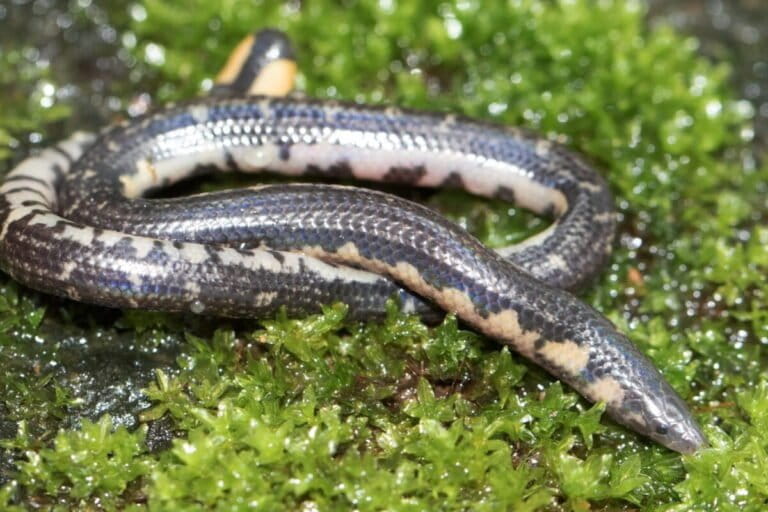
In the lush foothills of southern India’s Siruvani Hills, a routine day on a family coffee farm led to an extraordinary find that has now captured the attention of herpetologists worldwide.
A Chance Encounter in the Monsoon Rains

A Chance Encounter in the Monsoon Rains (Image Credits: Imgs.mongabay.com)
Ten years ago, during a heavy downpour in 2015, tour guide Basil P. Das and his father tended to their three-and-a-half-acre coffee plantation in Jellipara village, Palakkad district, Kerala. As they turned the soil, they uncovered a slender, unassuming creature slithering through the earth – a small snake measuring about a foot in length, with a glossy black body accented by beige bands. This unexpected sighting, initially dismissed as a common earth-dweller, proved far more significant upon closer examination by experts.
Researchers from institutions including the Zoological Survey of India later analyzed the specimen, confirming it belonged to an undescribed species within the shieldtail snake family. The discovery highlighted how everyday agricultural activities can intersect with scientific breakthroughs, turning a farmer’s routine into a pivotal moment for biodiversity studies. Basil Das preserved the snake carefully, unaware that his find would contribute to expanding knowledge of India’s subterranean reptiles.
Distinctive Traits of Rhinophis siruvaniensis
The newly described species, Rhinophis siruvaniensis, stands out for its specialized adaptations to a life spent mostly underground. This non-venomous burrowing snake features smooth, iridescent scales that aid in navigating tight soil tunnels, along with a reinforced tail tip resembling a small shield – a hallmark of the Rhinophis genus. Its coloration, predominantly black with subtle beige markings on the underside, provides camouflage in the dark, humid confines of forest floor litter and plantation earth.
Adults reach lengths of around 30 centimeters, making them elusive to the naked eye amid roots and debris. Genetic analysis revealed subtle differences from close relatives, such as unique scale patterns and DNA markers that set it apart. These traits not only distinguish Rhinophis siruvaniensis but also underscore the diversity hidden in India’s Western Ghats ecosystem. The snake’s diet likely consists of earthworms and small invertebrates, sustaining its secretive lifestyle.
Habitat Challenges in the Siruvani Hills
The Siruvani Hills, straddling the borders of Kerala and Tamil Nadu, form a biodiversity hotspot with dense forests and cultivated lands like coffee estates. This new species appears restricted to these elevations, where moist soil and leaf litter offer ideal burrowing conditions. However, expanding agriculture and climate shifts pose risks to such localized populations, as habitat fragmentation limits their range.
Conservationists note that coffee farms, while productive, can inadvertently disrupt underground ecosystems through tilling and pesticide use. The discovery prompts calls for sustainable farming practices that protect soil-dwelling species. Ongoing surveys in the region aim to assess population sizes and threats, ensuring that Rhinophis siruvaniensis does not vanish before its full story is told. Local communities, including farmers like the Das family, play a crucial role in reporting sightings to aid these efforts.
Broader Implications for Reptile Research
This find adds to a growing list of new species documented in India’s Western Ghats, a region renowned for its endemism. Shieldtail snakes, with over 20 known species in the country, represent a poorly understood group due to their fossorial habits – spending most of their time buried and surfacing rarely. The description of Rhinophis siruvaniensis, detailed in a recent study published by Mongabay, emphasizes the value of community involvement in science.
Experts hope this discovery will spur further exploration of agricultural landscapes for hidden biodiversity. It serves as a reminder that human-modified environments can harbor unique wildlife, bridging the gap between farming and conservation. As research continues, understanding these snakes could reveal more about ecosystem health in tropical regions.
- Burrowing lifestyle: Adapted for life in soil with a pointed snout for digging.
- Non-venomous: Harmless to humans, preying on small soil invertebrates.
- Endemic range: Known only from Siruvani Hills, highlighting vulnerability.
- Discovery timeline: Found in 2015, formally described in late 2025.
- Conservation need: Protected habitats essential amid agricultural pressures.
Key Takeaways
- A simple farming task uncovered a decade-old scientific gem in Kerala’s coffee fields.
- Rhinophis siruvaniensis showcases the untapped biodiversity of India’s hills.
- Balancing agriculture with conservation could safeguard future discoveries like this one.
This remarkable tale from the Siruvani Hills illustrates how nature’s secrets often lie just beneath the surface, waiting for curious eyes to reveal them. As more such stories emerge, they remind us of the delicate balance between human activity and the wild. What do you think about this discovery? Tell us in the comments.