
A rare celestial event unfolds on March 3, 2026, as the full moon passes through Earth’s shadow, transforming into a vivid red hue visible across vast regions of the globe.
The Allure of a Total Lunar Eclipse
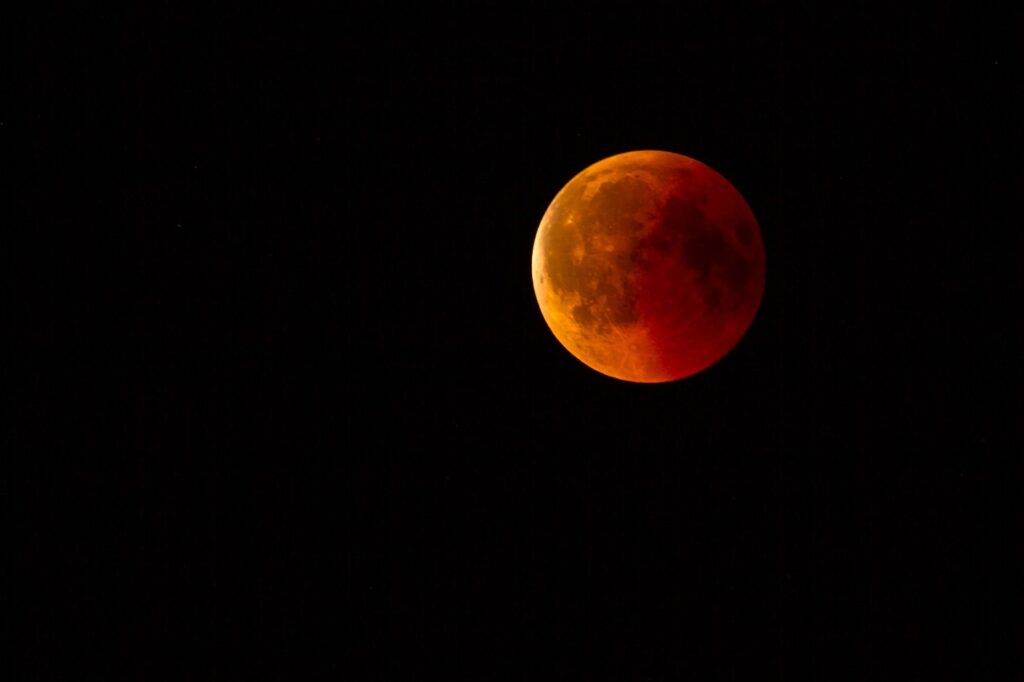
The Allure of a Total Lunar Eclipse (Image Credits: Pixabay)
During a total lunar eclipse, the moon enters the darkest part of Earth’s shadow, known as the umbra, creating the iconic “blood moon” effect. Sunlight filters through Earth’s atmosphere and bathes the lunar surface in crimson tones, a phenomenon that has captivated observers for centuries. This eclipse marks the third in a series approaching a tetrad, following events in 2025 and preceding one in August 2026. Astronomers note its significance as one of the more accessible total eclipses in recent years due to its broad visibility. The event promises a striking display for stargazers prepared to look skyward at the right moment.
Unlike solar eclipses, lunar ones pose no danger to the eyes, allowing viewers to watch without protective gear. The moon’s slow journey through the shadow builds anticipation over hours, with totality lasting nearly an hour. This particular eclipse coincides with the full worm moon, adding cultural resonance in some traditions. Experts from organizations like NASA highlight how such events remind us of our place in the solar system.
Global Visibility: Where to Catch the Show
The total lunar eclipse will grace skies over multiple continents, offering opportunities for billions to witness it. Viewers in North America will see the event rising in the east, while those in Asia and Australia catch it high overhead or setting in the west. The Pacific Ocean serves as a central viewing zone, with clear horizons ideal for island observers. In Europe, partial phases may be visible in the east, though totality favors eastern longitudes.
To pinpoint exact locations, interactive maps from reliable sources like Time and Date provide local timings and cloud cover estimates. Regions including northwest South America, the United States, Canada, Japan, China, India, and much of Russia fall under the full visibility path. Australia and southeast Asia also enjoy prime views. Even partial sightings extend to parts of Africa and the Middle East. Weather remains the wildcard, so checking forecasts closer to the date proves essential.
Timeline: From Penumbra to Full Totality
The eclipse begins subtly as the moon enters Earth’s faint outer shadow, the penumbra, around 4:43 UTC on March 3. This initial phase lasts about an hour before the more dramatic umbral contact at 5:09 UTC. Totality peaks from 6:25 to 7:23 UTC, when the moon fully immerses in the shadow for approximately 58 minutes. Observers will notice the moon’s disc gradually darken and redden during this interval.
Exit from the umbra follows at 8:39 UTC, with the event concluding at 9:05 UTC as the penumbra fades. Local times vary widely: for example, totality hits 1:25 to 2:23 a.m. EST in eastern North America, while in Tokyo, it spans 3:25 to 4:23 p.m. JST. These phases offer different experiences depending on location – early morning for the Americas, afternoon for Asia. Patience rewards those who track the progression with apps or telescopes.
Preparing for an Unforgettable Viewing
To maximize enjoyment, select a dark-sky site away from city lights, and arrive early to settle in comfortably. Binoculars or a small telescope enhance details like the moon’s craters against the red backdrop. Dress warmly, as March nights can chill even in milder climates. Families often turn these events into educational outings, discussing the science behind the colors.
Cloud cover poses the main challenge, but live streams from observatories provide alternatives for obstructed views. Joining local astronomy clubs connects enthusiasts for shared experiences. Remember, no special equipment protects eyes – simply gaze upward. This eclipse’s timing aligns with spring’s onset in the Northern Hemisphere, blending natural wonder with seasonal renewal.
Key Takeaways
- The eclipse’s totality lasts 58 minutes, turning the moon a striking red.
- Visibility spans North America, Asia, Australia, and the Pacific for optimal viewing.
- Safe to watch with the naked eye; check local times for your region.
As the blood moon of March 3, 2026, fades into memory, it leaves a lasting impression of cosmic beauty and unity under shared skies. Mark your calendar and step outside – what celestial wonders might you discover next? Share your viewing plans in the comments.