In the vast expanse of the cosmos, galaxy VV 340a stands as a striking example of how a central supermassive black hole can dominate and alter the fate of its host through powerful outflows.
Unprecedented Outflow from a Restless Core

Unprecedented Outflow from a Restless Core (Image Credits: Pixabay)
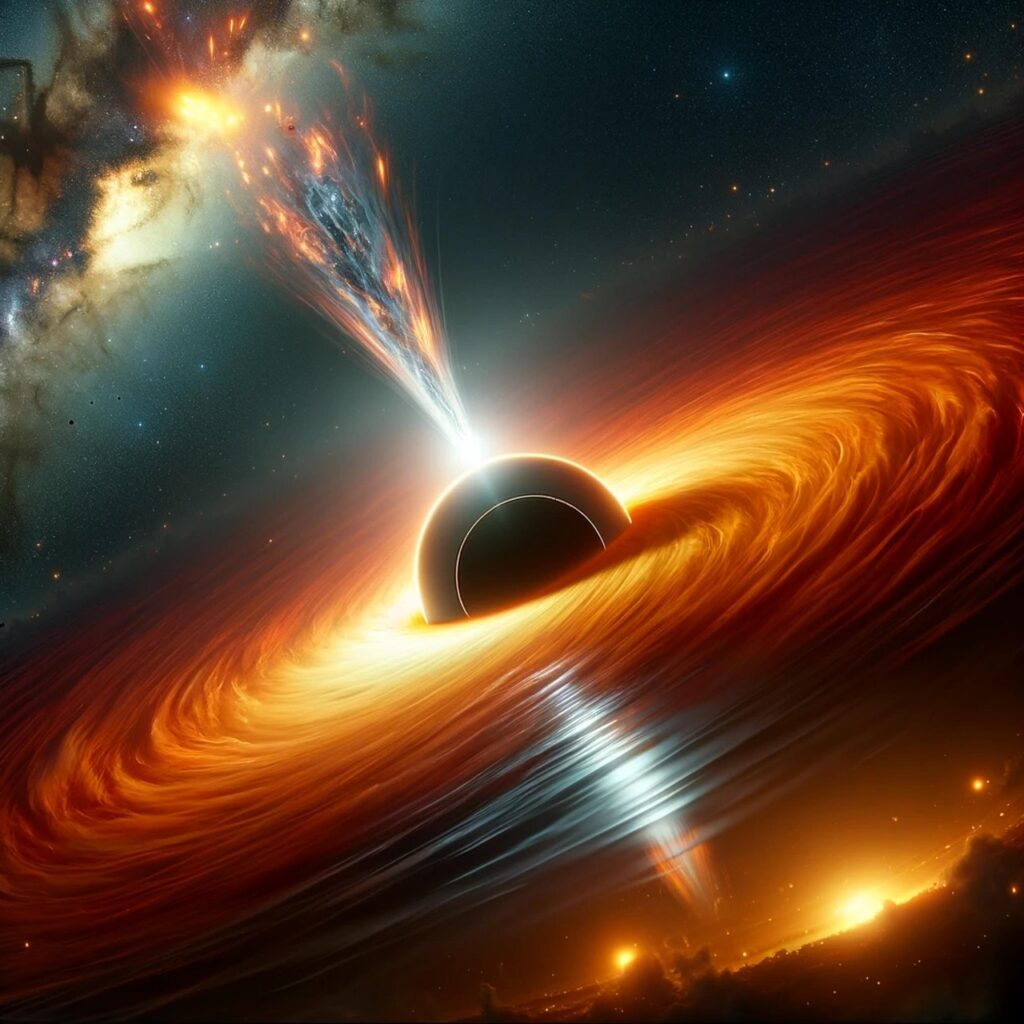
Astronomers have detected the most expansive stream of superheated gas ever recorded emerging from this spiral galaxy, driven by a supermassive black hole at its heart. The black hole unleashes a jet that twists and turns in a precessing motion, resembling a cosmic sprinkler scattering material across the galaxy. This restless beam, though not the most intense, reaches lengths of up to 20,000 light-years, far beyond the galaxy’s disk. Observations from advanced telescopes captured this phenomenon in vivid detail, highlighting how the jet interacts with the surrounding interstellar medium.
The energy output proves staggering, equivalent to the detonation of 10 quintillion hydrogen bombs each second. Such force heats the gas to millions of degrees, ionizing it and propelling it outward at high speeds. This process effectively clears away the raw materials needed for new stars, offering a rare glimpse into black hole feedback mechanisms. Researchers noted that the jet’s wobble creates spiral patterns in the gas streams, extending influence well outside the galactic core.
Tools That Unveiled the Cosmic Drama
The discovery relied on a combination of space-based and ground-based instruments to map the outflow’s structure and dynamics. The W. M. Keck Observatory’s Cosmic Web Imager on the Keck II telescope played a pivotal role, tracing cooler gas extensions beyond the heated zones. NASA’s James Webb Space Telescope pierced through dust to reveal the jet’s intricate paths, while other facilities provided complementary data on the galaxy’s overall morphology.
VV 340a, located about 500 million light-years away, presented a unique opportunity for detailed study due to its relative proximity and active nucleus. The team’s analysis, published in the journal Science, integrated multi-wavelength observations to quantify the ejection rates. These tools not only confirmed the jet’s precession but also measured its impact on the galaxy’s gas reservoir. The findings mark the first clear evidence of such a widespread wobbling jet in a disk galaxy.
Implications for Galactic Evolution
This event underscores how supermassive black holes regulate star formation on galaxy-wide scales, potentially stunting growth in spirals like VV 340a. The outflow removes star-forming gas at a rate sufficient to suppress new stellar births, transforming the galaxy into a quieter, more mature system over time. Such “negative feedback” prevents excessive star formation that could otherwise disrupt galactic stability.
Galaxies with active black holes often exhibit similar but less extended jets; however, the scale here sets a new benchmark. Scientists suggest this mechanism contributes to the observed diversity in galaxy types across the universe. By stripping away fuel, the black hole ensures its host evolves differently from more quiescent neighbors. Future studies may explore whether such jets trigger compensatory inflows or further isolation.
Key Patterns in the Jet’s Path
- The precessing motion creates corkscrew-like streams that ionize and heat gas over vast distances.
- Cooler gas filaments extend outside the disk, indicating the jet’s reach influences intergalactic environments.
- Energy deposition occurs unevenly, with hotspots where the jet interacts most intensely with dense clouds.
- The wobble’s period suggests underlying dynamics in the black hole’s accretion disk.
- Overall, the outflow spans regions typically reserved for stellar nurseries, disrupting potential star clusters.
Key Takeaways
- The jet in VV 340a represents the largest observed superheated gas stream, reshaping our understanding of black hole influence.
- Star formation suppression highlights feedback’s role in galaxy maturation.
- Multi-telescope observations provide the clearest evidence yet of precessing jets in disk galaxies.
As galaxy VV 340a demonstrates, even a seemingly modest black hole jet can wield transformative power, reminding us of the delicate balance shaping cosmic structures. What implications do you see for our understanding of the universe’s evolution? Share your thoughts in the comments.