
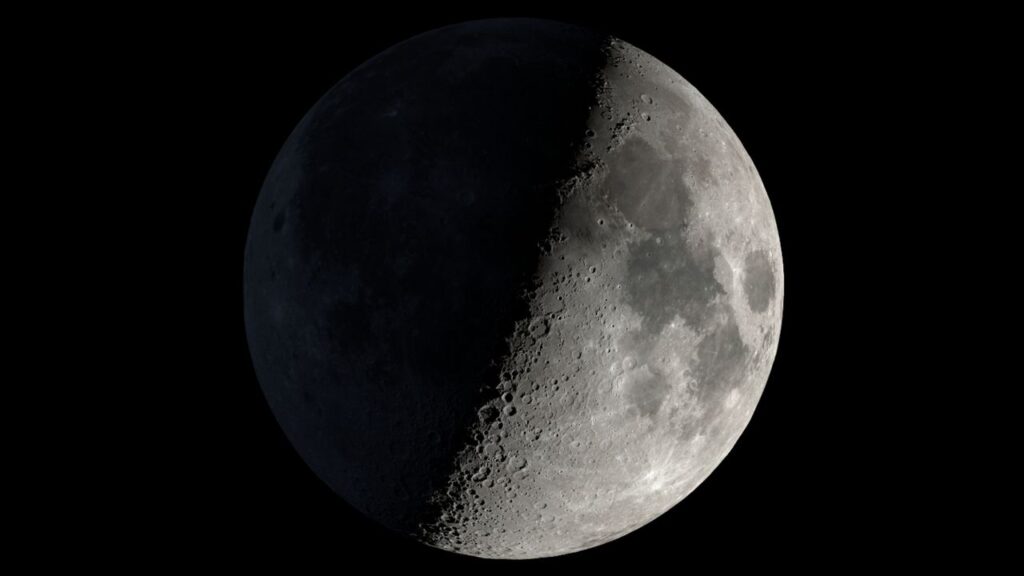
The first quarter moon rises tonight, its half-illuminated disk transforming familiar lunar features into striking displays of light and shadow.
Shadows Bring the Moon’s Surface to Life
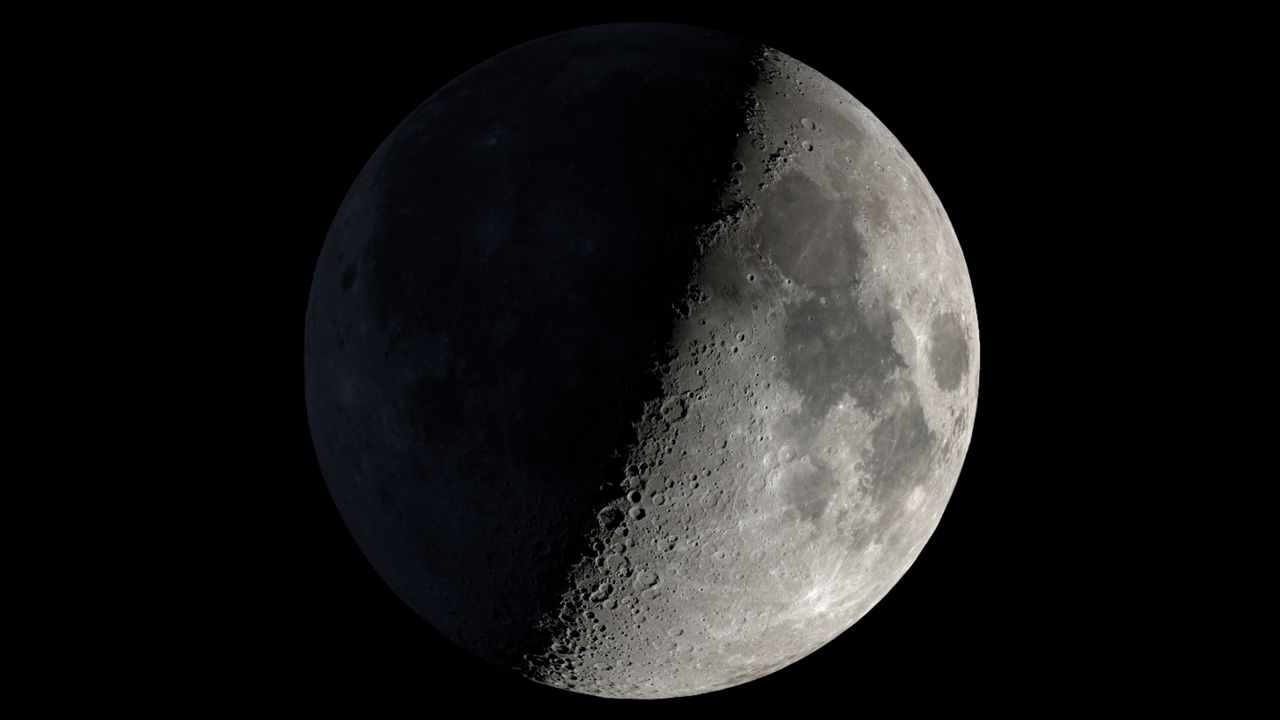
Shadows Bring the Moon’s Surface to Life (Image Credits: Cdn.mos.cms.futurecdn.net)
Sunlight strikes the moon at a shallow angle during the first quarter phase. This geometry produces elongated shadows that accentuate craters, mountains, and rifts. Observers gain a three-dimensional view of the terrain that full moon illumination obscures.
On January 25, the moon appears high above the southern horizon shortly after sunset. Its right half glows brightly while the left side remains in darkness. This setup spotlights three exceptional craters: Eudoxus, Aristoteles, and Cassini. Each bears the name of a historical astronomer and showcases unique geology under tonight’s lighting.
Eudoxus Crater: Dramatic Eastern Shadows
Eudoxus dominates the northeastern lunar quadrant, perched above the dark expanse of Mare Serenitatis. The crater measures 42 miles (67 kilometers) across and plunges 2.1 miles (3.4 kilometers) deep. Tonight, shadows cloak much of its eastern floor, creating a compelling contrast with the illuminated rims.
Ancient impacts formed this vast basin millions of years ago. The feature honors Eudoxus of Cnidus, a Greek mathematician who modeled planetary motions with concentric spheres around Earth. Telescopes reveal the crater’s terraced walls and central peaks in sharp relief against the shadowed interior.
Aristoteles Crater: Rugged Terrain Unveiled
Just north of Eudoxus lies Aristoteles, bordering the chilly Mare Frigoris. This 54-mile-wide (87 km) crater features broken floor terrain dotted with hills. Shadows tonight emphasize these irregularities, lending depth to the scene.
The crater commemorates Aristotle, the philosopher who inferred Earth’s sphericity from lunar eclipse shadows. He envisioned celestial bodies moving on crystalline spheres. Viewers with modest telescopes spot the crater’s irregular basin and subtle elevations under the first quarter glow.
Cassini Crater: Dark Pools in a Flooded Basin
Cassini scars the eastern rim of Mare Imbrium, straddling the Montes Caucasus range near the terminator line. At 35 miles (57 km) wide, its floor filled with lava long ago. Two smaller craters within it stand out as dark voids against the lit surroundings tonight.
Named for Giovanni Domenico Cassini, who charted Saturn’s moons and Mars’s rotation, this site blends ancient flooding with recent impacts. The shadowed inner basins offer a telescopic spectacle, highlighting the moon’s violent past.
How to Spot These Craters Tonight
Begin observing as twilight fades. The moon climbs high in the south, making it accessible from most locations. Binoculars reveal the craters as bright rings; a small telescope brings out shadows and details.
Start with Eudoxus above Mare Serenitatis, then scan north to Aristoteles. Leap toward the terminator for Cassini over the Caucasus mountains. Steady your view with a stable mount for best results.
- Focus on the terminator edge where shadows sharpen.
- Use medium magnification (100-200x) to balance field of view and detail.
- Observe early evening before the moon sets too low.
| Crater | Diameter | Location |
|---|---|---|
| Eudoxus | 42 miles (67 km) | Above Mare Serenitatis |
| Aristoteles | 54 miles (87 km) | Bordering Mare Frigoris |
| Cassini | 35 miles (57 km) | Eastern Mare Imbrium |
Key Takeaways
- First quarter shadows reveal lunar relief unmatched by other phases.
- Eudoxus, Aristoteles, and Cassini honor pioneering astronomers.
- Even basic optics unlock these ancient impact wonders tonight.
These craters remind us of the moon’s scarred history and human curiosity. Step outside tonight to witness nature’s canvas. Which feature captivates you most? Share your views in the comments.[1]