
Australia – Skywatchers from coast to outback prepare for a full moon on February 2 alongside prominent planets and a potential comet sighting between January 29 and February 5.
A Supermoon-Like Full Moon Lights Up the Sky
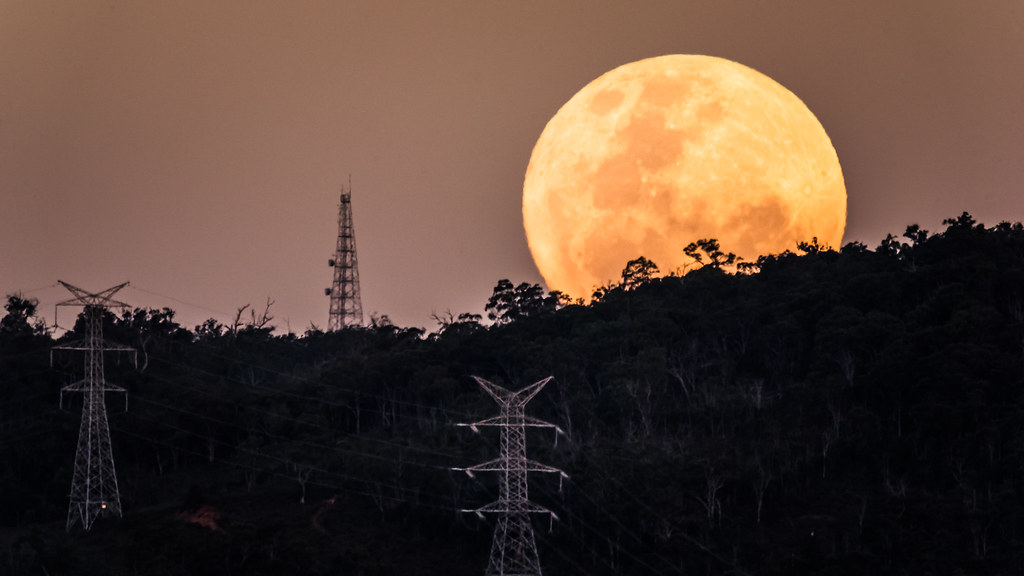
A Supermoon-Like Full Moon Lights Up the Sky (Image Credits: Flickr)
The moon reaches perigee, its closest point to Earth, on January 30, setting the stage for an especially large and bright full moon two days later on February 2.
This alignment amplifies the moon’s glow, washing out fainter deep-sky objects like clusters and nebulae. Bright stars such as Canopus and Sirius hover near the zenith, while Orion climbs high in the north-western sky. The Southern Cross lingers low in the southern heavens. Observers across the continent experience similar scenes roughly 90 minutes after sunset.
Saturn Bids Farewell in the West
Saturn appears as the brightest beacon in the north-western evening sky early in the week, though it sinks lower each night.
Spot it about 60 minutes after sunset, hugging the horizon. Telescopes reveal its rings, a highlight before it dips into twilight. By February 5, the ringed planet sets even earlier, challenging casual viewers.
Jupiter Steals the Show Near the Moon
Jupiter, fresh from opposition on January 10, remains at peak brightness and size, rising in the north-east before astronomical twilight.
On January 31, the waxing gibbous moon passes close by, forming a striking trio with the twin stars Castor and Pollux. This pattern graces the sky 90 minutes after sunset. The gas giant’s moons dance visibly through binoculars or small telescopes. Australia-wide, the view holds steady at local equivalent times.
Binocular Hunts for Uranus and a Dim Comet
Uranus glows at magnitude 5.7, just within reach for sharp naked eyes under dark skies, but binoculars pinpoint it easily above the Pleiades star cluster.
The waxing moon complicates the search early on, yet conditions improve by week’s end. Meanwhile, Comet C/2024 E1 Wierzchos hovers near Grus the Crane in the western sky. Despite predictions of greater brilliance, it stays faint, but rising higher post-sunset on February 5 boosts binocular chances near the constellation’s wing stars.
- Saturn: Low west, 60 minutes after sunset.
- Jupiter: North-east rise, near moon on Jan 31.
- Uranus: Above Pleiades, evening binocular target.
- Comet C/2024 E1: West near Grus, late-week prospect.
- Mercury, Venus, Mars: Hidden in twilight glare.
Key Takeaways
- Full moon on Feb 2 follows perigee for extra dazzle.
- Jupiter at opposition glow pairs with lunar close-up.
- Grab binoculars for Uranus and emerging comet.
Twilight claims Mercury, Venus, and Mars this week, leaving the evening to Saturn, Jupiter, Uranus, and the moon. For detailed maps, consult Southern Skywatch. Check cloud forecasts at SkippySky.
These fleeting alignments remind us of the cosmos’s quiet rhythm – seize clear nights with binoculars in hand. What catches your eye this week? Share in the comments.