
The Indonesian government recently approved cultivation rights over 328,000 hectares for a state-led rice plantation in Papua, bypassing standard consultation with local Indigenous groups and accelerating a process that typically spans years.
Lightning-Fast Path to Approval
Lightning-Fast Path to Approval (Image Credits: Imgs.mongabay.com)
Authorities issued the final Hak Guna Usaha (HGU) permit to PT Agrinas Pangan Nusantara, a state-owned firm, covering an area equivalent to 810,505 acres in the Merauke district. This decision followed the reclassification of 486,939 hectares of forest estate as non-forest land just months earlier, in September 2025.
The South Papua provincial government updated its spatial plan in November 2025 to designate zones for rice production, enabling the rapid handover. Officials described the timeline – from reclassification to permit – as completing in roughly five months, a stark contrast to the multi-year scrutiny usually required for overlapping customary lands.
Indigenous Voices Silenced in Rush
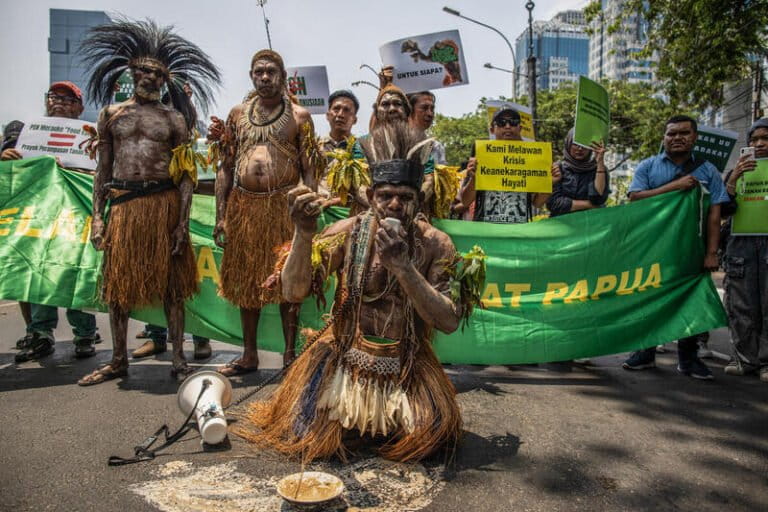
Activists highlighted the absence of free, prior, and informed consent from Indigenous landowners, a cornerstone of rights protections. Uli Arta Siagian, campaign head at WALHI, the Indonesian Forum for the Environment, criticized the pace: “Reaching common ground requires a long, careful process. There’s no way all of this could happen in just five months.”
Damianus Katayu, chair of the Papuan People’s Assembly, noted limited involvement: only one consultation occurred before the spatial plan finalized. Communities continue to reject the initiative, viewing it as state overreach on ancestral territories.
Deforestation and Broader Risks Emerge
The project already contributed to 5,934 hectares of tree loss by October 2025, part of wider food estate efforts including nearby sugarcane fields that cleared over 15,000 hectares. Civil society groups warned of repeating past failures, like Sumatra’s floods tied to hasty expansions.
Here is a timeline of key developments:
- Early 2024: National plans announced for Papua rice fields.
- August 2024: Heavy machinery, including 264 excavators, arrived with security escorts.
- September 2025: Forest land reclassified.
- January 2026: HGU permit granted.
Siagian called the approach “state violence against Indigenous communities in Papua.”
Officials Push Food Security Agenda
Nusron Wahid, National Land Agency chief, confirmed the permit on uninhabited state land.
Ulmi Listianingsih Wayeni, from South Papua’s planning agency, defended the spatial plan as compliant with procedures for National Strategic Projects, citing discussions on customary rights.
The initiative forms part of President Prabowo Subianto’s drive for self-sufficiency, targeting imports through expanded cultivation.
Key Takeaways
- Rapid permitting skips years of standard reviews and Indigenous consultations.
- Early deforestation signals larger ecological threats in biodiverse Papua.
- Project echoes failed national food estates, risking social and environmental fallout.
This clash underscores tensions between development goals and land rights in Papua. As machinery advances, the path forward hinges on genuine dialogue. What steps should ensure both food security and Indigenous protections? Share your views in the comments.