
When you think about dinosaurs, your mind probably jumps to Tyrannosaurus rex or Triceratops. Those are the superstars everyone knows. What’s fascinating though is that paleontologists have unearthed numerous prehistoric creatures from North America that don’t fit neatly into our expected categories. Some were initially mistaken for entirely different animals, while others have sparked decades of scientific debate.
These enigmatic dinosaurs challenge everything scientists thought they knew about dinosaur classification. From creatures identified by nothing more than giant arms for nearly fifty years, to dinosaurs that may not even be separate species at all, North America’s fossil record is filled with head-scratchers. Let’s be real, the more we dig, the more questions seem to pop up. So what makes these particular dinosaurs so puzzling to experts?
The Mysterious Hands That Became Deinocheirus
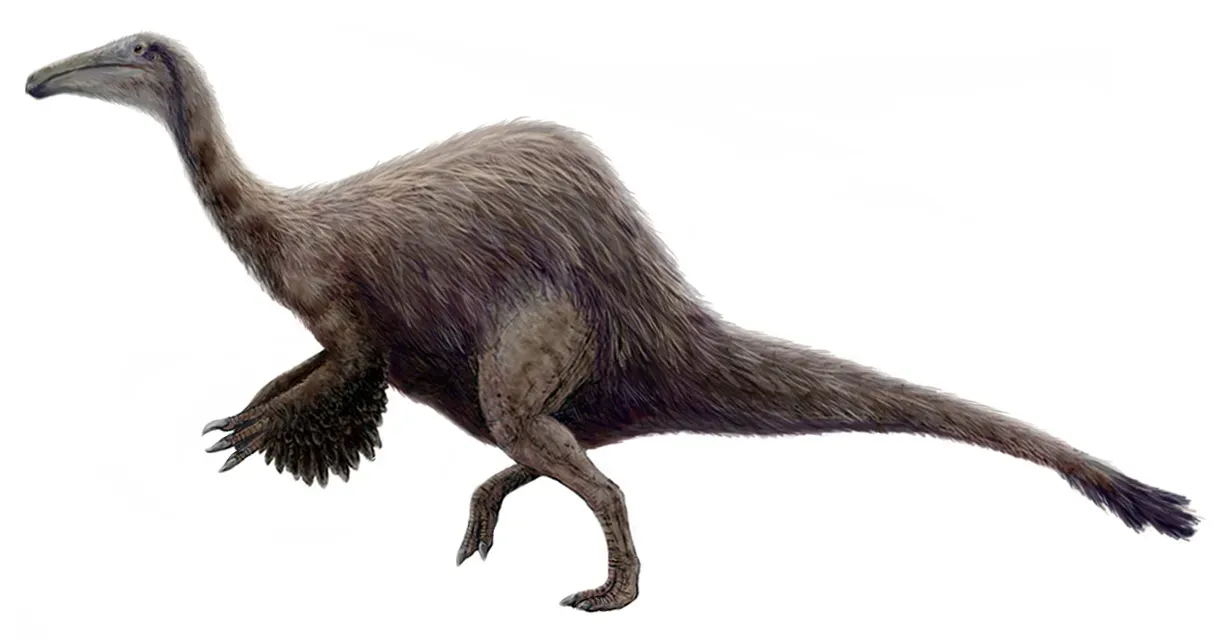
Imagine discovering a pair of arms measuring over eight feet long with massive claws, yet having absolutely no idea what animal they belonged to. That’s exactly what happened when Polish paleontologist Zofia Kielan-Jaworowska found eight-foot-long arms, tipped in three huge claws in Mongolia’s Gobi Desert back in 1965. For nearly half a century, Deinocheirus remained one of paleontology’s greatest mysteries.
For decades, Deinocheirus was known only from a pair of massive arms over two meters long. When a complete specimen was finally found, the surprise was enormous: this dinosaur had a humped back, a duck-like bill, and long legs. Scientists had speculated wildly about what creature could possess such unusual appendages. Some thought it might be a fearsome predator with giant arms for tearing prey apart. Others compared it to tree sloths, imagining a dinosaur that climbed trees to feed on vegetation and small animals found in branches.
The truth turned out stranger than anyone predicted. Deinocheirus was probably a towering herbivore, and, by virtue of those long arms and sail back, was one of the strangest to have ever evolved. It’s hard to say for sure what purpose that humped back served, though it may have been for display or temperature regulation. More than a thousand small, polished stones were discovered around the belly region of one of the newly discovered fossils, suggesting this bizarre creature swallowed rocks to help grind up tough plant material in its stomach.
Chirostenotes: The Dinosaur Assembled from Mismatched Parts
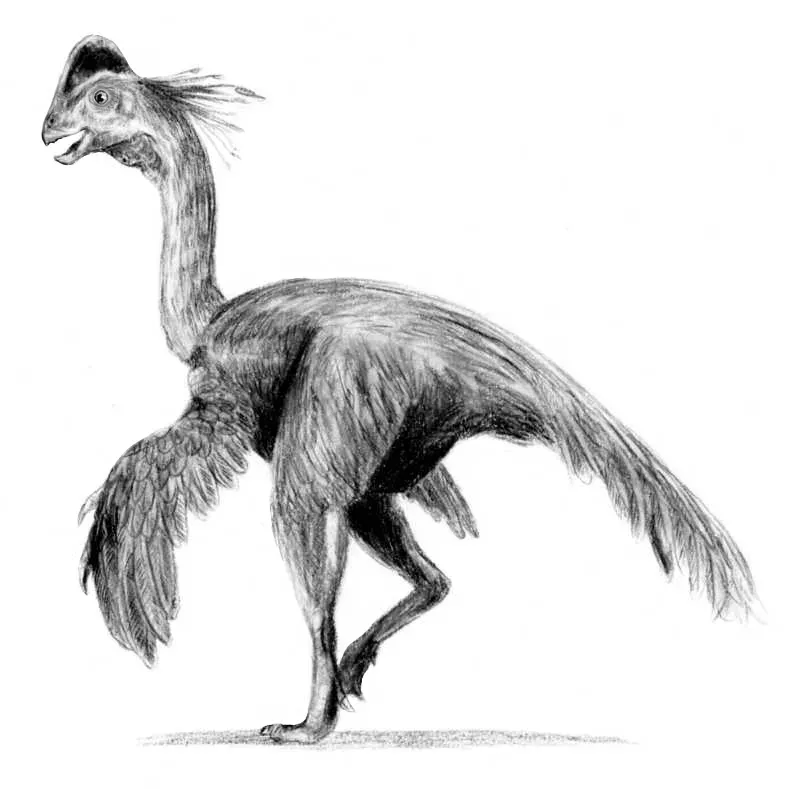
Chirostenotes has a confusing history of discovery and naming. Picture trying to solve a jigsaw puzzle where the pieces were found decades apart by different people who didn’t realize they all belonged to the same picture. The first fossils of Chirostenotes, a pair of hands, were in 1914 found by George Fryer Sternberg near Little Sandhill Creek in the Campanian Dinosaur Park Formation of Canada, which has yielded more dinosaurs than any other Canadian formation.
Here’s where it gets messy. Feet were then found, specimen CMN 8538 (also from the Dinosaur Park Formation), and in 1932 Charles Mortram Sternberg gave them the name Macrophalangia canadensis, meaning ‘large toes from Canada’. Sternberg correctly recognized them as part of a meat-eating dinosaur but thought they belonged to an ornithomimid. In 1936, its lower jaws, specimen CMN 8776, were found by Raymond Sternberg near Steveville and in 1940 he gave them the name Caenagnathus collinsi. For years, paleontologists treated these as completely separate animals.
Slowly the precise relationship between the finds became clear. In 1960 Alexander Wetmore concluded that Caenagnathus was not a bird but an ornithomimid. In 1969 Edwin Colbert and Dale Russell suggested that Chirostenotes and Macrophalangia were one and the same animal. In 1976 Halszka Osmólska described Caenagnathus as an oviraptorosaurian. In 1981 the announcement of Elmisaurus, an Asian form of which both hand and feet had been preserved, showed the soundness of Colbert and Russell’s conjecture. Even today, debate continues about whether Caenagnathus is truly the same animal or represents a distinct species. In 2007 a cladistic study by Philip Senter cast doubt on the idea that all of the large Dinosaur Park Formation fossils belonged to the same animal.
Anzu Wyliei: North America’s Chicken from Hell
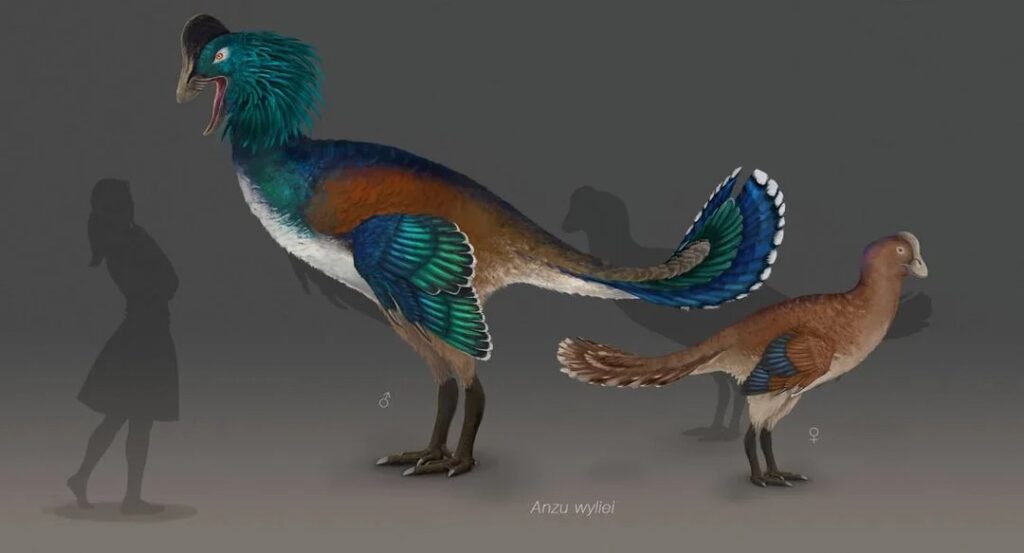
Discovered in the fossil-rich Hell Creek Formation, Anzu wyliei is a bird-like oviraptorosaurian dinosaur. More specifically, it is a member of the Caenagnathidae, a poorly understood group of oviraptorosaurs that lived mainly in North America during the Cretaceous Period. Scientists affectionately nicknamed it the “chicken from hell” because of its bizarre appearance and the hellish-sounding Hell Creek Formation where it was found.
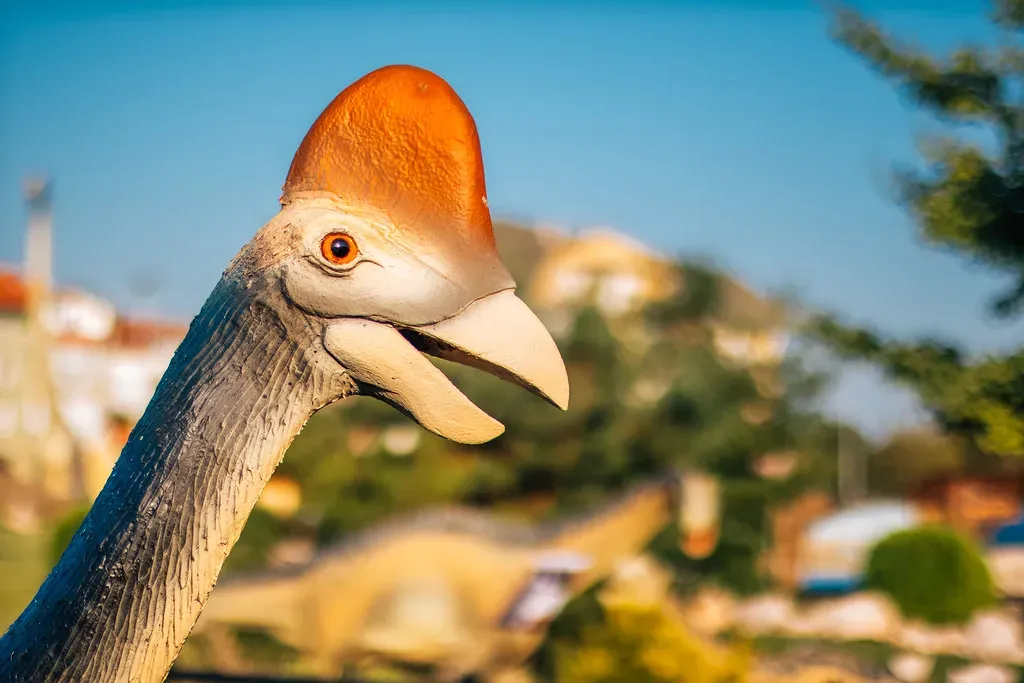
Anzu wyliei is characterized by a toothless beak, a prominent crest, long arms ending in large curved claws, long powerful legs with slender toes, and a relatively short tail. Anzu measured about 3.5–3.75 metres (11.5–12.3 ft) long, up to 1.5 metres (4.9 ft) tall at the hips and 200–300 kilograms (440–660 lb) in body mass, making it among the largest oviraptorosaurs in North America. Its enormous crest made of paper-thin bone was likely used for display, similar to how modern cassowaries attract mates.
What makes Anzu particularly interesting is what it reveals about oviraptorosaur evolution. The research team revealed that North American oviraptorosaurs were more closely related to each other than they were to most of their Asian cousins. It had been expected that oviraptorosaurs would be found in North America, as well as the documented specimens in Asia, as the two continents had a land connection during the Cretaceous, but the discovery of Anzu wyliei indicates that North American oviraptorosaurs were related more closely to each other than to their counterparts in Asia. Scientists still debate what this feathered creature ate, though its beak structure suggests it was probably an omnivore capable of eating everything from vegetation to small animals and possibly eggs.
Dracorex Hogwartsia: The Harry Potter Dragon That May Not Exist
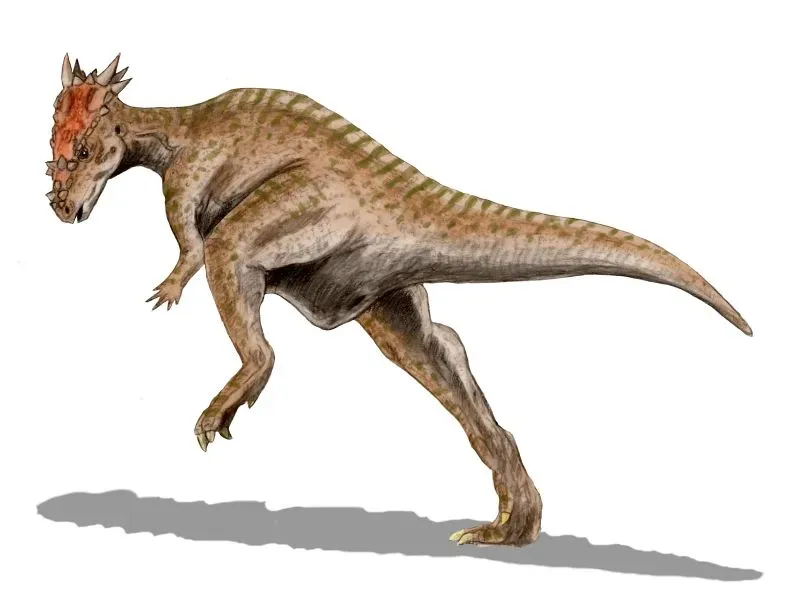
Few dinosaurs have captured the public imagination quite like Dracorex hogwartsia, named after the wizarding school from Harry Potter books. It is known from one nearly complete skull (the holotype TCMI 2004.17.1), as well as four cervical vertebrae: the atlas, third, eighth and ninth. These were discovered in the Hell Creek Formation in South Dakota by three amateur paleontologists from Sioux City, in the U.S. state of Iowa. The skull was subsequently donated to the Children’s Museum of Indianapolis for study in 2004, and was formally described by Bob Bakker and Robert Sullivan in 2006.
Here’s the twist: Dracorex might not actually be its own species at all. In 2007, they were proposed to be juvenile or female morphologies of Pachycephalosaurus. At that year’s meeting of the Society of Vertebrate Paleontology, Jack Horner of Montana State University presented evidence, from analysis of the skull of the Dracorex specimen, that it may be a juvenile form of Stygimoloch. In addition to this, he presented data that indicates that both Stygimoloch and Dracorex may be juvenile forms of Pachycephalosaurus. Think of it like discovering that what you thought were three different dog breeds were actually just a puppy, a teenager, and an adult of the same breed.
Horner and M.B. Goodwin published their findings in 2009, showing that the spike and skull dome bones of all three “species” exhibit extreme plasticity and that both Dracorex and Stygimoloch are known only from juvenile specimens, while Pachycephalosaurus is known only from adult specimens. These observations, in addition to the fact that all three forms lived in the same time and place, led them to conclude that Dracorex and Stygimoloch were simply juvenile Pachycephalosaurus, which lost spikes and grew domes as they aged. Still, some paleontologists remain unconvinced, arguing there may be subtle differences that justify keeping them separate. The debate continues to this day.
The Therizinosaur Puzzle: Plant-Eating Predators
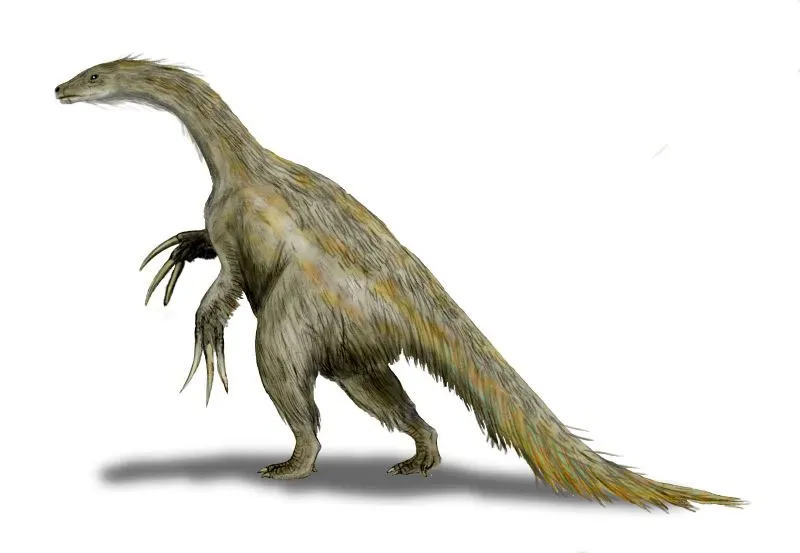
The first genus, Therizinosaurus, was originally identified as a turtle when described from forelimb elements in 1954. Let that sink in for a moment. Scientists looked at massive claws and thought they belonged to an ancient turtle. The most distinctive feature of Therizinosaurus was the presence of gigantic unguals on each of the three digits of its hands. These were common among therizinosaurs but particularly large and stiffened in Therizinosaurus, and they are considered as the longest known from any terrestrial animal. The arm of Therizinosaurus covered 2.4 m (7.9 ft) in total length, roughly equivalent to a basketball player lying down.
The confusion makes sense when you consider how bizarre these creatures were. Therizinosaurs certainly are weird creatures. They are theropods, but they eat plants. Instead of using their huge claws to disembowel prey, they were used to rummage through plants to eat, like ground sloths or pandas. Imagine a meat-eating dinosaur family that suddenly decided to go vegetarian. That’s essentially what happened with therizinosaurs.
Therizinosaurs were long considered an enigmatic group, whose mosaic of features resembling those of various different dinosaur groups, and scarcity of their fossils, led to controversy over their evolutionary relationships for decades after their initial discovery. Some scientists thought they were sauropods because of their long necks. Others classified them with different theropod groups. Therizinosaurus itself, obtained the top dimensions of the group, growing up to 10 m (33 ft) long and weighing over 5 t (11,000 lb), dimensions that make the genus among the largest-known theropods. For creatures this massive to be covered in feathers and eating plants rather than meat defied everything paleontologists expected from predatory dinosaur lineages.
Conclusion
These five dinosaurs remind us that prehistoric life was far stranger and more diverse than we typically imagine. Each one challenged paleontologists to rethink their assumptions about dinosaur classification, evolution, and behavior. From Deinocheirus with its bizarre body plan that puzzled scientists for nearly fifty years, to Dracorex which may represent nothing more than a juvenile growth stage, these creatures show how much we still have to learn.
The story of these enigmatic dinosaurs is really a story about science itself. It’s about piecing together incomplete evidence, revising theories when new discoveries come to light, and accepting that some mysteries take generations to solve. What other misunderstood dinosaurs are waiting to be discovered or reinterpreted? What do you think about these classification puzzles? The fossil record still holds countless secrets.