
Southern Thailand – Archived images from camera traps have revealed a significant population of endangered Asian tapirs in the Khlong Saeng–Khao Sok Forest Complex, offering fresh hope for the elusive species.
Bycatch Data Yields Surprising Population Insights
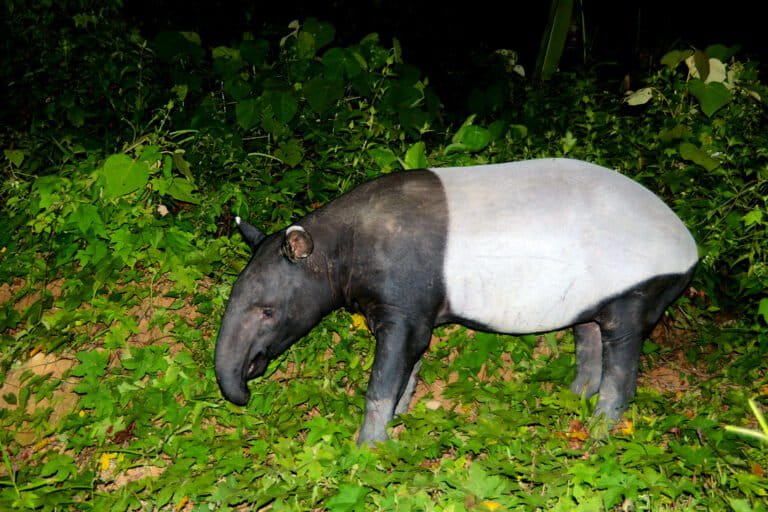
Bycatch Data Yields Surprising Population Insights (Image Credits: Imgs.mongabay.com)
Researchers identified at least 43 individual Asian tapirs from 91 photographs captured between 2016 and 2017. The cameras, originally deployed across 40 sites to monitor bears, incidentally recorded the tapirs as bycatch.[1] Wyatt J. Petersen of King Mongkut’s University of Technology Thonburi led the analysis, which estimated local abundance at 62.4 individuals, with a 95% credible interval of 49 to 85.
Density models produced figures of 6.1 tapirs per 100 square kilometers using mean maximum distance moved, or 10.8 per 100 square kilometers with half that distance. These rates rival populations in protected areas of Peninsular Malaysia. Extrapolating across the complex’s 4,693 square kilometers suggested up to 436 mature individuals, far exceeding prior estimates of fewer than 250 for all of Thailand and Myanmar combined.
Methods Unlock Identities from Shadows
Scientists distinguished tapirs through unique scars, ear notches, and sex traits visible on flanks in the nighttime shots. A Bayesian hierarchical model processed the non-spatial capture-recapture data, factoring in elevation as a key variable.
The approach accounted for uncertain effective sampling areas derived from movement data. Daily detection rates proved higher for males at 0.00038 versus 0.00018 for females, likely reflecting differences in ranging behavior. This technique demonstrated how overlooked bycatch could illuminate hard-to-study species without new fieldwork.
| Estimation Method | Density (individuals/100 km²) | 95% Credible Interval |
|---|---|---|
| Mean Maximum Distance Moved | 6.1 | 4.1–9.3 |
| Half Mean Maximum Distance Moved | 10.8 | 6.2–19.9 |
Behavioral Patterns Emerge from the Night
Tapirs appeared almost exclusively at night, with 88% of records falling between sunset and sunrise. Abundance rose with elevation, aligning with prior Thai observations but differing from Sumatran trends.
Males showed up twice as often, hinting at broader home ranges for females. These traits underscored the animals’ role as nocturnal forest dwellers, up to 350 kilograms each, with distinctive black-and-white camouflage.
- Primarily active around midnight, aiding predator avoidance and foraging.
- Positive link to higher elevations, possibly tied to seasonal forest dynamics.
- No strong tie to water sources, unlike some regional patterns.
- Slow reproduction demands vast, intact habitats for survival.
A Call for Focused Protection Efforts
Habitat loss and snares have halved tapir numbers in recent decades, per IUCN assessments. Fragmentation pushes survivors into core forests, away from risky edges patrolled by tigers and humans alike.
Ecologist Naparat Suttidate of Walailak University noted, “They are large, slow-reproducing species requiring large areas of specific habitat [and] play a vital role as seed dispersers, helping to maintain biodiversity in plant communities.” The study urged tighter monitoring and targeted surveys in this refuge.
Key Takeaways
- Khlong Saeng–Khao Sok hosts one of Thailand’s largest tapir populations.
- Bycatch analysis offers cost-effective monitoring for shy megafauna.
- Elevation-focused conservation could safeguard future numbers.
This discovery positions the forest complex as a conservation priority, where seed-dispersing tapirs sustain tropical biodiversity. What steps should protect such hidden strongholds? Share your thoughts in the comments.