
For most of human history, dinosaurs lived in our imaginations as grey and green giants, scaled like lizards and camouflaged like nothing more than oversized reptiles. Nobody really questioned it. Then science came along and shattered that image completely.
Microscopic pigment-bearing cell structures known as melanosomes can persist in fossils for tens of millions of years, and studies of preserved pigments have allowed scientists to reconstruct the actual colors of a wide range of extinct animals, including a number of dinosaurs. The results have been genuinely jaw-dropping. These were not dull, mud-colored beasts. Some were striped, some glowed with iridescence, some wore russet camouflage like a forest animal. Let’s dive in.
The Science of Seeing Ancient Color
![The Science of Seeing Ancient Color ([https://static-content.springer.com/esm/art%3A10.1038%2Fs41598-022-24602-x/MediaObjects/41598_2022_24602_MOESM1_ESM.pdf "SUPPLEMENTARY INFORMATION to
Intestinal preservation in a birdlike dinosaur supports conservatism indigestive canal evolution among theropods"], CC BY 4.0)](https://nvmwebsites-budwg5g9avh3epea.z03.azurefd.net/dinoworld/c791a1b9f4df1ad7b5db684d8679a44f.webp)
Intestinal preservation in a birdlike dinosaur supports conservatism in
digestive canal evolution among theropods”], CC BY 4.0)
You might be wondering how on earth anyone can figure out the color of a creature that died over a hundred million years ago. Here’s the thing: color, in its most basic form, is chemistry. The biological key to solving the coloration puzzle comes down to minuscule structures called melanosomes, which are tiny, blobby organelles that contain pigment, or melanin, and are present in soft tissues such as skin, scales, and feathers. Think of them as tiny, biological paint capsules that just happen to survive the ages.
Different shapes and arrangements of melanosomes in bird feathers are associated with different colors, including black, brown, red, buff, and even iridescent structural colors. So when you find them in a fossil, you can read them like a color code. Eumelanosomes from black and gray feathers tend to be long and sausage shaped, whereas pheomelanosomes from rufous or red-brown feathers are more rounded and jelly bean shaped. It sounds almost too simple, but that little detail unlocked an entire new field of prehistoric science.
Sinosauropteryx: The Striped Ginger Dino
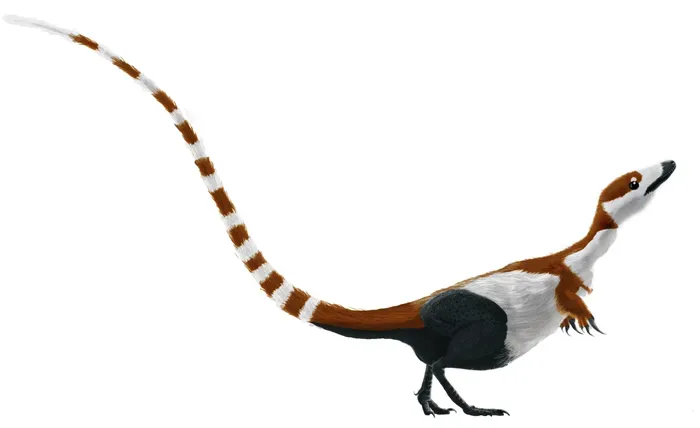
In 2010, a close examination of the feathers of Sinosauropteryx resulted in a surprising reveal. Discovered in 1996, Sinosauropteryx was the first dinosaur found with feathers, and when examined under a microscope, those feathers were found to have surviving melanosomes: the tiny, cellular organelles that generate melanin, and thus, pigment. Nobody expected that level of detail to survive. Yet there it was.
These little beasts, which were only about a meter long, had a robber mask around their eyes, dark reddish coloration on their backs, a pale belly, and long striped tails. Honestly, it sounds a bit like a prehistoric raccoon with attitude. Sinosauropteryx had featherlike bristles running across its head, back, and tail, and these bristles turned out to contain pheomelanosomes, revealing that the dinosaur had reddish-brown stripes covering the tail. It is one of the first times a dinosaur went from “unknown blob of grey” to something you could paint with real confidence.
Anchiornis: Nature’s First Color Palette
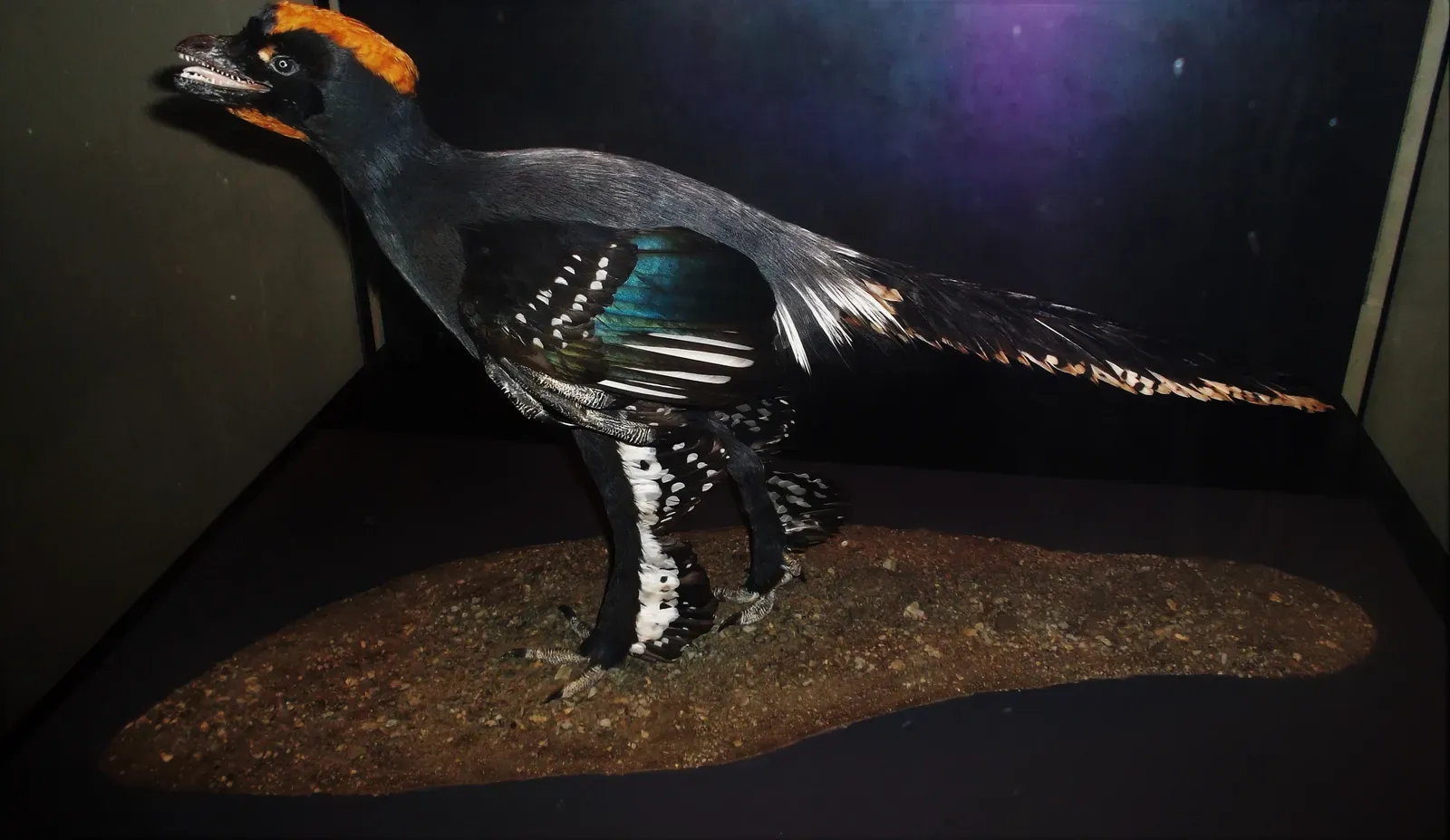
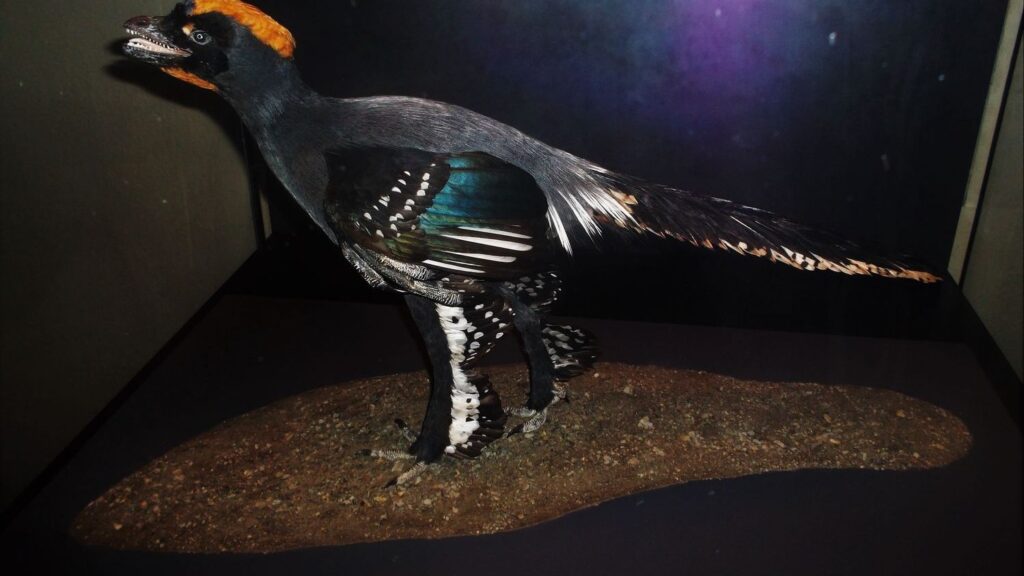
In 2010, paleontologists studied a well-preserved skeleton of Anchiornis, an averaptoran from the Tiaojishan Formation in China, and found melanosomes within its fossilized feathers. As different shaped melanosomes determine different colors, analysis of the melanosomes allowed the paleontologists to infer that Anchiornis had black, white, and grey feathers all over its body and a crest of dark red or ochre feathers on its head. Picture something resembling a woodpecker crossed with a raptor. Striking.
By comparing measurements from Anchiornis melanosomes with those of living birds, scientists could diagnose the color of the fossil feathers. Because they had sampled many places from all across the specimen, they could reconstruct the color of nearly its entire plumage. One of the most exciting moments was watching the plumage of Anchiornis come to life as the newly diagnosed colors, which were black, gray, rufous brown, and plain white, were mapped from sample numbers back onto their anatomical positions. I find that detail genuinely moving. The idea of a creature’s true appearance emerging after 160 million years is almost poetic.
Microraptor: The Crow of the Cretaceous
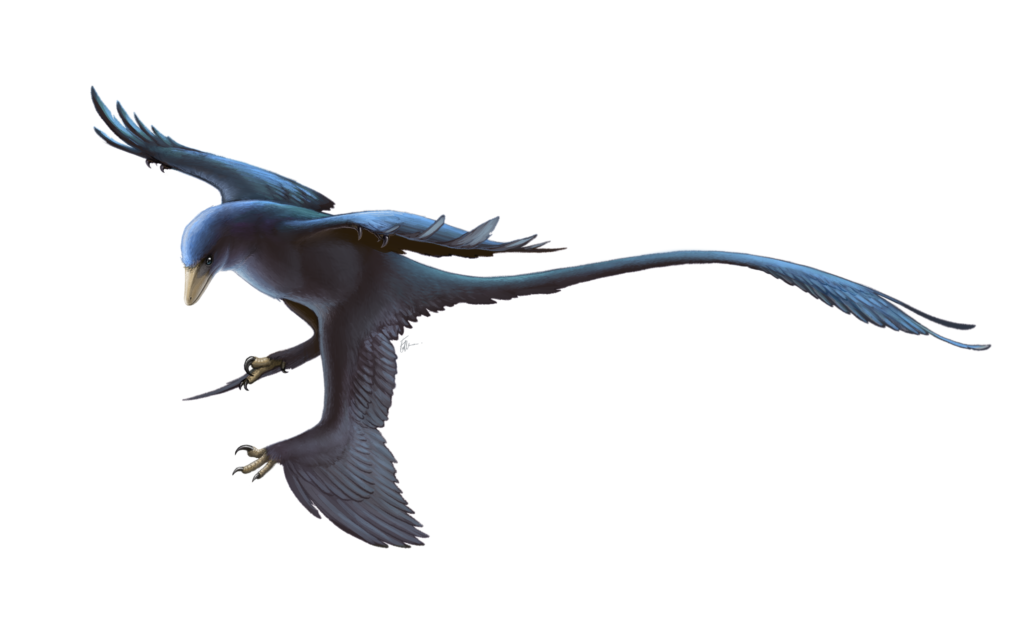
A team of American and Chinese researchers revealed the color and detailed feather pattern of Microraptor, a pigeon-sized, four-winged dinosaur that lived about 130 million years ago. The non-avian dinosaur’s fossilized plumage, which had hues of black and blue like a crow, is the earliest record of iridescent feather color. Let that sink in for a moment. A dinosaur with iridescent feathers, shimmering in the Cretaceous sunlight like a modern starling.
Researchers compared melanosome shape and density from a Microraptor fossil at the Beijing Museum of Natural History to a database of melanosomes from a variety of modern birds, and statistical analysis of the data predicts that Microraptor was completely black with a glossy, weakly iridescent blue sheen. The researchers also found that the tail feather was ornamental and likely evolved for courtship and other social interactions, not for aerodynamics. So not only was this dinosaur gorgeous, it was also, apparently, a bit of a show-off. These findings also contradict previous interpretations that Microraptor was a nocturnal animal, because dark glossy plumage is not a trait found in modern nighttime birds. One color discovery reshaped an entire behavioral hypothesis. That is remarkable.
Borealopelta: The Armored Beast That Still Needed to Hide
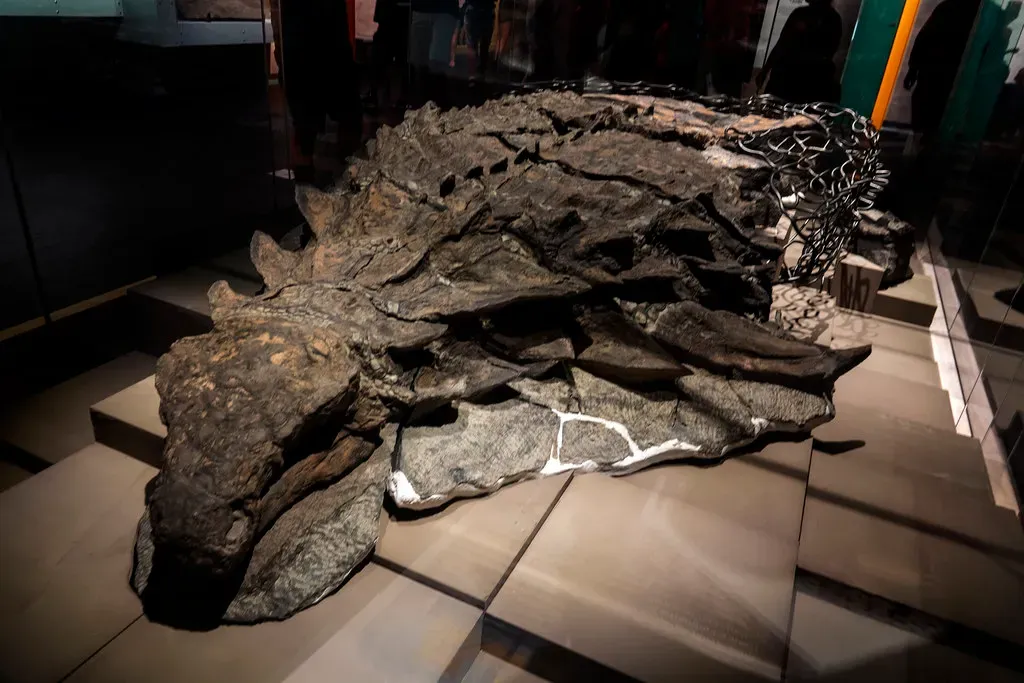
An analysis of the fossilized skin of Borealopelta markmitchelli, the most well-preserved of the armored dinosaurs ever unearthed, revealed that the ancient creature had a reddish-brown coloration and camouflage in the form of countershading, and that despite being the size of a tank, it was still hunted by carnivorous dinosaurs. That last part is almost hard to believe. Armored, the size of a small truck, and it still needed camouflage. The Cretaceous was no gentle place.
To infer the dinosaur’s pigmentation pattern, the paleontologists analyzed organic compounds in its horns and skin impressions. They found that the skin of Borealopelta markmitchelli exhibited countershading, a common form of camouflage in which an animal’s underside is lighter than its back. This suggests that the nodosaur faced predation stress from meat-eating dinosaurs. With an estimated body mass exceeding 1,300 kilograms, Borealopelta was much larger than modern terrestrial mammals that either are countershaded or experience significant predation pressure as adults. The presence of countershading suggests predation pressure strong enough to select for concealment in this megaherbivore despite possession of massive dorsal and lateral armor. No living animal today of comparable size bothers with camouflage. The fact that this one did tells you something terrifying about what was sharing its world.
Conclusion: A Prehistoric World Far More Colorful Than We Imagined
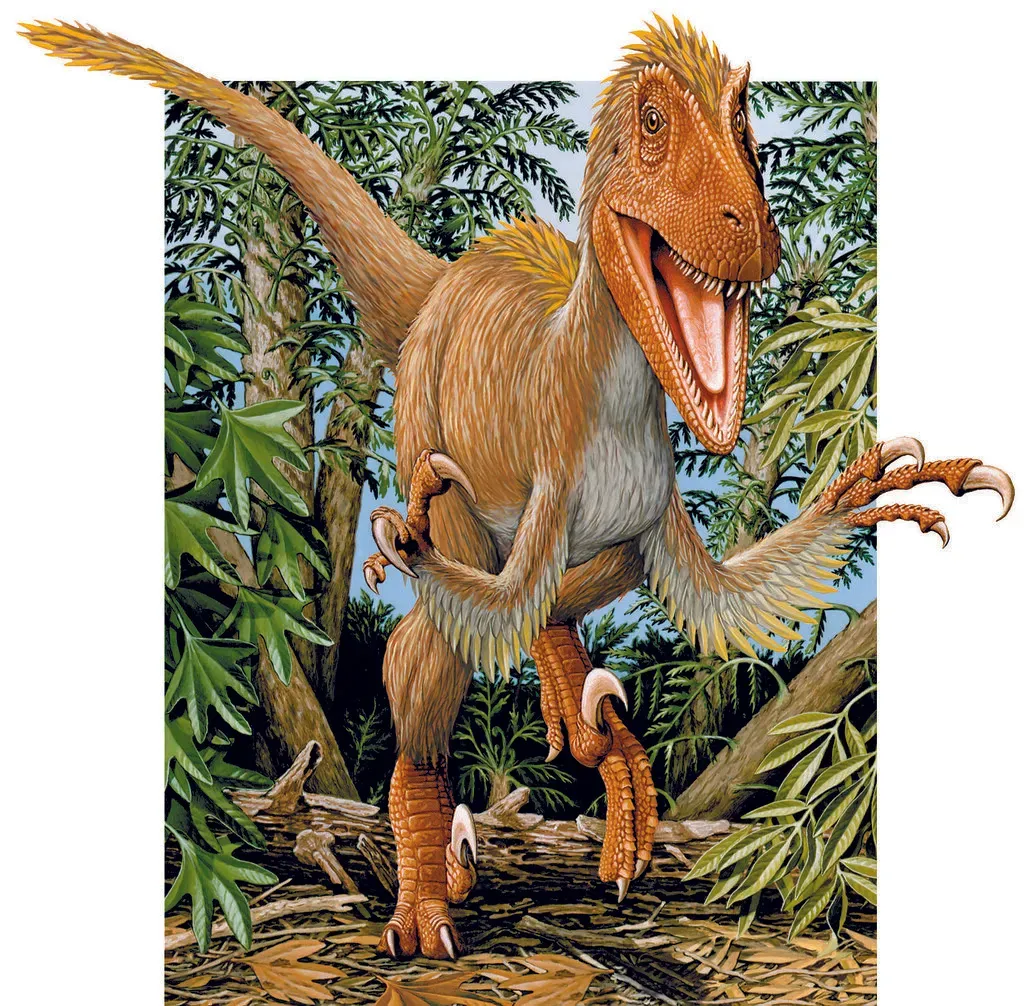
What these four fossils collectively prove is something that would have seemed like science fiction just a couple of decades ago. These findings are not only revealing, for the first time, what these creatures really looked like, but they are also elucidating previously murky aspects of the animals’ lives, from their activity cycles to the type of environment they inhabited. Color is not just decoration. It is biography. It tells us who was hiding, who was competing, who was displaying.
Feather color in dinosaurs may reveal whether color patterns were useful for camouflage or peacock-like courtship displays, and if there were color differences between the sexes, as in many modern birds. Each new discovery tightens the link between the animals of the Mesozoic and the birds singing outside your window right now. The striped tail of a Sinosauropteryx, the russet crest of an Anchiornis, the iridescent swagger of a Microraptor, and the earthy camouflage of a Borealopelta are not relics. They are windows.
The prehistoric world was never grey. We just needed the right tools to finally see it. What would you have guessed a 130-million-year-old dinosaur looked like before reading this? Tell us in the comments.