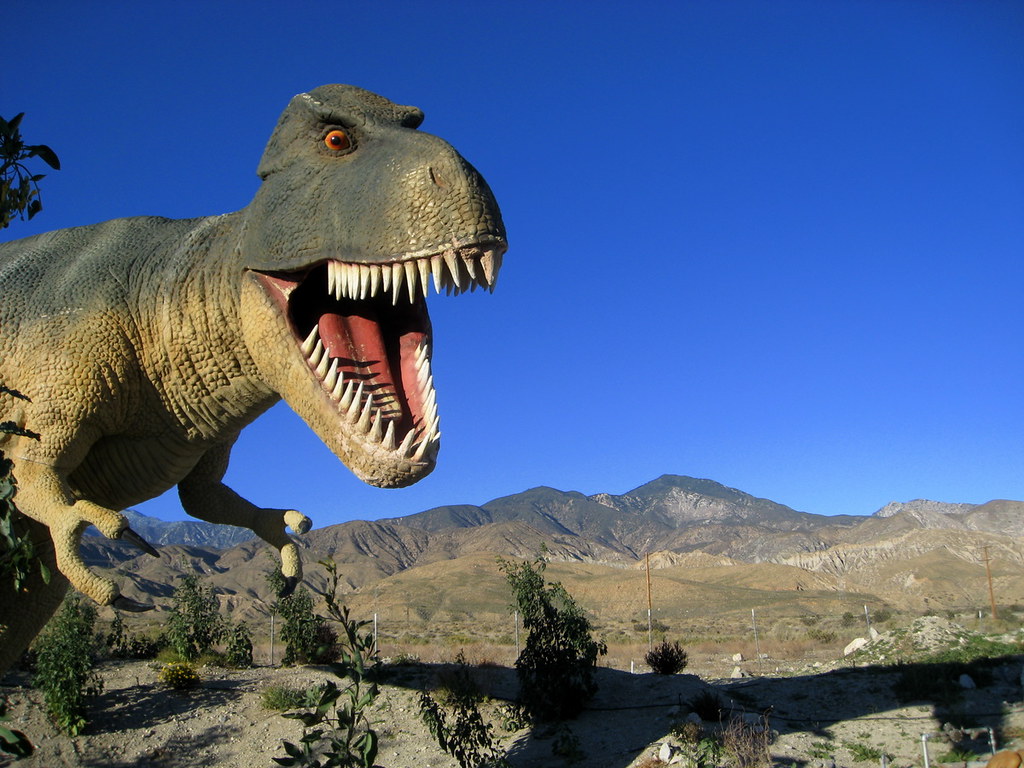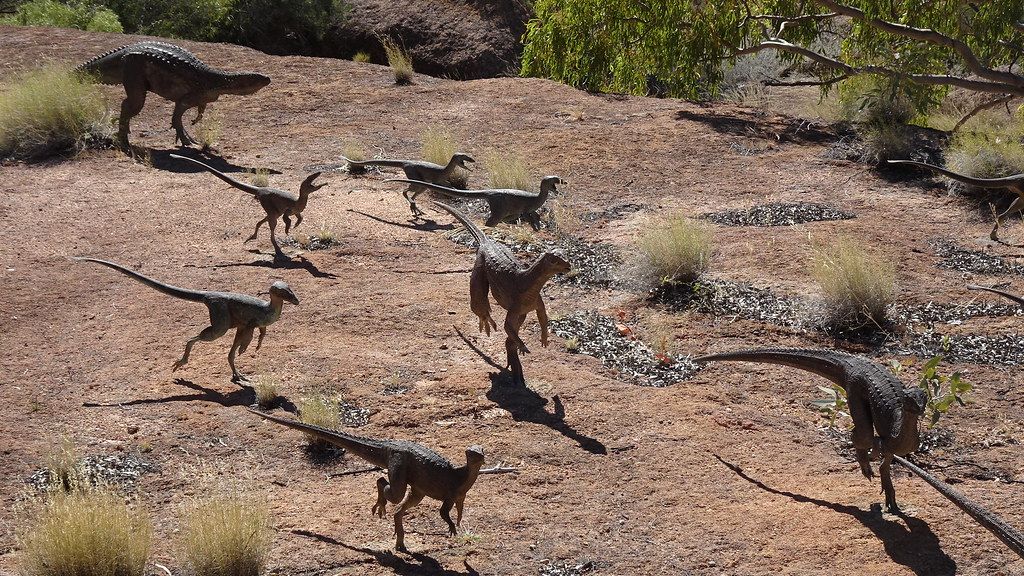
When most people think of dinosaurs, they picture a thundering T. rex shaking the earth with every step, or a long-necked sauropod calmly munching on treetops. That is the version Hollywood sold you, and it is only part of the story. There was another world happening just beneath the surface of the Mesozoic, one that was quieter, sharper, and in many ways far more fascinating. It was a world of small dinosaurs, operating in places the giants never could.
These creatures were not simply the “lesser” dinosaurs waiting around to be stomped. They were cunning specialists, some of them hunting in total darkness, others gliding between trees, and a few boasting brain-to-body ratios that put their massive relatives to shame. Once you start pulling at these threads, the story of dinosaurs gets a whole lot more interesting. Buckle up, because what you are about to discover might completely reframe everything you thought you knew about prehistoric life.
The Hidden Hierarchy: Why Size Was Not Everything
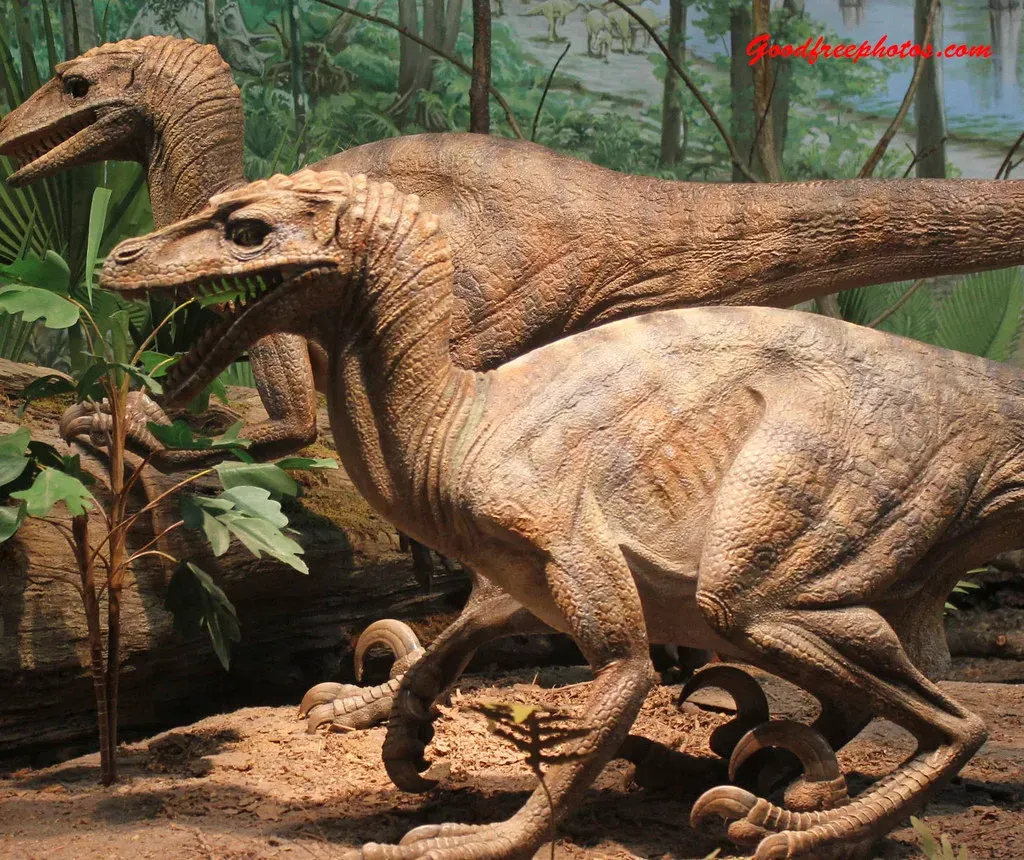
Here is the thing about the Mesozoic Era – it was not just a world of giant reptiles crashing through ferns. Dinosaurs were the dominant terrestrial vertebrates of the Mesozoic Era, especially during the Jurassic and Cretaceous periods. Yet within that dominance, there was a whole internal hierarchy that had nothing to do with bulk. Small predators carved out ecological roles that were completely inaccessible to larger creatures, filling niches in ways that kept entire ecosystems balanced and functioning.
The Mesozoic Era, often called the Age of Reptiles, was a time when theropod dinosaurs thrived – and these creatures were not homogenous. They displayed a remarkable variety in size, shape, and hunting strategies, a diversity that was key to understanding their dominance and survival over millions of years. Think of it like a modern rainforest. The big cats get all the attention, but it is the countless smaller predators, the snakes, the hawks, the monitor lizards, doing the quiet, relentless work of keeping prey populations in check.
Scleral Rings and Night Eyes: The Science of Darkness
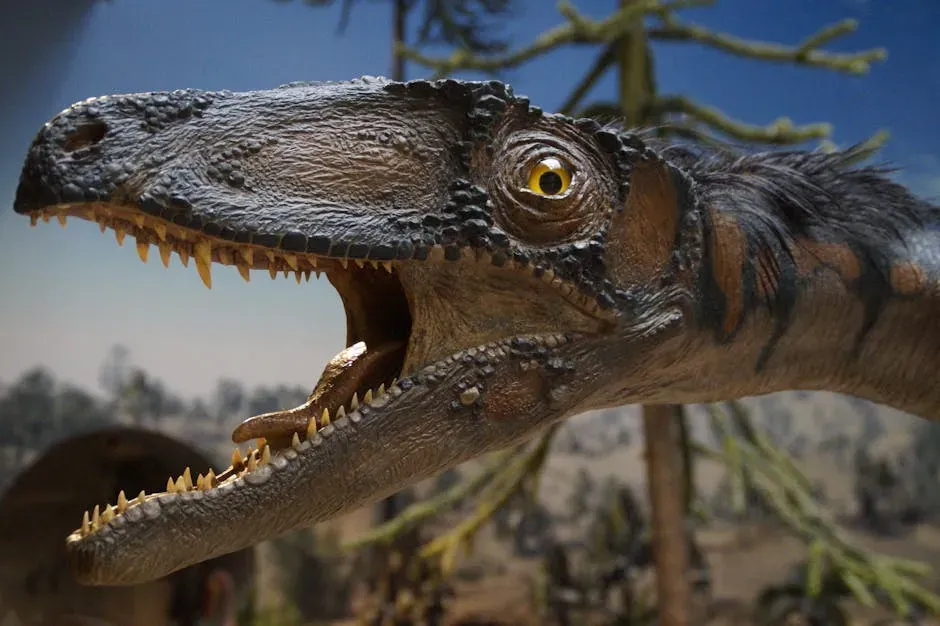
You might be wondering – how could scientists possibly know which dinosaurs hunted at night? The answer is surprisingly elegant. Comparisons between the scleral rings of dinosaurs and modern birds and reptiles have been used to infer daily activity patterns of dinosaurs. These small bones inside the eye, shaped like a ring of overlapping plates, preserve incredibly detailed information about how large a creature’s pupil was. Larger pupils mean more light gathered, which means better vision in dim conditions.
Although it has been suggested that most dinosaurs were active during the day, these comparisons have shown that small predatory dinosaurs such as dromaeosaurids, Juravenator, and Megapnosaurus were likely nocturnal. This is not guesswork. The larger the pupil compared to the size of the eye, the better a dinosaur could see in the dark. It is the same reason your cat’s eyes glow in a dim room, and the same principle at work in the ancient shadows of the Cretaceous.
Shuvuuia Deserti: The Desert Owl of the Dinosaur Age
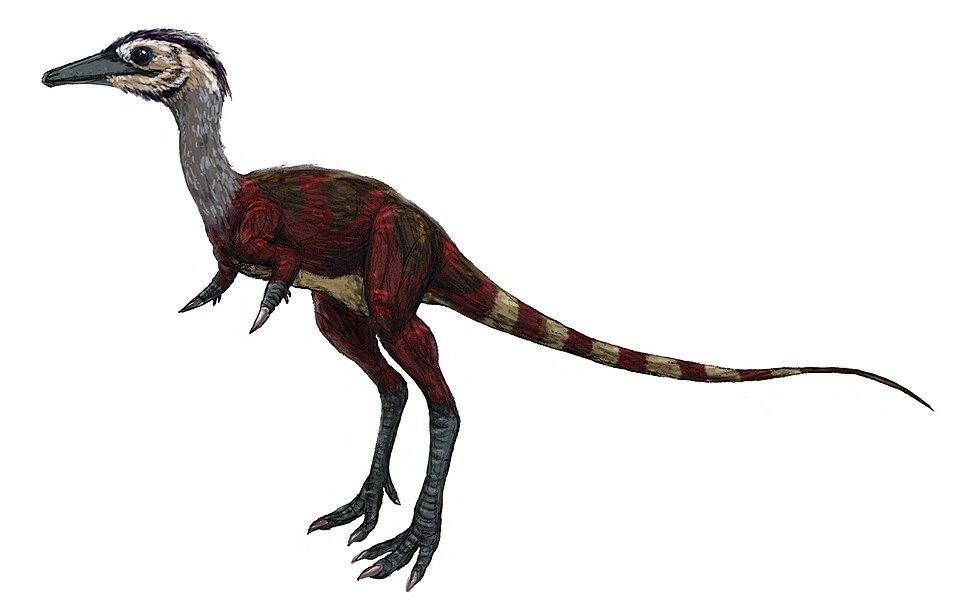
Research has shown that some theropods, such as the tiny desert-dwelling Shuvuuia deserti, benefited from a form of night vision and hypersensitive hearing, indicating they were nocturnal hunters. Honestly, when you learn about this little creature, it is hard not to be stunned. This was not just an animal that happened to see reasonably well at night. This was a highly specialized nocturnal predator, as finely tuned for darkness as the barn owls you might hear outside your window today.
Scans showed that Shuvuuia deserti had an extremely elongated inner ear canal for its size, similar to that of the living barn owl and proportionally much longer than all other bird species analyzed for comparison. According to statistical analyses, there is a very high chance, higher than 90 percent, that Shuvuuia deserti was nocturnal. A ninety percent probability. That is not a hunch – that is about as close to certainty as paleontology gets. The desert at midnight was this animal’s living room.
Troodon: The Smartest Hunter in the Shadows
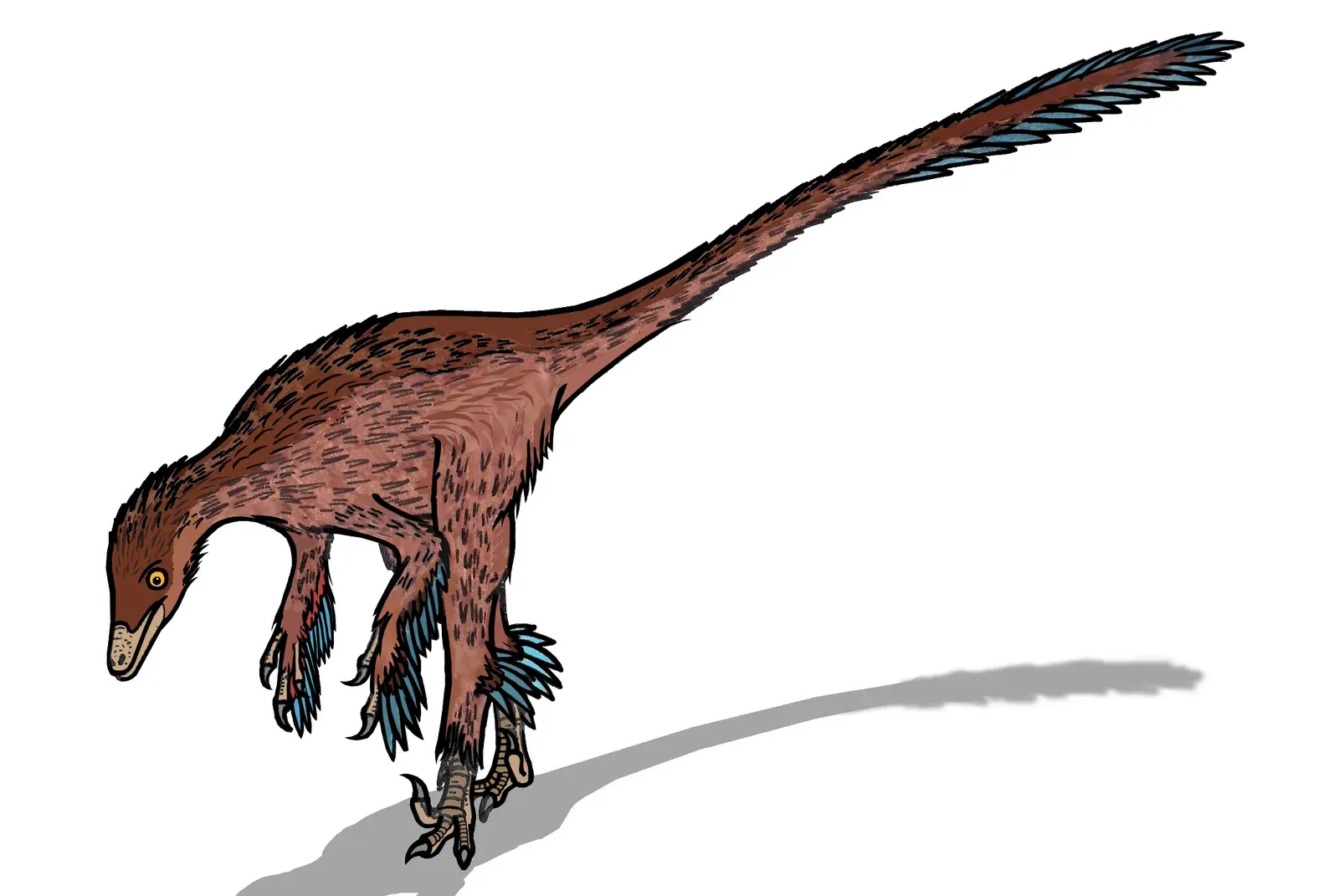
If there is one small dinosaur that makes you genuinely stop and think, it is Troodon. Troodon is often recognized as one of the smartest dinosaurs due to its relatively large brain size compared to its body. This small, terrestrial dinosaur could grow to about six feet long and weigh around sixty pounds. For reference, that is about the weight of a medium-sized dog. Yet its brain was, proportionally, operating on a completely different level than anything else in its environment.
Troodon had a large brain for its relatively small size and was probably among the smartest dinosaurs. Its brain is proportionally larger than those found in living reptiles, so the animal may have been as intelligent as modern birds. Because Troodon’s large eyes would have provided it with excellent vision in low-light situations, paleontologists conclude that this dinosaur hunted primarily at night while lurking in the dark forests. Furthermore, Troodon’s binocular vision would have enabled it to clearly focus on and strike small, fast-moving prey with deadly accuracy. That is a genuinely terrifying combination: brains, speed, and perfect night vision.
Microraptor: The Four-Winged Ghost of the Forest
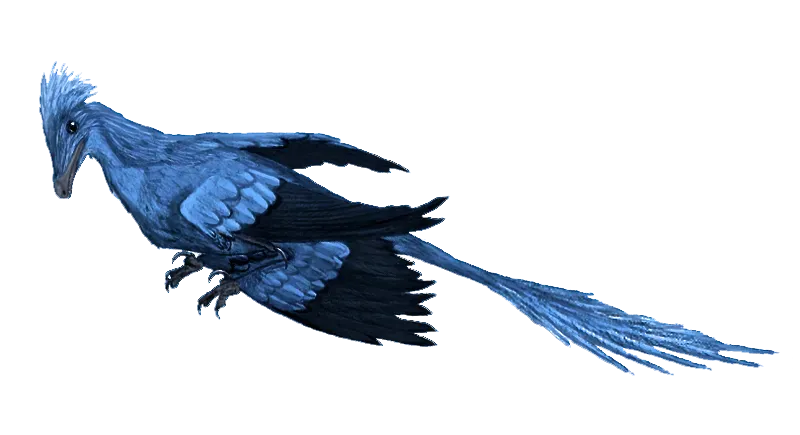
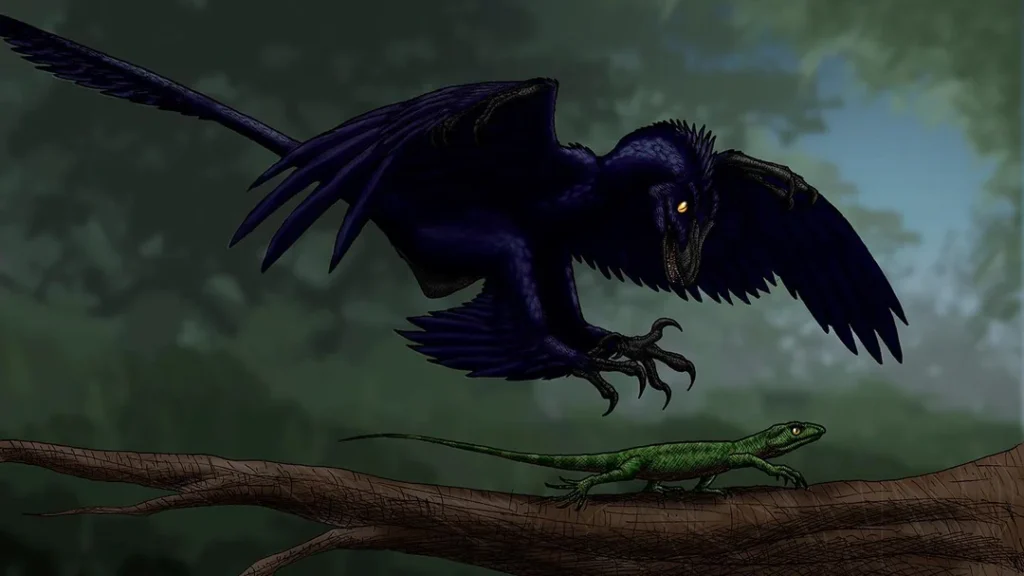
Now here is where things get truly wild. Microraptor is a genus of small, four-winged dromaeosaurid dinosaurs. Four wings. Let that sink in for a moment. While other predators were limited to the ground, Microraptor was navigating the treetops with a body plan that looked like something between a crow and a feathered dragon. By dinosaur standards, Microraptor was tiny, about the size of a crow, at around 77 centimetres in length.
A computer simulation of the flight performance of Microraptor suggests that its biplane wings were adapted for undulatory “phugoid” gliding between trees, where the horizontal feathered tail offered additional lift and stability and controlled pitch. It was an aerial ambush predator operating in three dimensions, long before the skies were crowded. In the past, scientists have found mammalian bones and bird bones among its gut contents, and in 2013, paleontologists found fish scales in the abdominal cavity of a specimen. This was an animal eating across the entire food web, from the treetops to the water’s surface.
Velociraptor: Debunking the Pack Hunter Myth
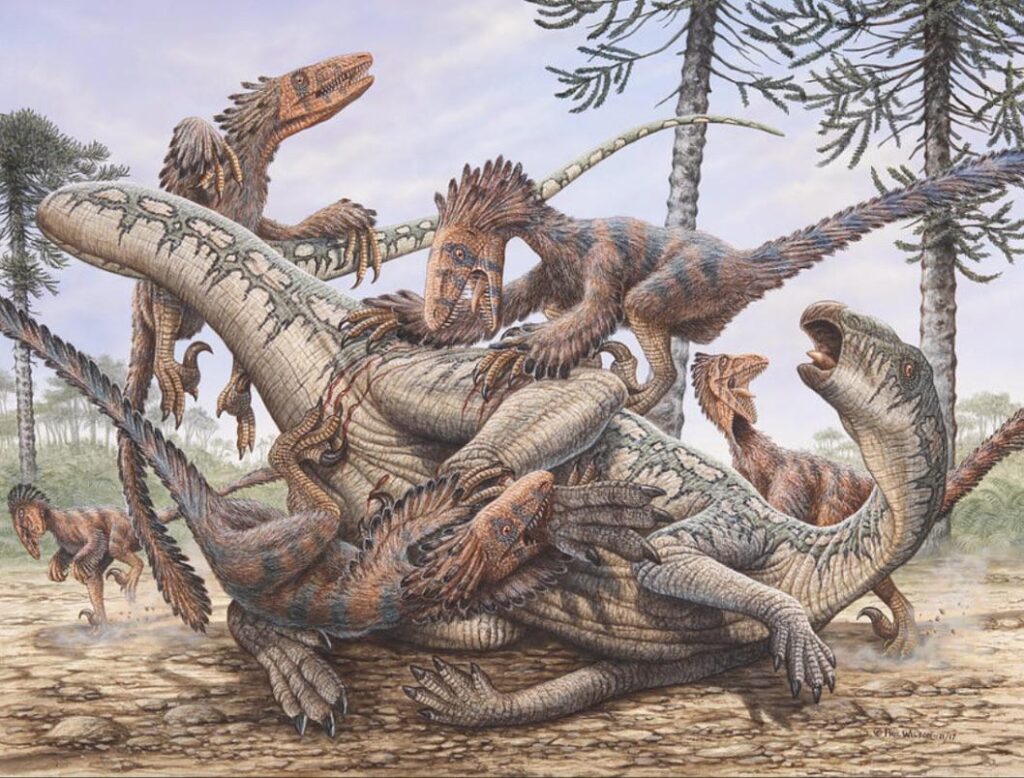
You have seen Velociraptor in the movies. Coordinated, terrifying, hunting in clever packs like prehistoric wolves. It is a great image, but let’s be real about what the science actually says. Velociraptor was more of a solitary predator than a pack hunter. Its diet primarily consisted of small to medium-sized prey, which aligned with its size and anatomical traits. The cinematic version was always more Hollywood than Cretaceous.
Its plumage, which included feathers on its forelimbs and tail, likely contributed to camouflage, aerodynamic control, and stability during high-speed pursuits, incline running, and quick directional changes. These feathered adaptations would have enhanced its ability to ambush and capture prey. So instead of a coordinated pack, picture a lone, feathered predator slipping through undergrowth with the quiet efficiency of a big cat. Velociraptor may have employed a strategy of ambush predation, using its agility to surprise and overpower prey. That is somehow even more unsettling than the movie version.
Compsognathus: The Chicken-Sized Terror
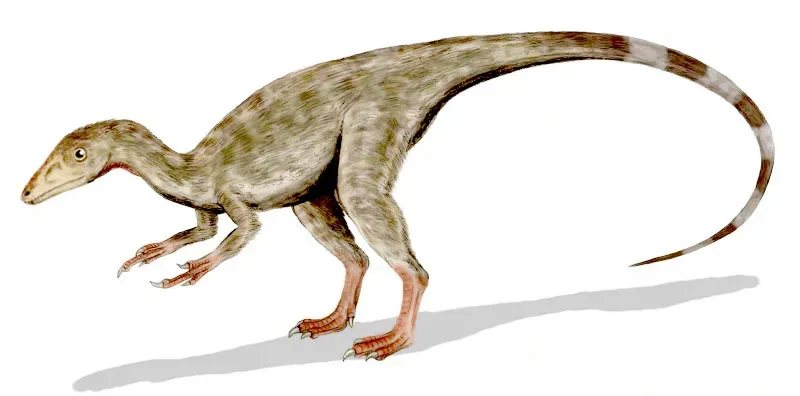
If you told someone that one of the most effective small predators of the Late Jurassic was roughly the size of a modern turkey, they would probably laugh. Compsognathus, often referred to as the “Dainty Jaw,” was a small theropod from the late Jurassic period measuring about one meter in length. This agile creature inhabited regions that are now Germany and France, and primarily hunted small lizards, showcasing its carnivorous diet.
The preserved remains of lizards found within Compsognathus fossils provide critical behavioral insights into its predation strategies, confirming its role as an agile predator. This adaptability in hunting behaviors demonstrates a sophisticated approach to survival, particularly in competitive environments. Think of it like a mongoose – small, blindingly quick, totally lethal to anything within its size range. A Compsognathus longipes fossil was found with a lizard in its stomach, giving us direct, irrefutable evidence of its predatory behavior. That kind of fossil preservation is extraordinarily rare, and it essentially hands us a snapshot of a meal from 150 million years ago.
Diversified Predation: Not All Small Hunters Were the Same
One of the most exciting developments in recent paleontological research has been the discovery that small dinosaurs from the same ecosystem and even the same family were not all doing the same thing. Morphological evidence combined with abdominal contents reveals that at least three distinct hunting styles were present among sinosauropterygids from the Yixian Formation. This is the kind of ecological complexity we associate with modern rainforests, not prehistoric swamps.
The first species, Huadanosaurus (about one meter long), was suggested to be a nocturnal predator that swallowed small prey items such as mammals whole. The second, Sinosauropteryx (about 1.2 meters), likely hunted during the day and dismembered prey such as lizards and insects. The third, Sinocalliopteryx (2.4 meters), fed on larger animals such as dromaeosaurids and birds. Three closely related dinosaurs, living side by side, each specializing in something completely different. That level of ecological partitioning is genuinely remarkable.
Feathers, Camouflage, and the Art of the Ambush
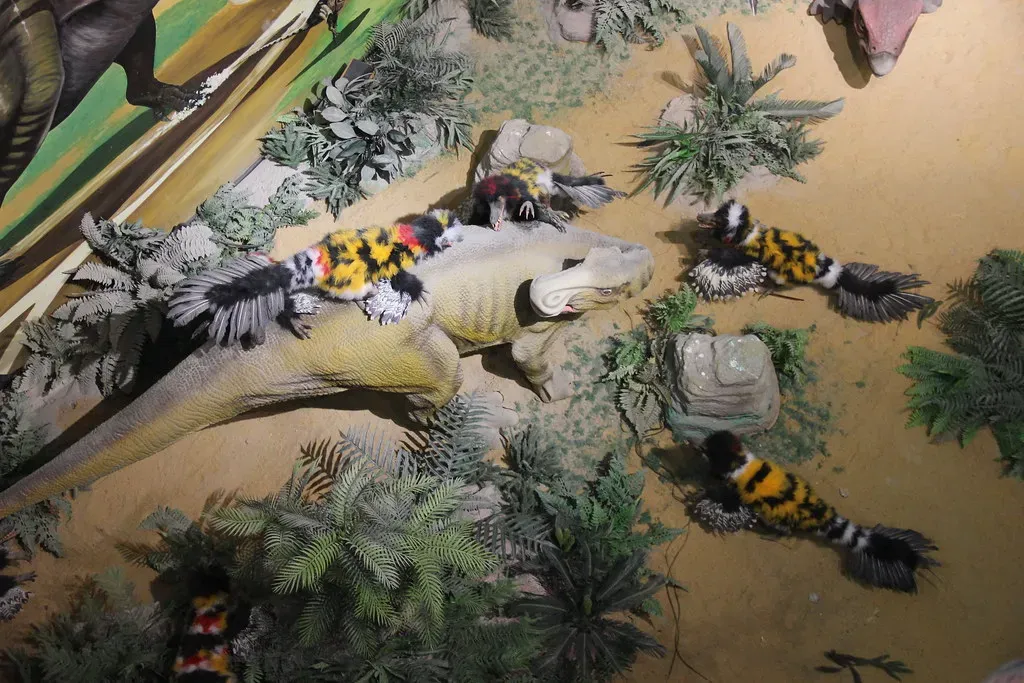
We have known for decades that many small theropods were feathered. Members of the subgroup Coelurosauria were most likely all covered with feathers, and it is possible that feathers were also present in other theropods. What has taken longer to fully appreciate is just how tactically useful those feathers were. This was not merely decoration or temperature regulation. Feathers were weapons of stealth.
Feather patterns might have helped small predators blend into their surroundings while stalking prey, serving as a camouflage mechanism, similar uses of which can be observed throughout much of animal history in modern predators such as leopards and snakes. In 2012, a new Microraptor fossil was discovered with preserved pigment cells. From these, researchers learned that Microraptor likely had shiny black feathers. Glossy black plumage in a shadowy, forested environment. You start to see just how well-designed these animals were for moving unseen.
The Legacy of Small Predators: How They Shaped Modern Birds
Here is perhaps the most mind-bending takeaway from all of this. The small, shadowy hunters of the Mesozoic did not just vanish at the end of the Cretaceous. They evolved. In the Jurassic, birds evolved from small specialized coelurosaurian theropods, and are currently represented by about 11,000 living species, making theropods the only group of dinosaurs alive today. Every sparrow you see at a feeder, every hawk circling overhead, every owl hunting at midnight – all of them are carrying the evolutionary inheritance of these unseen hunters.
Like Archaeopteryx, well-preserved fossils of Microraptor provide important evidence about the evolutionary relationship between birds and earlier dinosaurs. The line between “dinosaur” and “bird” is blurrier than most people realize, and it was the small predators who blurred it. Theropod dinosaurs were not just about brute strength and ferocity. Their success as a clade also lay in their fascinating anatomical adaptations, which played a crucial role in their evolution and dominance. The giants ruled the daylight and the headlines. The small ones ruled the shadows, and in doing so, shaped the world we live in today.
Conclusion
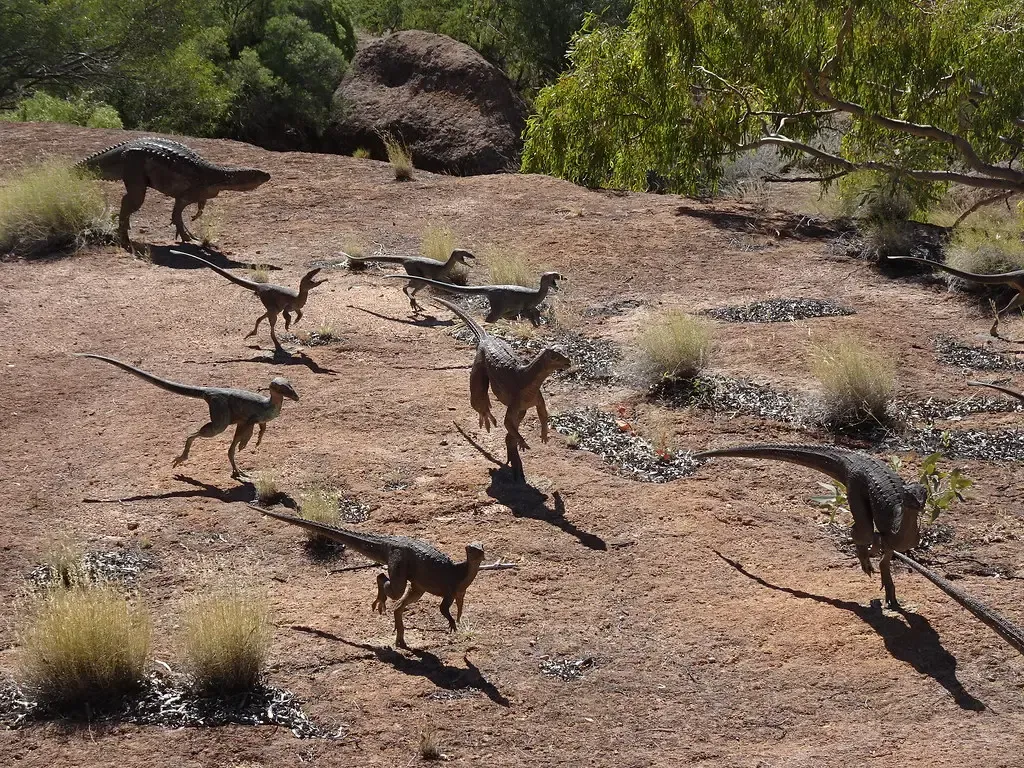
The story of small dinosaurs is, in many ways, the more interesting story. While we have spent a century being dazzled by the biggest and most dramatic specimens, an equally extraordinary world was unfolding at a smaller scale, in the undergrowth, in the treetops, and beneath the cover of darkness. These were not lesser animals. They were specialists, innovators, and ultimately survivors in a way the giants never managed to be.
The next time you watch a bird snatch an insect from mid-air, or hear an owl call out across a dark field, take a moment to consider what you are really looking at. You are watching the living descendants of the unseen hunters of the Mesozoic. Millions of years of shadow-dwelling, ambush-perfecting, brain-growing evolution, all distilled into something small enough to hold in your hand. Did you ever imagine that the most enduring dinosaurs would also be the smallest ones?