
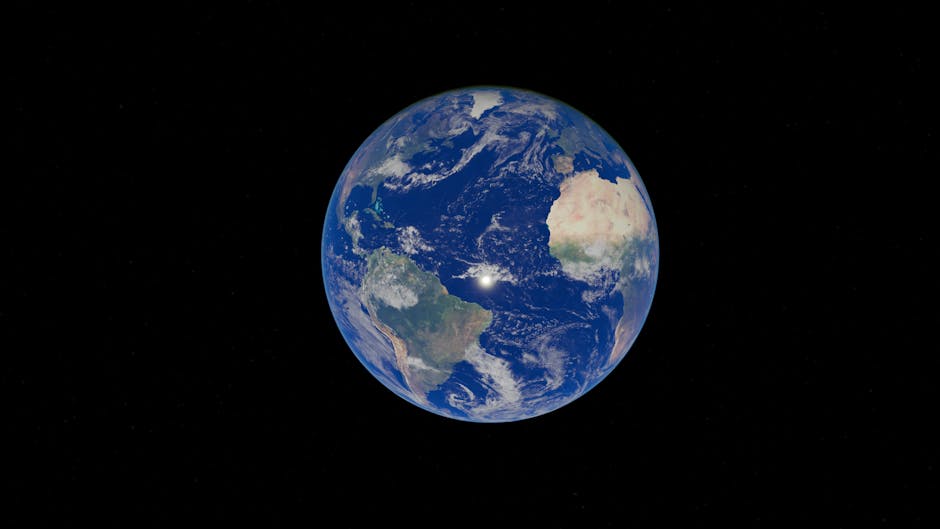
How did something as extraordinary as life crawl out of a lifeless, volcanic, storm-racked world? It is honestly one of the most mind-bending questions you could ever ask. Billions of years before the first human footprint, before even the first fish, before even the earliest bacteria left a trace in ancient rock, the Earth was already cooking up something incredible.
The origin of life on Earth via the spontaneous emergence of a protocell prior to Darwinian evolution remains a fundamental open question in physics and chemistry. Scientists have been wrestling with it for generations, yet no single theory has won the debate. The questions of how life forms, whether life is an inevitable outcome, and how diverse its presentation could be remain some of the most profound in science, confronting key issues such as the plausibility of alternative biochemistries and the transition from purely chemical systems to information-bearing, evolvable entities. So buckle up. Each of these six theories carries something extraordinary, something that might just shift how you see the world beneath your feet. Let’s dive in.
The Primordial Soup: Life Brewed Like Ancient Tea
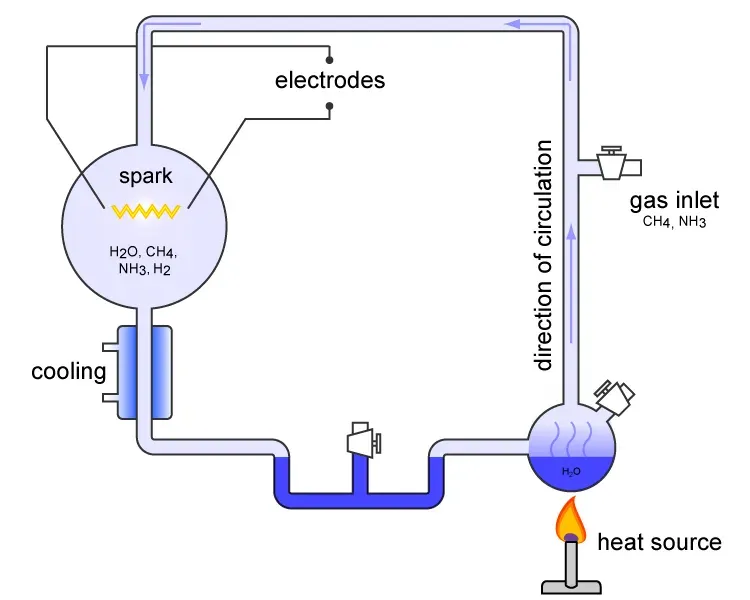
Here’s the thing: long before any laboratory ever tried to recreate life, a simple but bold idea had already taken root. The Oparin-Haldane model, or the “primordial soup” hypothesis, suggests that the chemical makeup of early Earth’s atmosphere, sparked by electricity, led to the spontaneous formation of organic molecules. Think of it as the Earth brewing life the same way you’d brew tea, slowly, under heat and pressure, until something meaningful materializes in the cup.
In 1953, a graduate student named Stanley Miller and his professor Harold Urey performed an experiment demonstrating how organic molecules could have spontaneously formed from inorganic precursors. The now-famous Miller-Urey experiment used a highly reduced mixture of gases including methane, ammonia, and hydrogen to form basic organic monomers such as amino acids. Later replications of the Miller-Urey experiment have created a wide assortment of amino acids and other organic molecules, including the building blocks of DNA and RNA. Not bad for a glorified jar of gas and electricity, right?
The Hydrothermal Vent Theory: Life Born in the Deep Dark
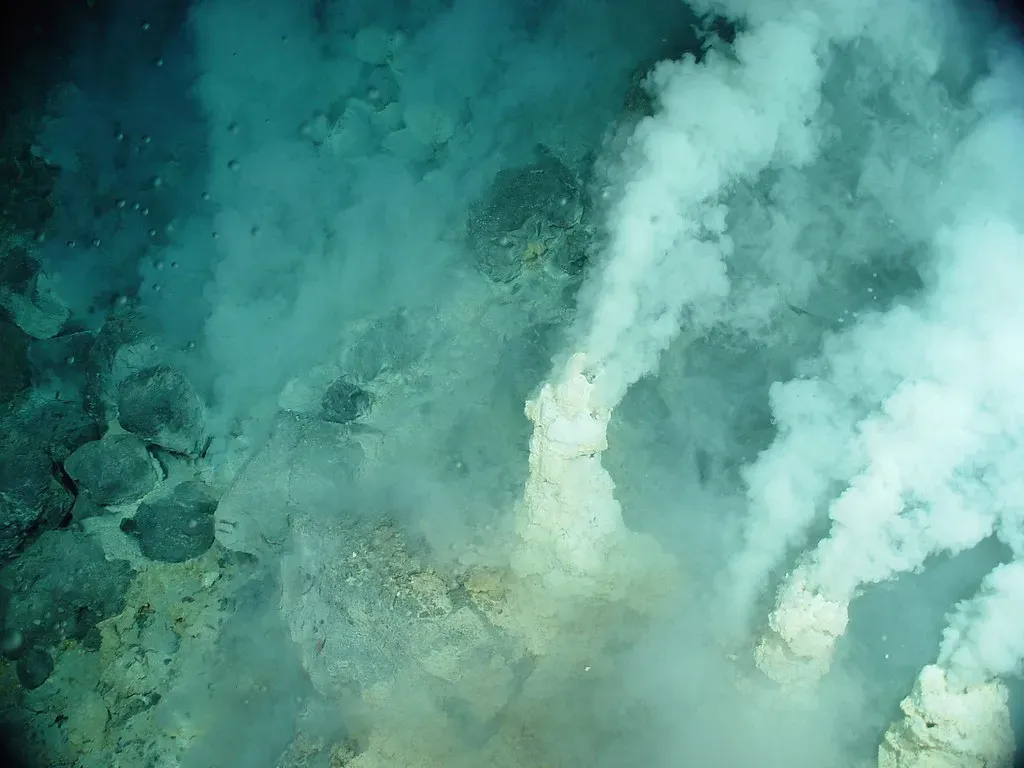
In 1977, scientists discovered biological communities unexpectedly living around seafloor hydrothermal vents, far from sunlight and thriving on a chemical soup rich in hydrogen, carbon dioxide, and sulfur. Inspired by these findings, scientists later proposed that hydrothermal vents provided an ideal environment with all the ingredients needed for microbial life to emerge on early Earth. Imagine life not starting under the warmth of the sun at all, but instead lurking in the pitch-black, crushing depths of the ocean. It sounds like the stuff of science fiction.
At the simplest level, there are two kinds of hydrothermal vents: the hot black smoker type, around 350 degrees Celsius, the chemistry of which is driven by the magma-chamber below ocean-floor spreading zones, and the cooler Lost City type, around 50 to 90 degrees Celsius, the chemistry of which is driven not by magma, but by a process called serpentinization. Scientists who support the hydrothermal vent theory propose that lipid vesicles formed inside the inorganic chambers around the vent and acted as containers for other organic molecules. Eventually, the early proto-cells housed in these chambers evolved an independent proton gradient similar to the one maintained at the vent’s surface, just as modern cells maintain today through a system of electron-transferring chemical reactions.
The RNA World Hypothesis: The Molecule That Did Everything
![The RNA World Hypothesis: The Molecule That Did Everything (Created with the rendering program Protein Explorer [1] using coordinates 1H38 deposited at the RCSB PDB repository. [2], Public domain)](https://nvmwebsites-budwg5g9avh3epea.z03.azurefd.net/dinoworld/cd555ce950fe82547b9252d71702f03e.webp)
The RNA world hypothesis proposes that on early Earth there existed an abundance of RNA life produced through prebiotic chemical reactions. In addition to carrying and translating genetic information, RNA is a catalyst, a molecule that increases the rate of a reaction without itself being consumed, meaning a single RNA catalyst could have produced multiple living forms. Honestly, if RNA were a person, it would be the overachiever in the room, doing two jobs at once while everyone else is still figuring out their role.
One recent study unites two prominent origin of life theories: the “RNA world,” where self-replicating RNA is proposed to be fundamental, and the “thioester world,” in which thioesters are seen as the energy source for the earliest forms of life. Under certain environmental conditions, laboratory experiments have synthesized RNA nucleotides including adenine, thymine, guanine, and uracil in simulated black smoker hydrothermal vents. These bases are oligomerized in the presence of catalytic mineral surfaces, and chains of up to four nucleotides have been synthesized, which could be evidence for a plausible pathway to RNA formation. Science is getting closer to closing this gap, and that is genuinely thrilling.
Panspermia: Did Life Hitchhike to Earth from Space?
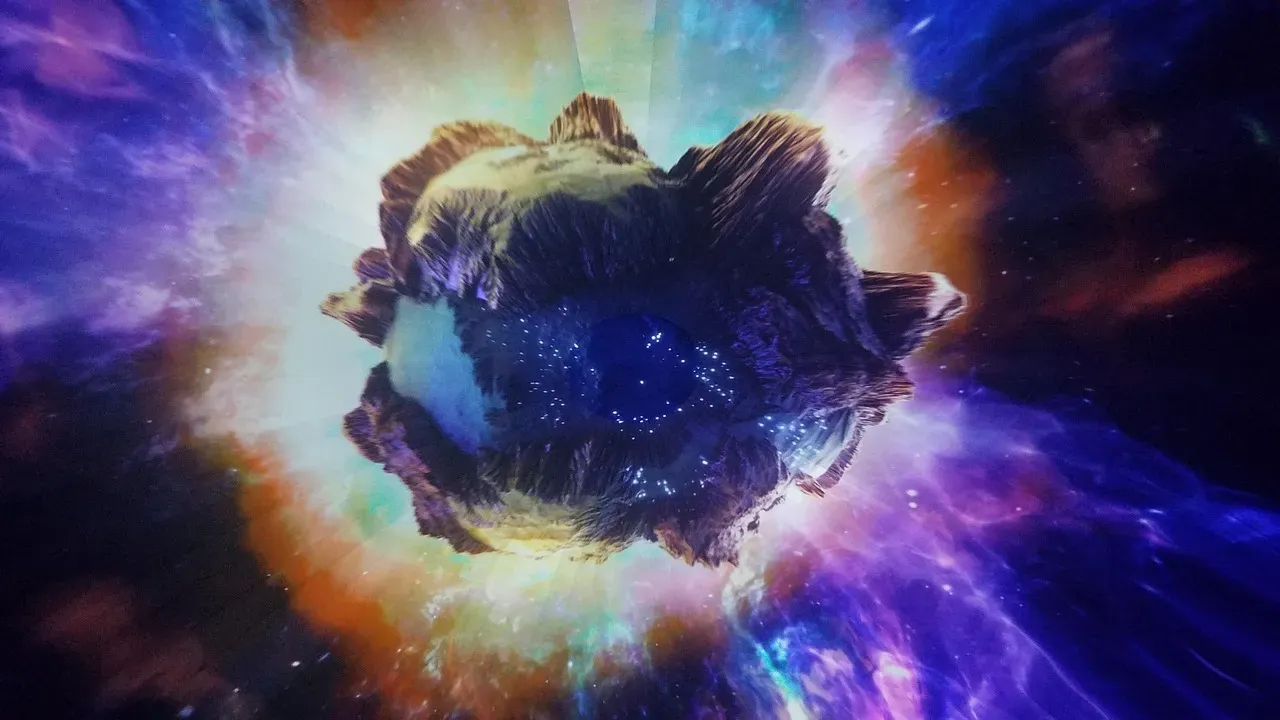
The theory of panspermia, first developed in the mid-nineteenth century, holds that life was carried to Earth, and that this life may have been carried to numerous other planets on meteors, comets, and asteroids originating from elsewhere in the galaxy. Panspermia argues that when these natural projectiles impacted a planet, bacteria were deposited and began evolving to change the environment. I know it sounds crazy, but let’s be real: given how quickly life seems to have appeared on Earth, the idea that it arrived with a little cosmic head start is not as wild as it first seems.
A 2024 study published in Nature Ecology and Evolution pushed back the estimated age of the Last Universal Common Ancestor of all terrestrial life to somewhere between 4.09 and 4.33 billion years ago, several hundred million years older than previous estimates. This means life appeared on Earth extremely rapidly, possibly just 200 million years after the planet became habitable. This breathtaking speed raises profound questions. If life arose so quickly on Earth, was it truly a spontaneous event, or did it arrive from elsewhere already partially assembled? LUCA already encoded about 2,600 proteins, comparable to modern bacteria, and even had a primitive immune system, suggesting either an extraordinarily efficient origin process or the possibility that life had a head start elsewhere in the cosmos.
The Iron-Sulfur World Theory: Chemistry on a Mineral Scaffold
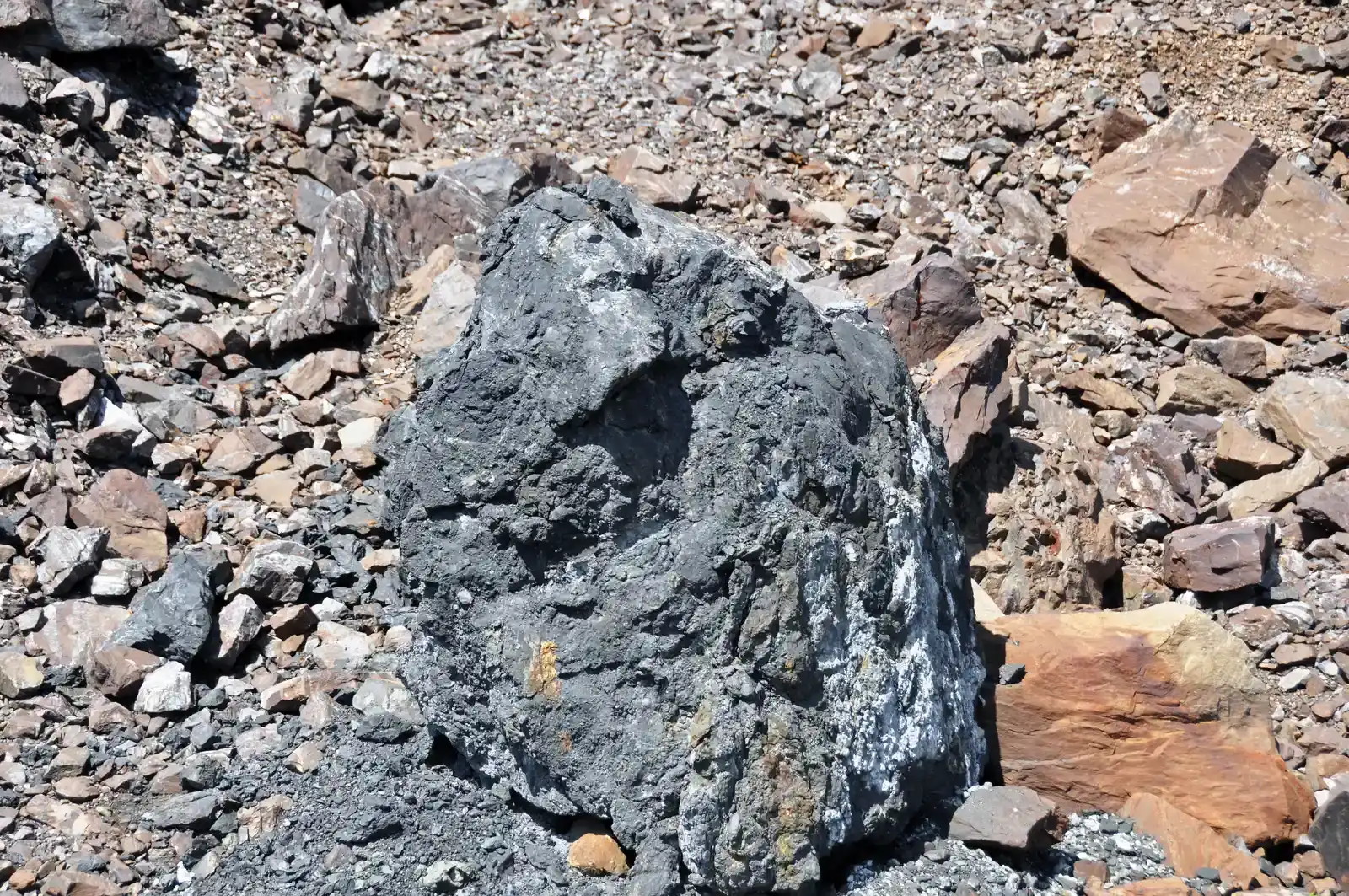
In the late 1980s, German chemist Günter Wächtershäuser proposed another theory of abiogenesis associated with the hydrothermal vent environment. He proposed that the earliest cells formed with naturally occurring structures composed of iron sulfide and associated metals around the surface of volcanically active vents in the deep ocean. Think of it this way: rather than life emerging from a liquid soup, it was more like life crystallizing out of a mineral scaffold, the way a crystal lattice builds up atom by atom. It’s a profoundly different picture.
Proposals like those from Woese and Wächtershäuser, alongside the similarities between the acetyl-CoA metabolic pathway and serpentinization reactions at alkaline hydrothermal vents, have led to a range of theories on whether life began capable of transforming simple carbon compounds into complex organics it could use as a food source. Computational methods have even verified that a proto-metabolism relying on thioester organic sulfur compounds could function and replicate the advantages of phosphorus chemistry, including the role phosphate plays in facilitating energetically unfavorable reactions. In other words, life may have found a workaround long before it found its most familiar ingredients.
The Warm Little Pond and Clay World Theory: Darwin’s Wild Hunch Was Right
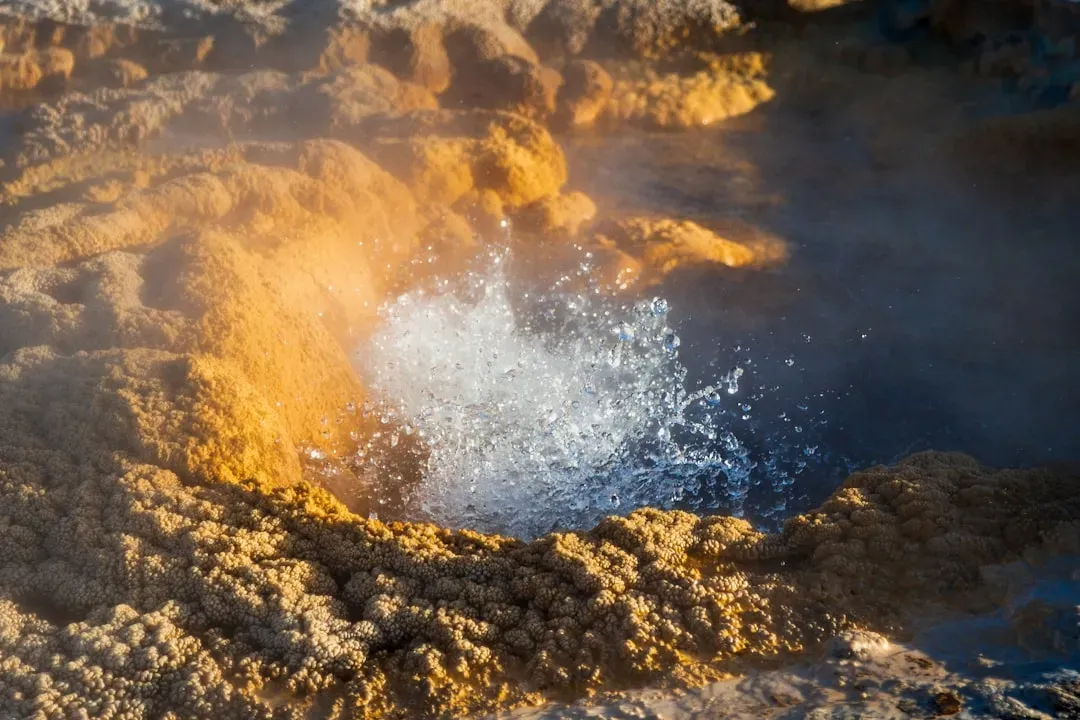
Although Darwin did not speak explicitly about the origin of life in On the Origin of Species, he did mention a “warm little pond” in a letter to Joseph Dalton Hooker dated February 1, 1871. It was more of a passing thought than a scientific proposal, honestly. Yet that casual, almost offhand suggestion seeded an entire field of inquiry that is still very much alive today. You need a fluctuating environment that is sometimes wet and sometimes dry: a wet period so that components mix and interact, and then a dry period so that water is removed and these components can form a polymer. Wet and dry cycling occurs every day on continental hydrothermal fields, which allows for concentration of reactants as well as polymerization.
Scientists as far back as John Desmond Bernal in the late 1940s speculated that clay surfaces would play a large role in abiogenesis, as they might concentrate monomers. Several such models for mineral-mediated polymerization have emerged, such as the interlayers of layered double hydroxides like green rust over wet-dry cycles. Connected to the question of life’s initial metabolism are theories around the environment it emerged in, with proposals including alkaline hydrothermal vents at the ocean floor, hot springs on volcanic islands, and surface alkaline lakes. It’s hard to say for sure which of these was Earth’s true “cradle,” but the warm little pond remains surprisingly competitive among scientists, even now.
Conclusion: A Question That Keeps the Universe Interesting
Six theories, six radically different visions of how everything began. What makes this topic so endlessly compelling is that none of them has been definitively proven, and each carries within it a grain of truth that keeps scientists working through the night. The questions of how life forms, whether life is an inevitable outcome, and how diverse its presentation could be remain some of the most profound in science, confronting the transition from purely chemical systems to information-bearing, evolvable entities.
By examining the early environments of Earth, the planetary processes, and the biochemical systems, and comparing them with what we know about other planets in our solar system and beyond, we can begin to understand the prerequisites for life. Recent discoveries of exoplanets, some within habitable zones with intriguing chemistry, further challenge us to consider whether life is an inevitable outcome of planetary evolution or an astonishing cosmic fluke. Perhaps the most humbling realization is this: you are the end product of whichever of these processes actually worked. Life found a way, billions of years ago, on a planet that had no reason to produce anything more than rock and steam.
Which of these six theories feels most convincing to you? Drop your thoughts in the comments, because this is one debate that is far from over.