Northeastern Germany – More than 125,000 years ago, the shores of ancient lakes at Neumark-Nord drew massive straight-tusked elephants from across Europe. Neanderthals turned this resource-rich landscape into a hunting ground, systematically processing the remains of over 70 of these colossal animals. A recent study examining fossilized teeth has unveiled the elephants’ extensive migrations and bolstered evidence of deliberate, organized predation by our extinct relatives.
Unearthing a Prehistoric Killing Field
Unearthing a Prehistoric Killing Field (Image Credits: Popular-Archaeology)
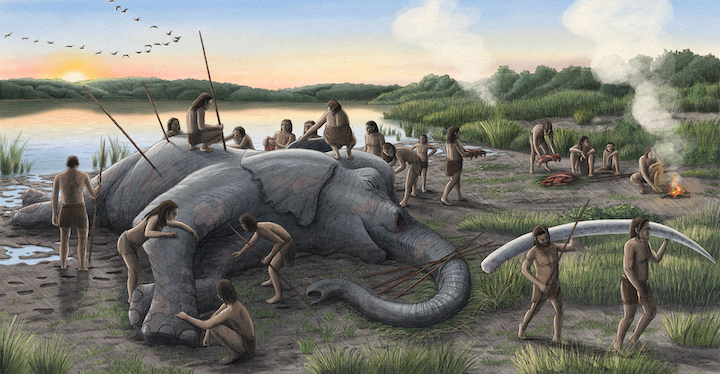
Excavations at the former lignite mine of Neumark-Nord in Saxony-Anhalt revealed an extraordinary concentration of straight-tusked elephant fossils. These remains, preserved in fine-grained lake sediments, represent at least 70 individuals from the Last Interglacial period, known as the Eemian.
Archaeologists identified cut marks on bones, indicating Neanderthals butchered the carcasses thoroughly to extract meat, fat, and marrow. Prior research established that this activity spanned at least 2,500 years, with the site serving multiple purposes: a kill zone in some areas and a processing station, dubbed a “fat factory,” in others.
One elephant could yield enough calories to sustain a group of 25 Neanderthals for three months, providing about 2,500 daily portions of 4,000 kcal each. Such yields demanded coordinated efforts in hunting, transport, and preservation, possibly through drying or smoking meat.
Isotopes Map Epic Migrations
Researchers analyzed molars from four adult elephants, using strontium isotope ratios to trace movements over eight to ten years of tooth growth. Two males displayed elevated strontium signatures, pointing to foraging in distant regions up to 300 kilometers away, including areas with radiogenic bedrock like the Harz Mountains or Saxon volcanic complexes.
The other two individuals, one male and one likely female, showed local signatures, suggesting home ranges closer to the site. Bayesian modeling of provenance confirmed non-overlapping territories, with seasonal fluctuations indicating subseasonal travels. “Thanks to isotope analyses, we can trace the movements of elephants almost as if we had a travel diary that has been preserved in their teeth for more than one hundred thousand years,” said Elena Armaroli, lead author of the study.
- Non-local males: Sr ratios around 0.71375, home ranges in Precambrian-Paleozoic terrains.
- Local individuals: Sr ratios near 0.7095–0.7105, matching regional bioavailable strontium.
- Maximum distance: 300 km, comparable to modern elephant ranges but in a forested interglacial Europe.
Paleoproteomics confirmed three males and one probable female, aligning with the site’s skewed adult male assemblage. Males’ solitary lifestyles likely made them prime, easier targets compared to herd-bound females.
Diet and Habitat Clues from Enamel
Carbon and oxygen isotopes in the teeth revealed a diet dominated by C3 plants, confirming the elephants as browsers adapted to interglacial woodlands. One non-local male fed in denser forests, showing a “canopy effect” with more negative δ13C values around -13.2‰, while a local individual grazed semi-open areas at -11.4‰.
These patterns matched gut contents from prior analyses, including leaves, twigs, and grasses. Neanderthals may have influenced habitats through fire use, creating attractive open patches near lakes that drew thirsty migrants.
| Elephant ID | Sex | Sr Signature | δ13C Range (‰) | Provenance |
|---|---|---|---|---|
| 832A (NN-2) | Male | High (0.71377) | -12.7 to -13.7 | 300 km distant |
| 2719A (NN-2) | Male | High (0.71375) | N/A | 300 km distant |
| 11B (NN-1) | Male | Low (0.70965) | N/A | Local |
| E22 (NN-1) | Female? | Low (0.70953) | -9.9 to -12.1 | Local |
Evidence of Sophisticated Predation
The concentration of prime-age males from varied origins rules out scavenging. “The concentration of remains and the isotope profile of the animals suggest that Neanderthals did not kill the elephants merely when a favorable opportunity arose. Everything points to organized hunting,” Armaroli noted.
Neanderthals demonstrated landscape knowledge, cooperation, and planning over generations. They supplemented elephant hunts with smaller game like horses and deer, gathered plants such as hazelnuts, and modified environments with fire.
Key Takeaways
- Over 70 elephants processed at Neumark-Nord, mostly adult males in peak condition.
- Males migrated up to 300 km, converging at lakeside hotspots.
- Hunting one giant provided months of sustenance, highlighting group strategies.
This window into Neumark-Nord reframes Neanderthals not as mere survivors, but as active ecological engineers. Future genetic analyses of the elephants promise deeper insights into population dynamics and human-animal interactions. What strategies might prehistoric hunters have used? Share your thoughts in the comments.