Southern Brazil – Paleontologists recently uncovered a cluster of minuscule fossil bones representing one of the smallest known sauropodomorph dinosaurs from the Late Triassic. Found at the Cerro da Alemoa outcrop, these remains belong to a juvenile specimen that offers vital evidence on the developmental patterns of early long-necked dinosaur relatives. The discovery highlights flexible growth tactics in these ancient creatures, potentially paving the way for the massive sizes achieved by their descendants.
A Breakthrough at Cerro da Alemoa
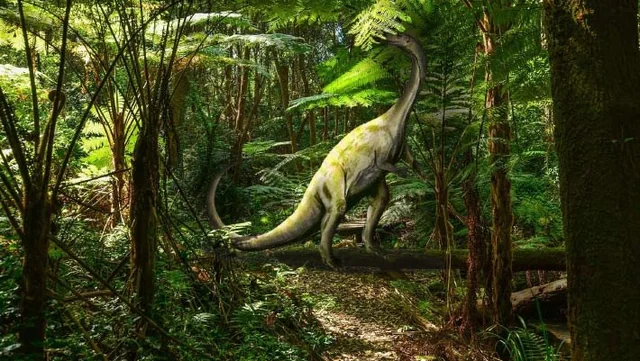
A Breakthrough at Cerro da Alemoa (Image Credits: Reddit)
The fossils emerged from the Cerro da Alemoa site within the Santa Maria Supersequence, specifically the Santa Maria Formation in Rio Grande do Sul state. This location falls in the Hyperodapedon Assemblage Zone, dating to the Carnian stage of the Late Triassic, roughly 237 to 227 million years ago. Researchers described the outcrop as a key record of the region’s geology and fauna.
A team led by Luciano Artemio Leal of the Universidade Estadual do Sudoeste da Bahia, along with Leomir Santos Campos, Átila Augusto Stock Da-Rosa, and Juliana Manso Sayão, recovered the disarticulated but associated bones. Housed as specimen UFSM11326 in the paleontological collection at LEP/UFSM, the find stands out for its exceptional small scale amid Brazil’s rich Triassic deposits. The site’s significance lies in its contribution to documenting early dinosaur diversity in Gondwana.
Dissecting the Delicate Remains
The collection includes a right humerus, a right metatarsal III, the proximal end of an ungual phalanx, an almost complete presacral neural arch, and a vertebral centrum. Every element measures less than 5.7 centimeters in length, marking them among the tiniest dinosaur fossils from Brazil’s Triassic rocks. Post-mortem deformation and abrasion affected some pieces, yet they retained enough detail for in-depth study.
- Right humerus: Features an extended deltopectoral crest.
- Metatarsal III: Notable for its distal width.
- Neural arch: Distinct diapophysis position and infracavities.
- Other elements: Confirm sauropodomorph traits.
These characteristics allowed precise anatomical comparisons. The bones point to a juvenile individual, smaller than many contemporaries even at this stage.
Osteohistology Reveals Interrupted Development
Thin sections from the humerus and metatarsal III exposed a compact cortical structure dominated by fibrolamellar bone, primarily woven tissue with longitudinal and reticular vascularization. Telltale signs included an annulus and a line of arrested growth (LAG), indicating at least one full cycle of growth pause. The dinosaur had completed its first arrest and reached midway through the second, confirming its youth.
“The observed features suggest an individual still in development, having already undergone its first growth arrest and being midway through its second cycle,” the researchers noted. This pattern differs from the rapid, uninterrupted expansion seen in later giants. Such flexibility early on could represent an adaptive strategy in Triassic environments.
Basal Position in Sauropodomorph Lineage
Phylogenetic analysis rooted the specimen firmly in the basal sauropodomorph clade, classified as genus and species indeterminate within a family of uncertain placement. It aligns with other Carnian-age sauropodomorphs from the region. Diagnostic traits in the humerus, metatarsal, and neural arch supported this assignment.
“A combined analysis of its morphology, osteohistology, and phylogeny positions it as a basal sauropodomorph from the Brazilian Triassic period,” the team stated. This placement underscores the global spread of early sauropodomorphs and their diversity in South America. Comparisons to species like Massospondylus carinatus highlight shared yet distinct features.
Reshaping Views on Early Evolution
The juvenile’s growth interruptions suggest early sauropodomorphs employed novel strategies, favoring smaller body plans during the Triassic. These pauses may have allowed adaptation to resource-scarce settings, setting the stage for Jurassic gigantism. The find enriches knowledge of dinosaur origins before their dominance.
“Our results provide evidence for novel growth strategies during the early evolution of this group, leading to the emergence of small-bodied dinosaurs in the Triassic,” the paleontologists concluded. Detailed in an upcoming Palaeoworld paper, the study bridges gaps in sauropodomorph developmental history. It prompts reevaluation of how these herbivores transitioned to colossal forms.
This Brazilian treasure redefines the humble beginnings of sauropod ancestors, proving that even the tiniest fossils hold transformative power. As research continues, such discoveries remind us of the intricate paths evolution took over millions of years. What do you think about these growth insights? Tell us in the comments.
Key Takeaways
- The fossils represent a juvenile basal sauropodomorph, among Brazil’s smallest Triassic dinosaurs.
- Osteohistology shows growth pauses via lines of arrested growth, indicating flexible development.
- The find illuminates early evolutionary strategies preceding sauropod gigantism.