Earth’s Triassic period dawned amid devastation from the end-Permian mass extinction, the deadliest event in history that wiped out over 80 percent of species. Survivors faced a supercontinent called Pangaea locked in extreme conditions, with scorching tropics acting as barriers to life. A recent study now shows that archosauromorph reptiles, precursors to dinosaurs and crocodiles, pushed through these hellish zones over distances up to 10,000 miles, unlocking new territories and evolutionary success.
Resilience Born from Catastrophe
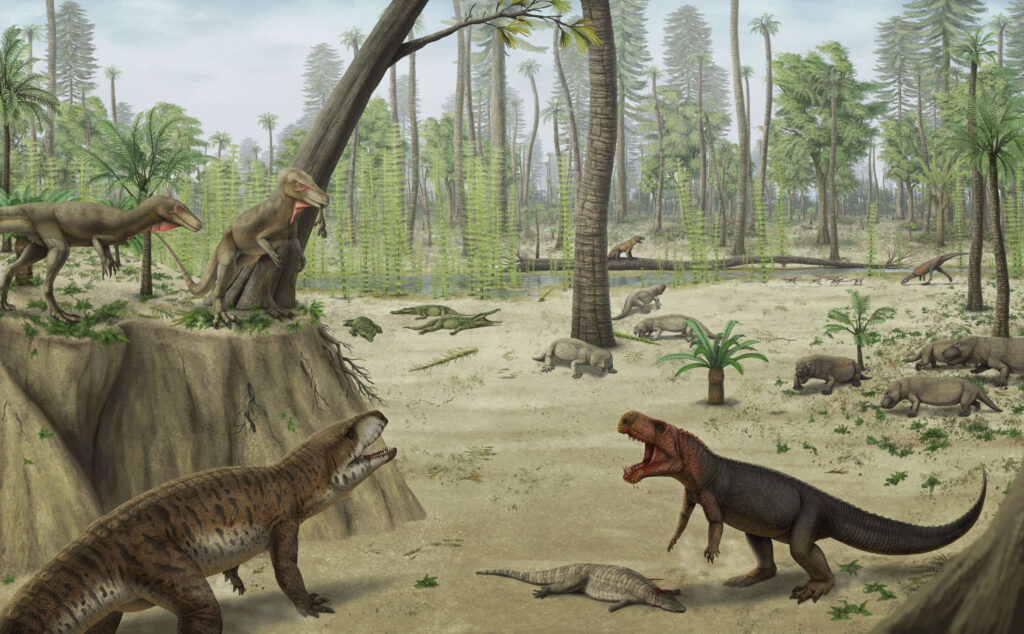
Resilience Born from Catastrophe (Image Credits: Reddit)
More than 250 million years ago, the end-Permian extinction claimed half of all land animals and 81 percent of marine species, leaving a post-apocalyptic landscape. Archosauromorphs emerged as unlikely victors, smaller and more reptile-like than the giants they would spawn. Their survival set the stage for migrations that reshaped ecosystems across Pangaea.
Researchers long puzzled over fossil gaps that hinted at unseen journeys. These reptiles did not merely persist; they ventured into regions once thought impassable. This tenacity allowed them to radiate globally during the Triassic, outpacing rivals.
Unveiling the Tropical Hellscape
Pangaea’s equatorial belt transformed into a “tropical dead zone” of unrelenting heat and drought, temperatures soaring beyond modern extremes. Scientists previously viewed this vast swath – stretching thousands of miles – as a barrier no tetrapod could cross. Yet archosauromorphs proved otherwise, enduring conditions that felled other lineages.
The zone spanned from what is now North America to southern China, a 10,000-mile gauntlet of arid badlands and seasonal monsoons turned lethal. Fossil evidence from coasts like the ancient Panthalassan Ocean supported the idea of transcontinental movement. Their adaptability to such hostility marked a turning point in vertebrate history.
TARDIS: Mapping Ancient Routes
A breakthrough came with TARDIS, a modeling system for “terrains and routes directed in space-time.” Developed by paleontologists at the University of Birmingham and University of Bristol, it merged fossil records, phylogenetic trees, and paleogeographic maps. This tool filled evidentiary voids, simulating dispersal paths with unprecedented precision.
Dr. Joseph Flannery-Sutherland, the study’s lead from Birmingham, explained the innovation: “Gaps in their fossil record have increasingly begun to tell us something about what we weren’t seeing when it comes to these reptiles. Using our modeling system, we have been able to build a picture of what was happening to the archosauromorphs in these gaps and how they dispersed across the ancient world.” The approach revealed migrations rivaling modern epic treks, confirming the reptiles’ hardiness.
- Integrated evolutionary trees with continent reconstructions.
- Quantified climate tolerances beyond fossil biases.
- Traced routes up to 16,000 kilometers long.
- Linked dispersal to post-extinction recovery patterns.
- Highlighted tropics as viable corridors, not walls.
Evolutionary Edge in the Fire
Professor Michael Benton of Bristol noted the methodological leap: “The evolution of life has been controlled at times by the environment, but it is difficult to integrate our limited and uncertain knowledge about the ancient landscape with our limited and uncertain knowledge about the ecology of extinct organisms. But by combining the fossils with reconstructed maps of the ancient world, in the context of evolutionary trees, we provide a way of overcoming these challenges.”
Flannery-Sutherland added: “Our results suggest that these reptiles were much hardier to the extreme climate of the Pangaean tropical dead zone, able to endure these hellish conditions to reach the other side of the world. It’s likely that this ability to survive the inhospitable tropics may have conferred an advantage that saw them thrive in the Triassic world.” This prowess propelled archosauromorphs to dominance, seeding dinosaurs’ rise by the Late Triassic.
Examples like Benggwigwishingasuchus underscore their reach, with fossils appearing far from origins. The study, detailed in Nature Ecology & Evolution (DOI: 10.1038/s41559-025-02739-y), reframes Triassic biogeography.
Key Takeaways:
- Archosauromorphs crossed 10,000 miles of deadly tropics post-extinction.
- TARDIS model bridges fossil gaps with spatial simulations.
- Their resilience fueled dinosaur and crocodile lineages.
This research illuminates how environmental gauntlets forge evolutionary winners. Archosauromorphs did not just survive – they conquered, setting Earth’s course for 165 million years of dinosaur reign. What lessons might this hold for life amid today’s climate shifts? Share your thoughts in the comments.