Heligoland, Germany – Northern gannets perched on sheer cliffs of this North Sea archipelago have begun incorporating plastic debris into their nests, a stark sign of marine pollution’s encroachment. Researchers recently captured images of nests laden with fishing lines, nets, and ropes, materials the birds mistake for seaweed and aquatic plants. This adaptation highlights broader challenges facing seabird populations amid rising ocean waste levels.
Nearly Every Nest Contains Marine Debris
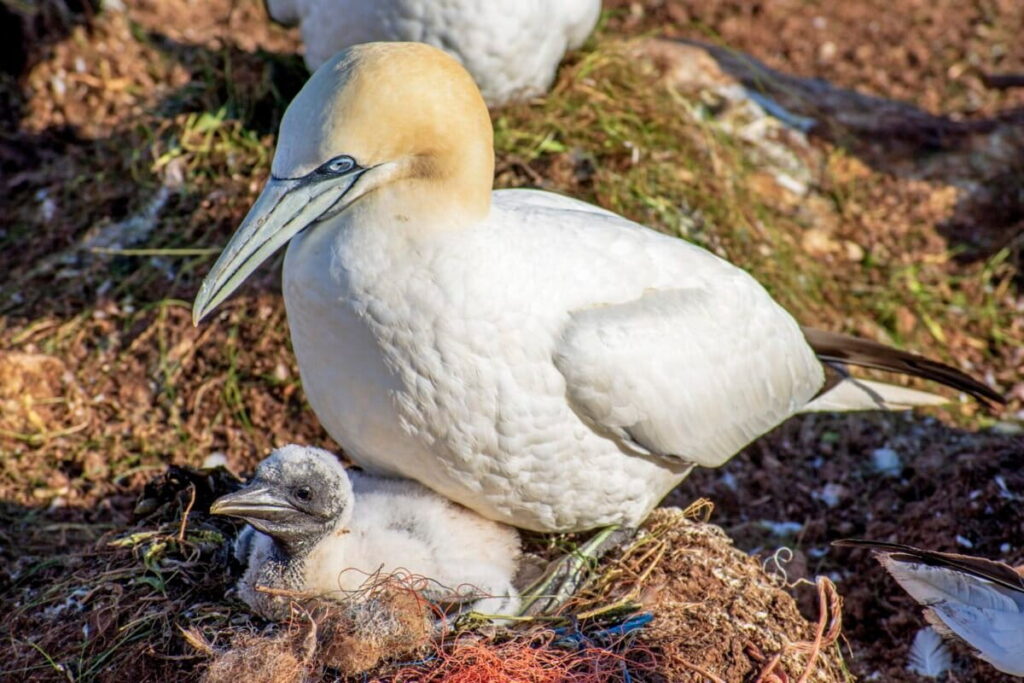
Nearly Every Nest Contains Marine Debris (Image Credits: Mongabay)
An estimated 98 percent of northern gannet nests on Heligoland hold plastic waste, amounting to 1.6 tons of marine litter across the colony. The Lummenfelsen nature reserve hosts 600 to 700 breeding pairs each year from March to October, Germany’s sole colony for this species since the 1990s. Some individual nests weigh more than 3 kilograms of plastic alone.
Threadlike plastics dominate, including dolly ropes from bottom-trawling fisheries and nylon yarns from fishing gear. Gannets collect these items at sea, confusing them with natural nesting materials like algae, grass, feathers, and mud. Martin Brogger, a researcher from Argentina’s Institute of Marine Organisms Biology, documented such nests during a visit to the island.
From Traditional Builds to Synthetic Structures
Northern gannets, or Morus bassanus, traditionally constructed nests from seaweed and other floating vegetation gathered during foraging dives. These large seabirds, spanning the northern Atlantic, return annually to the same cliff ledges to raise a single chick. Plastic integration marks a recent shift as ocean debris proliferates.
A 2021 analysis of over 10,000 seabird nests across five northwest European countries revealed that 12 percent incorporated plastic. Earlier surveys at Heligoland showed 100 percent of nests affected as far back as 2005. The trend persists, with gannets now favoring synthetic ropes over natural alternatives in many cases.
Deadly Consequences for Breeding Birds
Plastic in nests poses severe risks, particularly to juveniles and inexperienced adults. Entanglement in loose ropes and nets prevents hunting or flying, leading to starvation or strangulation. Approximately 14 birds perish daily on Heligoland from these incidents.
Chicks face additional threats when parents inadvertently feed them plastic fragments. Across Europe, five seabird species exhibit this behavior, compromising breeding success and chick survival. Populations already decline due to such pollution alongside other pressures like food scarcity.
| Species | Percentage of Nests with Plastic |
|---|---|
| Herring gull | 32% |
| Great black-backed gull | 53% |
| European shag | 80% |
Challenges in Conservation and Cleanup
Efforts to remove embedded plastic from nests prove counterproductive. Disturbing structures risks greater harm to breeding pairs and invites fresh debris collection, heightening entanglement odds. Local scientists advise against direct intervention on Heligoland.
- Annual North Sea plastic input reaches 20,000 tons, with 600,000 cubic meters afloat.
- Ghost nets demand specialized divers for retrieval, at high cost.
- Decomposition spans over 400 years, complicating recycling.
- Pollution impacts seals, whales, dolphins, turtles, fish, and land animals.
Conservation photography, like projects by Lana Tannir, raises awareness to spur policy changes and public action against marine litter sources, especially fishing gear.[1][2]
Key Takeaways
- 98% of Heligoland gannet nests contain plastic, totaling 1.6 tons.
- Daily deaths from entanglement average 14 birds.
- Broader European studies show 12% of seabird nests affected, with risks to chicks.
Northern gannets’ plastic nests serve as a visible warning of plastic’s infiltration into food webs and ecosystems. Reducing upstream sources through better waste management and fishing practices offers the path forward. What steps can communities take to curb marine debris? Tell us in the comments.