Petrified Forest National Park, Arizona — Fossils unearthed from a rich bonebed in the Chinle Formation have unveiled Sonselasuchus cedrus, a peculiar crocodile-line archosaur that underwent a striking transformation during its lifetime. This Late Triassic reptile, dating back about 215 million years, began life walking on four legs before shifting to a bipedal stance as an adult. Researchers determined this change through detailed analysis of limb proportions across numerous specimens, highlighting the diversity of ancient archosaurs.
A Treasure Trove of Fossils at Kaye Quarry
A Treasure Trove of Fossils at Kaye Quarry (Image Credits: Facebook)
Excavations at Kaye Quarry, located in the Sonsela Member of the Chinle Formation, began in 2014 and have yielded over 3,000 fossils to date. The site produced more than 950 disarticulated bones belonging to Sonselasuchus cedrus, representing a minimum of 36 individuals, most of them skeletally immature. This multitaxic bonebed also contains remains of fish, amphibians, dinosaurs, and other reptiles, with no signs of depletion even after a decade of work.
Tom Kaye first discovered the material, which paleontologists Elliott Armour Smith and Christian A. Sidor formally described in 2026. The holotype specimen, a left maxilla cataloged as PEFO 47305/UWBM 119436, helped diagnose the new genus and species. Sidor noted the site’s productivity: “Since starting fieldwork at Petrified Forest in 2014, we have collected over 3,000 fossils from the Sonselasuchus bonebed, and it doesn’t seem to show any signs of petering out.”
Distinctive Features of a Shuvosaurid Oddity
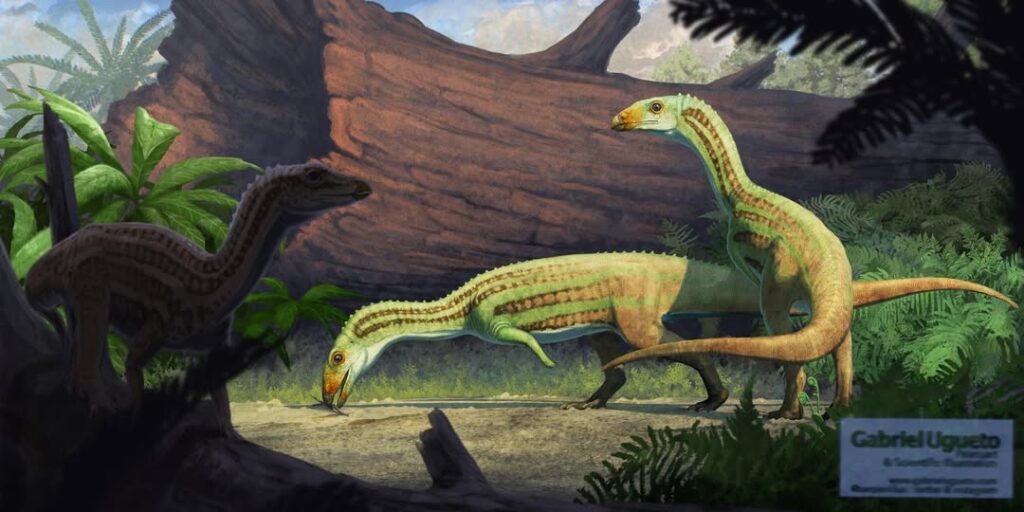
Sonselasuchus cedrus belonged to Shuvosauridae, a group of poposauroid pseudosuchians known for their convergence with ornithomimid theropod dinosaurs. The reptile stood about 25 inches tall, roughly the size of a poodle, with a toothless beak likely covered in keratinous rhamphotheca, large eye sockets, and hollow bones. Its skull featured unique maxillary traits, such as a reduced body, enlarged subnarial foramen, and expanded posterior process.
Postcranial elements closely resembled other shuvosaurids, though subtle differences emerged. The name honors the Sonsela Member and the Egyptian crocodile deity Sobek, while “cedrus” references nearby Cedar Tank and the juniper-dominated Late Triassic forests where the animal lived. Phylogenetic analysis placed it in an unresolved clade with Effigia okeeffeae and Shuvosaurus inexpectatus.
The Ontogenetic Locomotion Revolution
Juvenile Sonselasuchus specimens displayed forelimbs and hindlimbs of more equal proportions, suggesting quadrupedal locomotion early in life. As individuals matured, hindlimbs grew longer and more robust, while forelimbs followed a negative allometric trajectory, shrinking relatively from about 75 percent to 50 percent of hindlimb length. This pattern indicated a shift to bipedalism in adulthood, with larger femurs supporting upright posture.
Armour Smith explained: “By analyzing the proportions of the limb skeletons of different animals, we determined its bipedal stance may have been the result of a differential growth pattern. We think that Sonselasuchus cedrus had more proportional forelimbs and hindlimbs as young, and their hindlimb grew longer and more robust through adulthood. Essentially, we think these creatures started out their lives on four legs… they then started walking on two legs as they grew up. This is particularly peculiar.” Such a transition echoed rare patterns seen in some early dinosaurs but marked a first for croc-line archosaurs.
Echoes of Convergence in Ancient Ecosystems
Shuvosaurids like Sonselasuchus shared striking similarities with bird-line ornithomimids, including bipedalism, edentulous beaks, hollow bones, and large orbits. These traits evolved independently, driven by overlapping ecological niches in Late Triassic floodplains and forests.
- Bipedal posture for efficient movement.
- Toothless beak suited for plant material or small prey.
- Hollow bones reducing weight for speed.
- Enlarged orbits possibly aiding vision in dim forest understories.
Michelle Stocker of Virginia Tech described shuvosaurids as “absolute weirdos that live in the late Triassic. They really look like dinosaurs.” Armour Smith added that “croc-line and bird-line archosaurs evolved in the same ecosystems and converged upon similar ecological roles.” Shuvosaurids persisted as key players in North American faunas throughout the period.
Key Takeaways
- Sonselasuchus cedrus shifted from quadrupedal juveniles to bipedal adults via limb growth disparities.
- Over 950 fossils from 36+ individuals highlight a rare ontogenetic study opportunity.
- Convergence with ornithomimids underscores parallel evolution in Triassic ecosystems.
This discovery challenges assumptions about archosaur diversity and locomotion evolution, reminding us that croc-line reptiles pioneered traits later popularized by dinosaurs. As excavations continue, more secrets from these ancient forests may emerge. What do you think about this bipedal croc relative? Tell us in the comments.