Céreste, southern France – Scientists recently unveiled a stunning fossil that captures the delicate beauty of an emperor butterfly from 34 million years ago. Discovered in early Oligocene lake deposits, the specimen known as Apaturoides monikae offers the first definitive evidence of the Apaturinae subfamily fluttering amid ancient woodlands and waterways. This well-preserved find, housed in museum collections for decades, now reshapes understandings of butterfly evolution during a time of dramatic environmental change.
One of the Best-Preserved Butterfly Fossils on Record
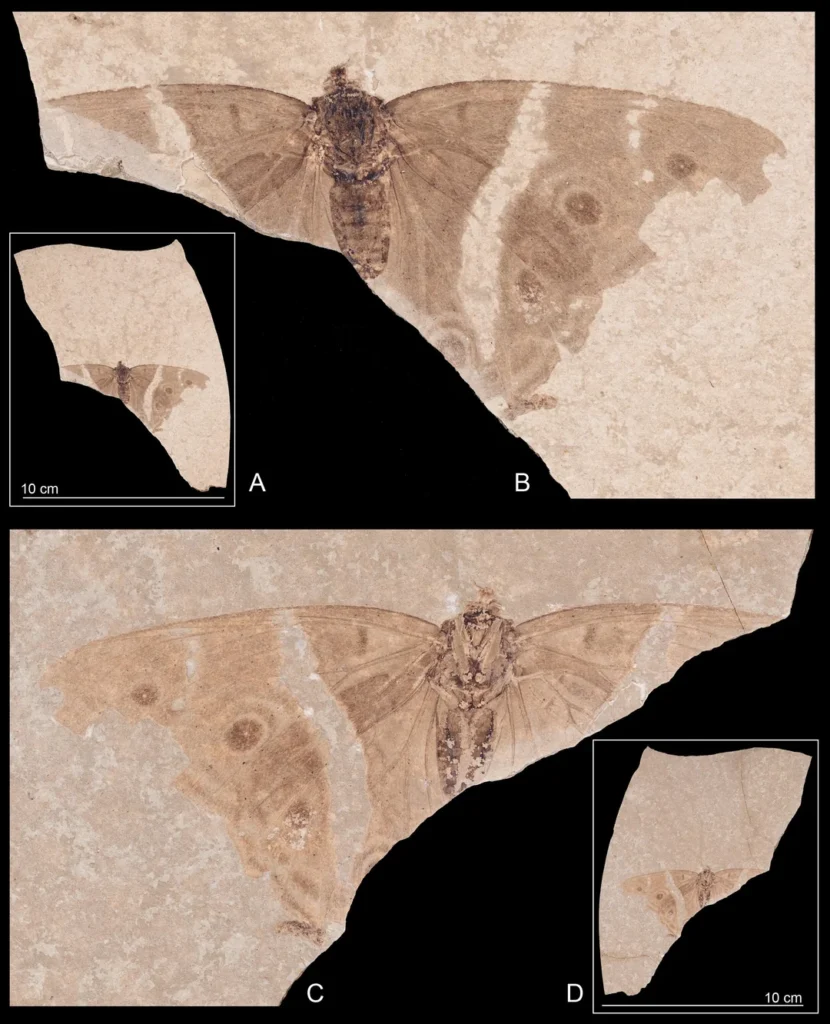
One of the Best-Preserved Butterfly Fossils on Record (Image Credits: Reddit)
Researchers identified Apaturoides monikae as a new genus and species after re-examining a specimen collected in 1979 by Herbert Lutz from the Campagne-Calavon Formation. The fossil emerged from laminated limestones in the Luberon UNESCO Global Geopark, a site renowned for its rich array of ancient life forms. What sets this discovery apart lies in its exceptional condition. Most of the right wing and significant portions of the left wing remain intact, revealing complete venation and subtle patterns like eyespots.
The head, thorax, and much of the abdomen also survived, with details such as a well-developed proboscis measuring about 0.9 mm and scaled thorax visible from both sides. Such preservation rarely occurs because butterfly wings typically disintegrate over time. Lead author Hossein Rajaei noted, “These exceptional features allow for precise classification in the butterfly family tree.”
Detailed Anatomy Echoes Modern Emperors
The butterfly boasted a wingspan of roughly 90 mm, with a forewing length of 41 mm and a rounded apex. Dark streaks lined the wing margins, complemented by grey bands and multiple eyespots – two on the forewing and three on the hindwing. Venation patterns closely mirrored those in the modern genus Apatura, though differences in wing shape and angle distinguished it as a unique extinct lineage.
- Forewing: Open cell, stalked R3–5 veins, eyespots between M1-M2 and CuA1-CuA2.
- Hindwing: Waved termen, three eyespots, CuA2 originating midway from base.
- Body: Thick short abdomen, non-reduced forelegs, uncoiled haustellum.
- Antennae: Right side with four basal segments preserved.
These traits placed Apaturoides monikae firmly within Nymphalidae’s Apaturinae subfamily, resembling Palearctic emperors but representing a stem group.
A New Anchor for Evolutionary Timelines
This fossil supplies a crucial minimum age for Apaturinae diversification, dated to the Rupelian stage between 33.9 and 28.4 million years ago. Molecular studies previously estimated the Apatura-clade split around 33 million years ago, but placed Apatura itself at 16 million years – far younger than this evidence suggests. The specimen challenges those timelines, indicating either older origins or remarkable trait conservation in living species.
Hossein Rajaei explained, “This fossil find suggests that the Apatura lineage is either older than molecular analyses suggest, or that today’s Apatura species have preserved characteristics of their ancestors over long periods of time.” Professor Torsten Wappler emphasized the role of museum holdings: “This discovery highlights the importance of protected fossil deposits and the enduring value of museum collections.” The international team, including experts from Germany, Sweden, and the US, published findings in Acta Palaeontologica Polonica in 2026.
Life Amid Oligocene Lakes and Forests
The Campagne-Calavon Formation preserved Apaturoides monikae in a lacustrine setting of calm, shallow lakes with varying salinity. Surrounding prehistoric forests teemed with diverse life, as evidenced by associated fossils of mammals, birds, fish, plants, and insects. Emperor butterflies likely nectar-fed in this vibrant ecosystem, their iridescent wings flashing through woodland canopies.
Such deposits offer snapshots of post-Eocene recovery, when cooling climates fostered new insect radiations. This butterfly’s presence hints at early Apaturinae dispersal from Southeast Asia to Europe, predating later migrations to Africa and the Americas.
Key Takeaways
- First Apaturinae fossil calibrates evolution to at least 34 million years ago.
- Exceptional preservation reveals venation, patterns, and body details matching modern Apatura.
- Underscores value of reanalyzing historical collections for new insights.
This emperor butterfly fossil not only bridges gaps in lepidopteran history but also reminds us how fragile records of the past endure in stone. What secrets might other museum drawers still hold? Tell us in the comments.