When most people think of prehistoric terror, their minds immediately jump to towering dinosaurs stomping across dry land. T. rex with its bone-crushing jaws, Spinosaurus with its sail-like back. Those are the creatures that dominate films, toy aisles, and school projects. Honestly, it makes sense. Dinosaurs are photogenic monsters.
Here’s the thing though: they were land-bound. The moment you step into the ancient ocean, you enter a world that makes any land predator look almost… quaint. The seas of the Mesozoic were ruled by creatures that could dwarf a city bus, bite through solid bone in a single snap, and hunt using senses we still don’t fully understand. You think a T. rex is scary? Wait until you meet what was lurking beneath the waves. Let’s dive in.
Mosasaurus: The Ocean’s Ultimate Killing Machine
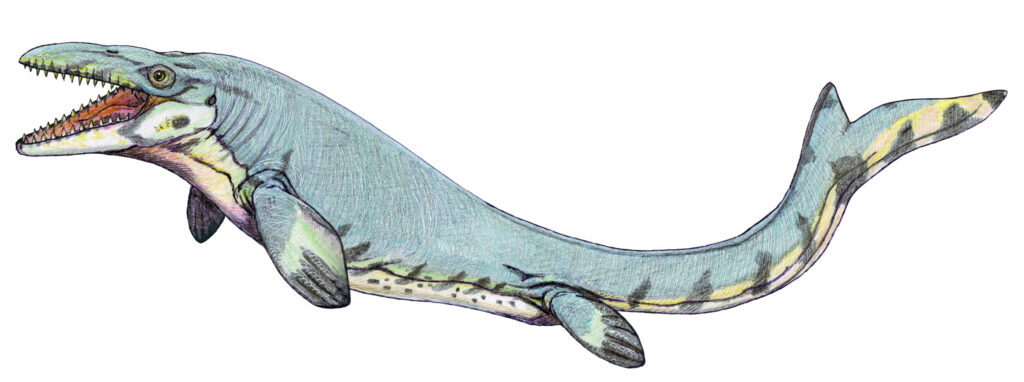
You’ve probably seen it in Jurassic World, and yes, that version is far bigger than reality. Still, the real animal is nothing short of jaw-dropping. Mosasaurs were a group of marine lizards that lived roughly 75 to 69 million years ago, and when they were alive, they could reach lengths of up to 50 feet, roughly the length of a bus. That’s not a movie exaggeration. That’s a real, scales-and-teeth, air-breathing predator built like a scaled-up monitor lizard with paddle limbs and a power tail.
Mosasaurus was likely endothermic and maintained a constant body temperature independent of the external environment, though direct evidence specific to the genus is lacking. Think about what that means in practical terms: this was essentially a warm-blooded sea monster, one that could remain active and aggressive in cold waters where most cold-blooded rivals would have slowed down. Mosasaurus fossils have been found in North and South America, Europe, Africa, Western Asia, and Antarctica, spanning a wide range of oceanic climates including tropical and subpolar. It was a common large predator, positioned at the top of the food chain.
Paleontologists have discovered the preserved remains of mosasaur stomachs containing food like fish, sharks, cephalopods, birds, and even other mosasaurs. It is likely that mosasaurs were not picky and would eat pretty much anything that could fit into their enormous mouths. And those mouths were extraordinary. Some mosasaurs had long, narrow jaws designed for catching fish, while others possessed crushing teeth capable of breaking through the hard shells of ammonites. Imagine a predator so versatile it could crack through armored prey like we crack walnuts.
Several fossils document deliberate attacks on Mosasaurus individuals by members of the same species, with fighting likely taking place in the form of snout grappling, as seen in modern crocodiles. These animals were so aggressive they routinely attacked each other. I think that alone tells you everything you need to know about just how intense the ancient oceans really were.
Kronosaurus: The Titan With Banana-Sized Teeth
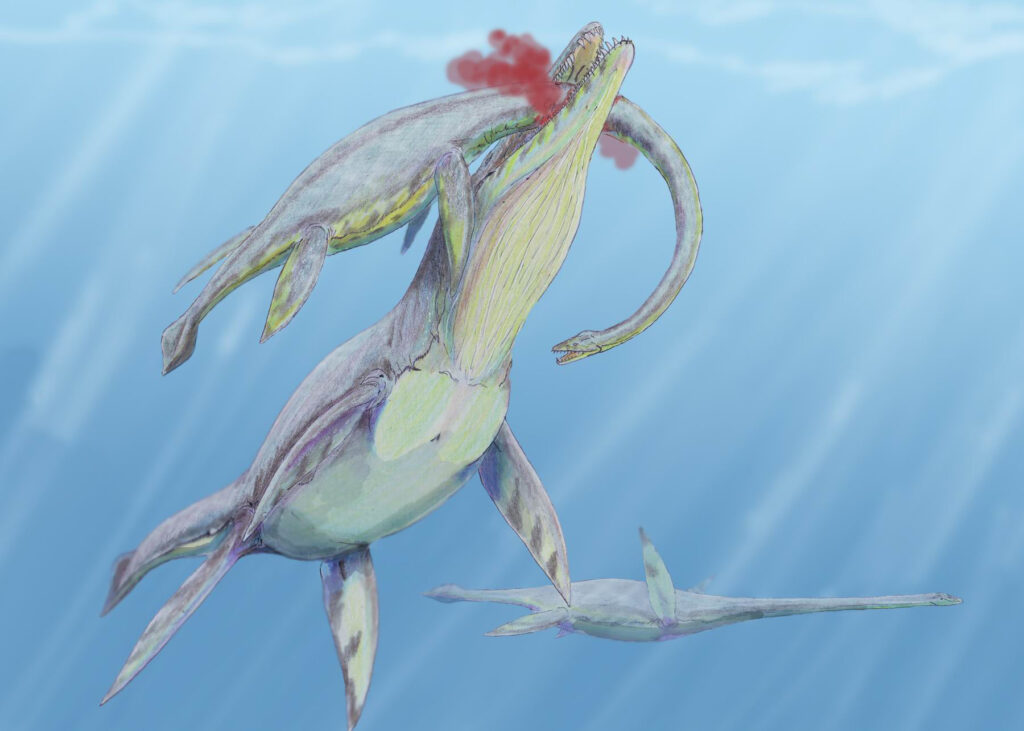
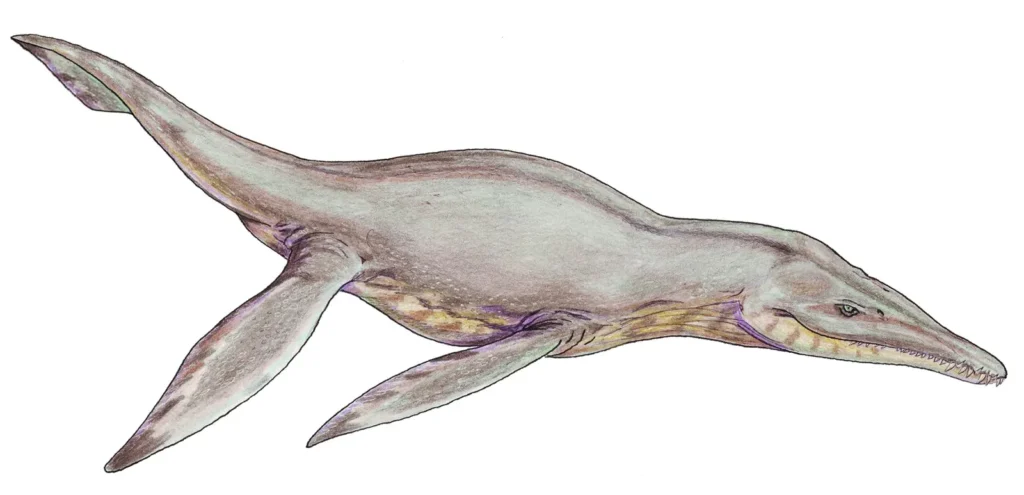
Named directly after Kronos, the king of the Titans in Greek mythology, this creature more than earns the reference. Kronosaurus lived during the Early Cretaceous Period and was one of the largest genera of pliosaur, reaching about 9 to 10 meters in total body length, and was probably one of the top undersea predators of its time. Picture something the length of two family cars placed end to end, built like a torpedo, and driven by four enormous paddle-like flippers. Now give it a skull nearly the size of a dining table.
It used teeth the size of bananas to feast on ichthyosaurs, other plesiosaurs, turtles, and fish. Let that image settle for a moment. Banana-sized teeth. Not for show either. Large, round bite-marks have been found on the skull of an Albian-age Australian elasmosaurid that could be from a Kronosaurus attack. The forensic evidence of its predatory life is literally carved into the bones of its victims, found millions of years later by paleontologists who were just as stunned as you are right now.
Feeding on marine reptiles, sharks, fish, large squid, and turtles, Kronosaurus weighed in at up to 28,000 pounds and measured up to 34 feet long. The world’s only mounted Kronosaurus skeleton is at the Harvard Museum of Natural History. Honestly, that mounted skeleton must be one of the most humbling objects in any museum on Earth. Kronosaurus had special air chambers on its snout that were used to scent prey in the same way a pair of ears work, pinpointing exactly where a smell is coming from. You could not hide from this thing. It would smell you coming.
The largest pliosaurs, such as Kronosaurus, Liopleurodon, and Predator X, were undoubtedly pelagic hunters, living out their lives in the deeper waters, and because their size rivaled that of modern whales, stranding on shore would have been deadly. These were pure ocean killers. No coming ashore. No escaping into shallow water. Their entire existence was built around domination of the deep.
Pliosaurus funkei: The Predator That Made T. Rex Look Tame
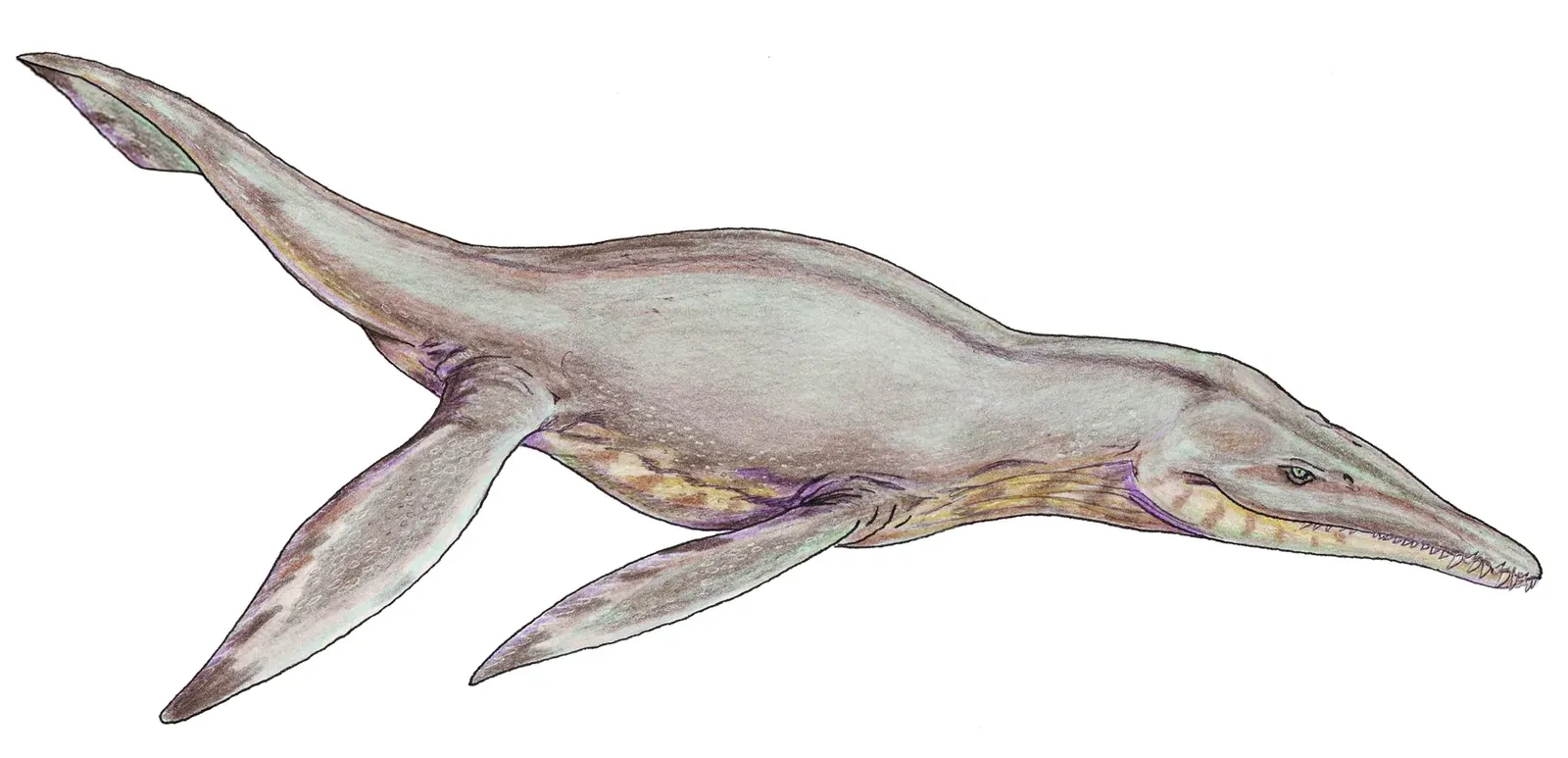
It is hard to say for sure exactly how large “Predator X” actually grew, but even the most conservative estimates are staggering. This giant marine reptile, now named Pliosaurus funkei, spanned about 40 feet and had a massive skull with a bite four times as powerful as Tyrannosaurus rex. Four times. That is not a rounding error or a rough estimate. That is the kind of difference that redefines what you mean by the word “powerful.” A T. rex bite is already the stuff of nightmares, and this creature multiplied it.
Between 2004 and 2012, a University of Oslo team uncovered two big pliosaurs on the Arctic island of Svalbard. The only pliosaur material previously found there was a part of a tail vertebra, making the discovery of two specimens a major boon. The fossil recovery was nothing short of extraordinary. Highly fragmentary remains were found, and an effort began to recover the fossils from Spitsbergen in the Svalbard archipelago, with the fragments numbering around 20,000 pieces in number, slowly coming together to form a particularly huge pliosaur. That is 20,000 fragments pieced together, literally like a three-dimensional jigsaw puzzle from the deep past.
Pliosaurus is interpreted by paleontologists as a marine predator at the top of the food chain, with powerful cranial musculature that gave it an exceptionally strong bite. Unlike some relatives better adapted to small, mobile prey, Pliosaurus appeared to favor a predatory strategy based on short, targeted bites delivered to the back of the jaw where the force of pressure was greatest. This was a precision killer. Not just brute strength, but calculated, anatomically engineered lethality. It likely captured a wide variety of marine prey, ranging from medium-sized fish to smaller marine reptiles, subduing them by firmly immobilizing with its robust jaws before crushing or swallowing them, a strategy characteristic of a generalist predator of the Jurassic seas.
For more than 80 million years, the pliosaurs were the apex predators of the world’s oceans, feasting on all manner of prey from large fish to other marine reptiles, including their close cousins the plesiosaurs. There is also fossilized gut content showing that some pliosaurs scavenged dinosaur carcasses that had washed out to sea. Yes. You read that correctly. Even dinosaurs were not safe from what prowled the ocean.
Liopleurodon: The Ambush Artist of the Jurassic Seas
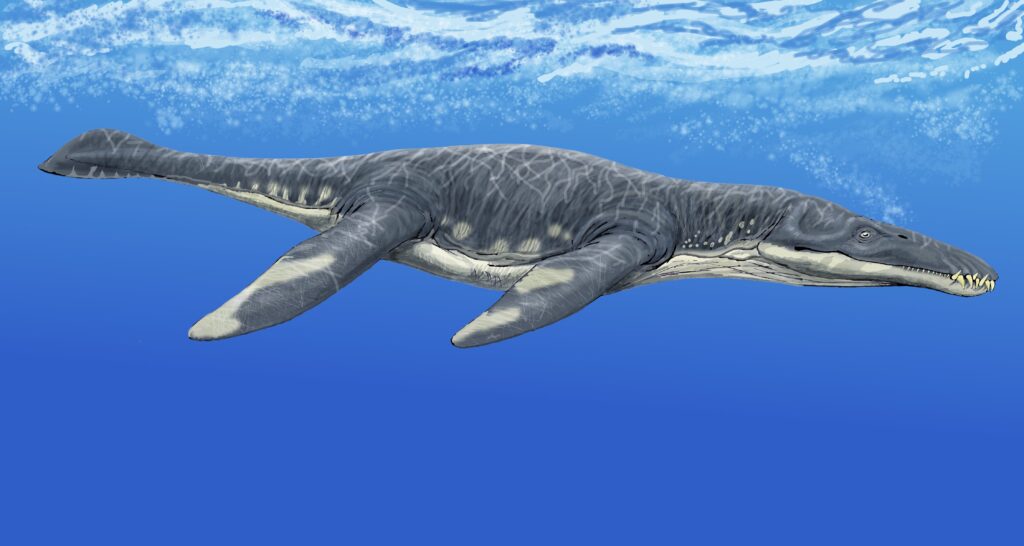
Let’s be real: Liopleurodon has something of a complicated reputation in paleontology. A famous BBC documentary once depicted it as a 25-meter sea monster, which turned out to be a wild exaggeration. In 1999, its size was greatly exaggerated in the BBC documentary series Walking with Dinosaurs, where it was depicted as reaching 25 meters in length. However, different attributed specimens show that the animal could reach a size ranging from 4 to 8 meters long, with some researchers estimating a maximum length of approximately 10 meters. Even at the more modest end, though, do not let that fool you for a second.
Various studies show that Liopleurodon would have been an ambush predator, feeding on fish, cephalopods, and other marine reptiles. Think of it like the ocean’s version of a great white shark, but with four powerful flippers and a set of long, smooth-sided teeth. A study involving a swimming robot demonstrated that although this form of propulsion is not especially efficient, it provides very good acceleration, a desirable trait in an ambush predator. Studies of the skull have also shown it could probably scan the water with its nostrils to ascertain the source of certain smells. It could smell you. It could accelerate in a heartbeat. And you likely would not see it coming until far too late.
The Liopleurodon was probably the most ferocious of the pliosaurs, with evidence suggesting this ambush predator had a lower jaw with the longest tooth ever on the front, capable of tearing the flesh of other predators. The Jurassic oceans were essentially its private hunting ground. The Liopleurodon lived in Europe from 165 to 155 million years ago and possibly longer. That is roughly ten million years of reign as a top predator, an almost incomprehensible stretch of time for any species to dominate an ecosystem.
Pliosaurs are classified in the order Plesiosauria along with their long-necked relatives and possessed powerful jaws and large teeth, using four large fins to swim through Mesozoic seas. Everything about this animal was engineered for one purpose: finding prey and consuming it. It is a masterpiece of evolutionary design, and I find it quietly terrifying that something this efficient simply disappeared from our oceans forever.
Elasmosaurus: The Long-Necked Nightmare You Cannot Outswim
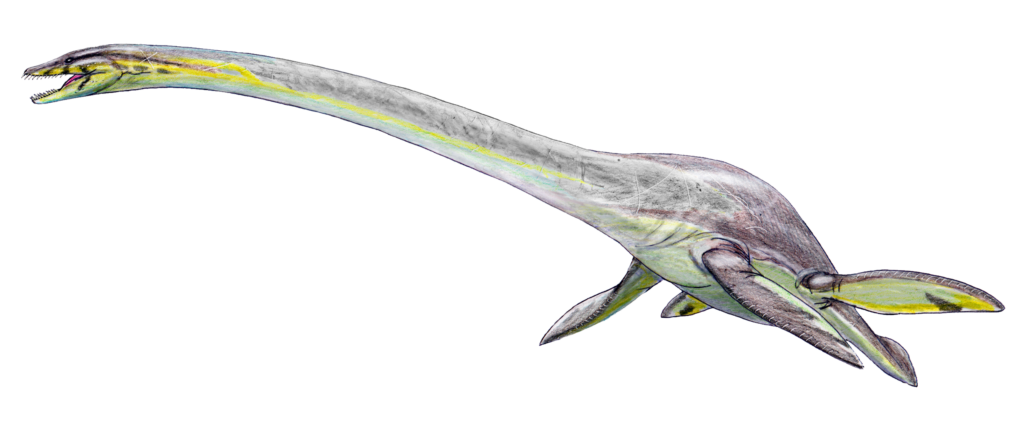
You might wonder what makes a creature terrifying if it is not purely a raw-power predator. Elasmosaurus answers that question in the most unsettling way possible. Elasmosaurus was a plesiosaur with 72 neck vertebrae, giving it a neck that was more than seven meters long. Seven meters of neck. Its overall body reached around 14 meters in length, meaning the neck alone made up the majority of the animal. Imagine seeing that silhouette gliding toward you through the water.
The long necks of elasmosaurids are composed of a large number of cervical vertebrae, and in Elasmosaurus these number 71, more than in other plesiosaurs including fellow elasmosaurids. This sheer number of vertebrae not only extended the length of the neck but also gave greater flexibility for fine control of the head. The Elasmosaurus was an extremely large variation of a plesiosaur that lived primarily during the Late Cretaceous period, and so long was the neck on this creature that it was rarely able to raise its head above water for any extended period of time. That detail alone transforms your mental image entirely. This was a creature that hunted entirely underwater, using that astonishing neck to steer its head into schools of fish with precision.
Elasmosaurus’ neck is so extreme that it caused confusion for more than a century. When the famous paleontologist Edward Drinker Cope named Elasmosaurus, he believed that the neck was so long that it was actually the tail. This meant he ended up putting the skull on the wrong end of the animal. Even the scientists who first studied it got confused about which end was which. That is the kind of anatomical strangeness that should genuinely unsettle you.
Plesiosaurs were a group of marine reptiles with boat-like bodies and four flippers. There were long-necked plesiosaurs and short-necked plesiosaurs, and they lived from the Triassic period until they went extinct alongside the non-avian dinosaurs at the end of the Cretaceous period. Elasmosaurus survived for an extraordinarily long time, thriving in ancient seas where smaller, unlucky creatures swam directly into range of that slow, flexible, impossibly long neck. Think of it as nature’s most patient predator.
Conclusion
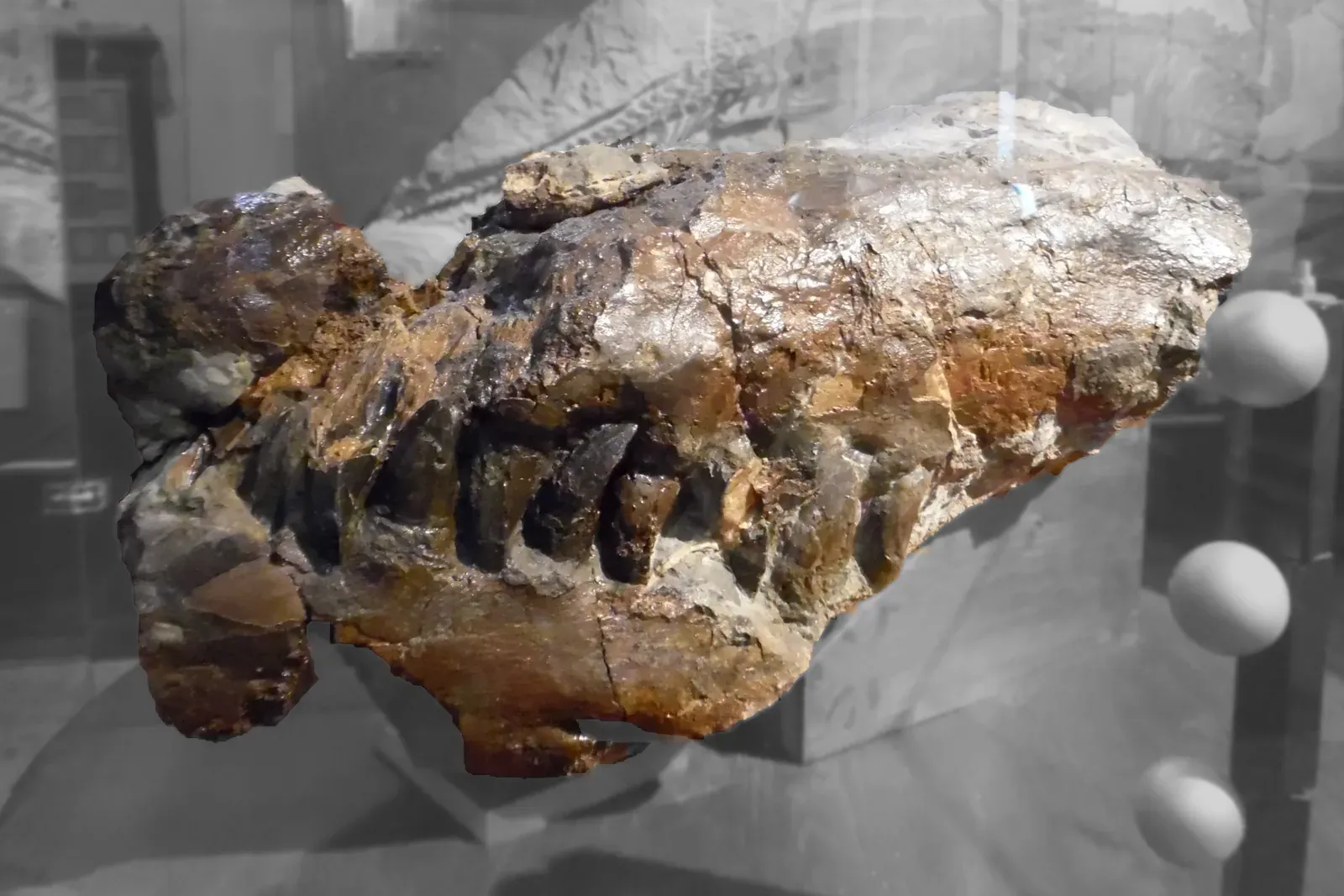
So there you have it. Five creatures that make even the most fearsome land dinosaur look almost manageable by comparison. From the warm-blooded killing efficiency of Mosasaurus to the banana-toothed dominance of Kronosaurus, from the four-times-T-rex bite of Pliosaurus funkei to the stealth ambush genius of Liopleurodon, and the quietly surreal nightmare of Elasmosaurus with its impossible neck, the ancient oceans were a genuinely different kind of terrifying.
What strikes me most about all of these animals is not their size, shocking as that is. It is the sheer variety of ways evolution found to build an apex predator. Each of these creatures took a completely different approach to dominating the sea, and each of them was breathtakingly good at it. The dinosaurs get all the glory, but honestly? Millions of years ago, stepping into the ocean would have been far more dangerous than anything walking on land.
So next time you’re at the beach, wading into the surf, maybe spare a quiet thought for what once ruled those waters. Did you ever expect the ocean’s ancient monsters to be this spectacular?