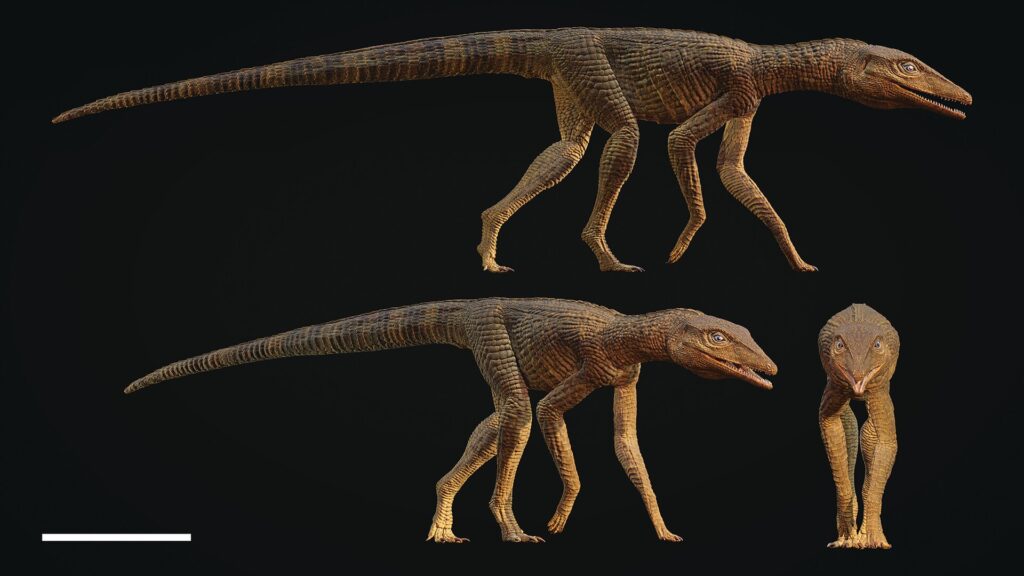
Gloucestershire, UK – Researchers have unveiled a remarkable fossil from the Late Triassic period that challenges assumptions about early crocodile evolution. This slender predator, known as Galahadosuchus jonesi, dashed across dry landscapes 215 million years ago with the agility of a greyhound. Unlike the ambush hunters of today, it thrived entirely on land, pursuing small prey through vegetation in a world of arid uplands and rocky karsts.
A Sprinting Predator Emerges from the Fossils
A Sprinting Predator Emerges from the Fossils (Image Credits: Wikimedia)
The discovery began in 1969 when collector Ron Croucher unearthed remains at Cromhall Quarry near Gloucester. These bones lingered in the Natural History Museum in London for decades, initially thought to belong to another species. Detailed CT scans and comparisons by PhD student Ewan Bodenham revealed 13 key differences, confirming a new member of the crocodylomorph group.
Bodenham’s analysis highlighted its cat-sized frame and lightweight build. A thigh bone measuring about 2.5 inches underscored its gracile form, optimized for rapid movement rather than wallowing in water. This non-crocodyliform ancestor belonged to the Saltoposuchidae family, showcasing the diverse body plans of early relatives of modern crocodiles.
Body Built for the Chase
Long, slender legs positioned directly beneath its body granted an upright stance, far removed from the sprawling limbs of contemporary crocodiles. Shorter, stockier wrist bones and a distinct femur with a medially directed head enhanced stability during sprints. Leaf-shaped osteoderms provided armor without excess weight, allowing agile navigation through undergrowth.
Scientists describe it as a “reptilian greyhound,” emphasizing its narrow body, lightweight skull, and cursorial adaptations like a crurotarsal ankle joint. These features enabled it to weave through vegetation, hunting small reptiles, amphibians, and early mammals in relatively dry environments. Its toothy snout and scaly skin evoked crocodilian familiarity, yet its lifestyle diverged sharply from aquatic norms.
- Slender, elongated limbs for speed
- Upright posture akin to dogs
- Lightweight frame, roughly cat-sized
- Distinct wrist and femur for agile locomotion
- Leaf-shaped osteoderms for flexible protection
Life in Triassic Britain’s Rugged Wilds
The fossils came from fissure deposits along the Bristol Channel, where surface animals washed into caves during rare rains. This preserved a snapshot of Late Triassic ecosystems on hot, arid plains dotted with uplands and limestone karsts. Galahadosuchus jonesi shared these lands with relatives like Terrestrisuchus gracilis and small vertebrates such as Kuehneosaurus and Thecodontosaurus.
As a fully terrestrial hunter, it stalked prey across open ground and rocky terrain, far from the subtropical seas nearby. This diversity of fast-moving predators hinted at specialized niches before the Triassic-Jurassic mass extinction, triggered by volcanic upheavals that reshaped the climate. The species illuminated how crocodylomorphs experimented with land-based strategies millions of years ago.
A Name Honoring Inspiration and Upright Grace
The genus “Galahadosuchus” draws from Sir Galahad of Arthurian legend, symbolizing the creature’s moral uprightness mirrored in its posture. The species epithet “jonesi” pays tribute to David Rhys Jones, Bodenham’s secondary school physics teacher in Wales. “Mr. Jones was just such a good teacher… genuinely interested in the sciences,” Bodenham recalled.
The findings appeared in The Anatomical Record in February 2026, detailed in a paper titled “A second species of non-crocodyliform crocodylomorph from the Late Triassic fissure deposits of southwestern UK.”The Anatomical Record Such recognition underscores the personal drives behind paleontological breakthroughs.
Key Takeaways
- Galahadosuchus jonesi reveals early crocodylomorphs’ terrestrial prowess, distinct from modern aquatic forms.
- Its greyhound-like build supported speed in arid Triassic uplands, hunting small vertebrates.
- The discovery expands Saltoposuchidae diversity, prefiguring mass extinction ecosystems.
This “reptilian greyhound” reminds us that crocodile lineages once embraced speed over stealth in water. As studies continue, such fossils bridge gaps in our understanding of prehistoric adaptability. What do you think about these land-loving croc ancestors? Tell us in the comments.