Picture a world where every continent you know – every ocean, every mountain range, every desert – was crammed into a single colossal landmass. No Atlantic. No Indian Ocean. Just one giant stretch of rock, surrounded by an endless sea. That was Pangea, and for hundreds of millions of years, it ran the show when it came to Earth’s climate.
Pangea is Earth’s most recent supercontinent, which existed roughly 320 million to 195 million years ago. You might think a single landmass would make for a simple, uniform climate. Think again. What Pangea actually created was one of the most extreme, complex, and fascinating climate systems our planet has ever seen. Let’s dive in.
A World Assembled: The Birth of Pangea and Its Immediate Climate Shock
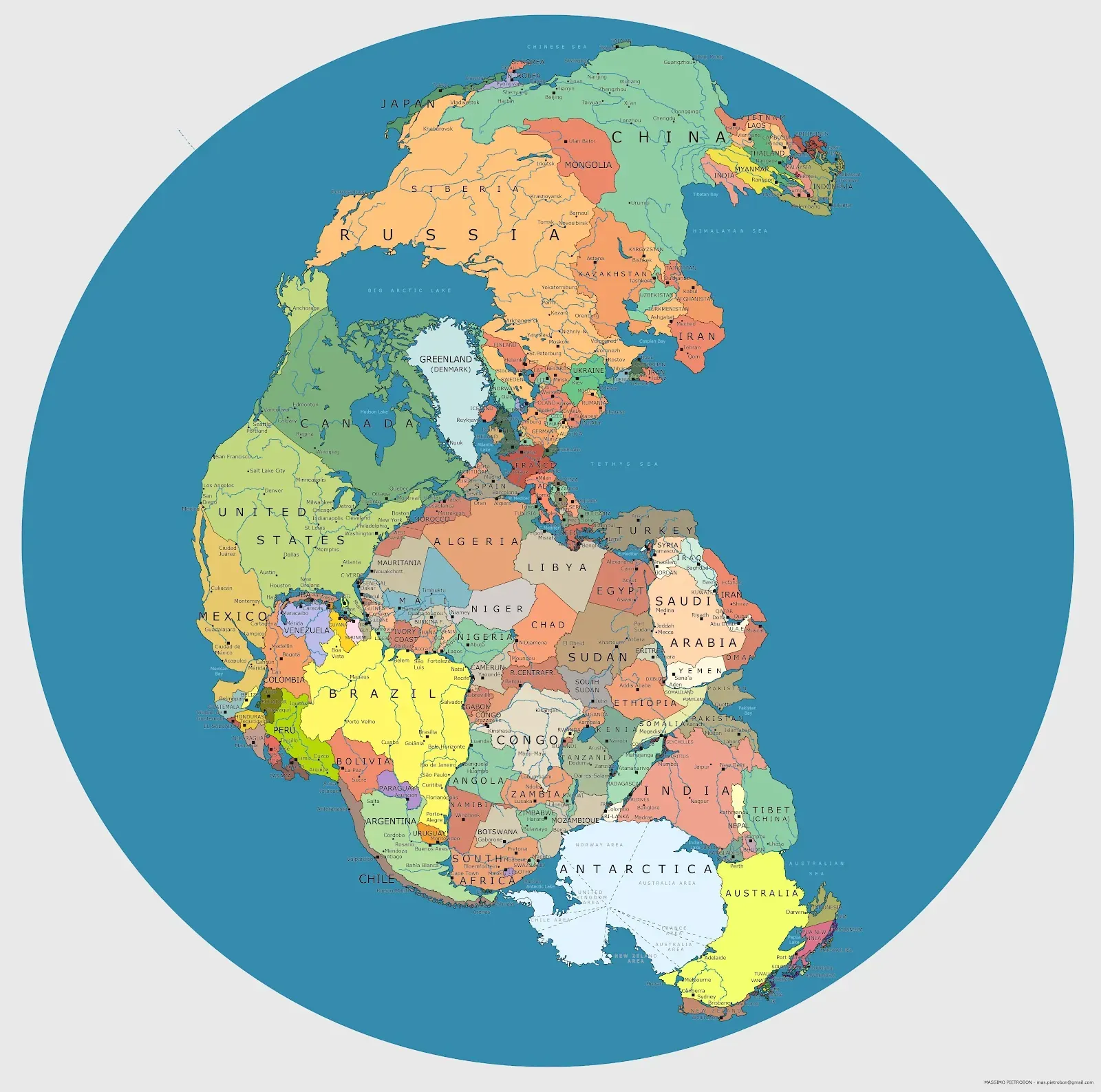
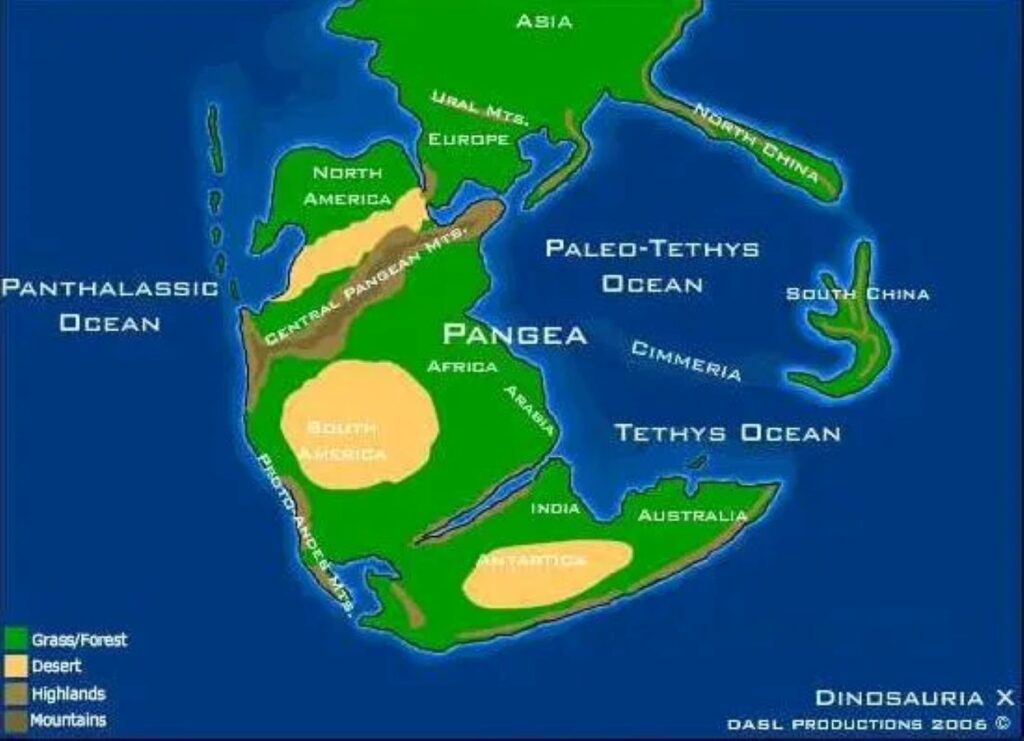
Pangea assembled from the earlier continental units of Gondwana, Euramerica, and Siberia during the Carboniferous period approximately 335 million years ago, and began to break apart about 200 million years ago, at the end of the Triassic and beginning of the Jurassic. Think of it like pushing all the furniture in a massive room into one corner – you’re left with a lot of empty space on one side, and a chaotic, crowded mess on the other. For Pangea, that “crowded mess” translated directly into wild climate extremes.
The assembly of the various large landmasses into the supercontinent led to the development of extensive dry climates in the supercontinent’s tropics during Permian times. As low-latitude seaways closed, warm surface ocean currents were deflected into much higher latitudes, and cool-water upwelling developed along Pangea’s west coast. In other words, the very act of continents colliding began reshuffling the planet’s heat budget in profound ways.
The Interior Desert: A Climate Unlike Anything on Earth Today
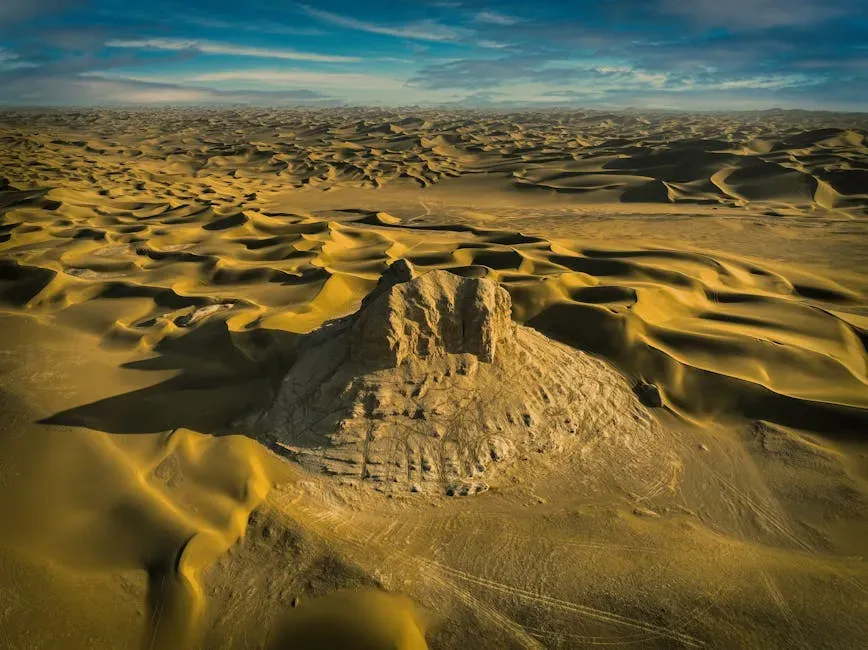
Here’s the thing – if you had stood in the center of Pangea during the Permian period, you might not have lasted long. The inner parts of the supercontinent were, in comparison to its shores, significantly drier and cooler, likely forming one of the most extensive desert systems in Earth’s geological history, with extreme variations of heat and cold. It makes the Sahara look like a mild inconvenience.
Air temperatures began to rise, ice melted, and the supercontinent dried out, creating large deserts across the equator. Extreme winds ripped across the land as the climate turned increasingly hot, dry, and hostile. Scientists have even recovered ancient salt crystals from Oklahoma rock cores that preserve tiny pockets of water from nearly 300 million years ago. From this, researchers know that the surface temperature reached over 73 degrees Celsius during the day at the equator in the interior region of Pangea. That is not a typo. That was reality.
The Pangean Megamonsoon: A Weather System with No Modern Equal
Numerous climate models predict that the geography of the supercontinent Pangea was conducive to the establishment of a “megamonsoonal” circulation. In general, geologic evidence supports the hypothesis of a megamonsoon that reached maximum strength in the Triassic. You can think of it as the modern-day South Asian monsoon, but scaled up to a planetary level, with the power to reverse global wind patterns.
Pangea’s large size limited the moderating effect of the global ocean; its continental climate was highly seasonal, with very hot summers and cool winters. The strong contrast between the Pangea supercontinent and the global ocean triggered intense cross-equatorial monsoons, sometimes referred to as the Pangean megamonsoons. Several studies have indicated that the circulation was so intense during the Triassic that it would have been capable of reversing part of the predominantly easterly global wind flow, and so westerly winds impacted the western coast, working to maximize surface convergence and increased seasonality along the western coasts of each continent.
Mountains, Oceans, and Atmospheric Disruption
Extensive mountain-building events, or orogenies, occurred where the continents collided with one another, and the newly created high mountain ranges strongly influenced local and regional terrestrial climates. Honestly, this is one of the most underrated aspects of the Pangea climate story. Mountains do not just affect the land around them – they rewrite the atmosphere itself. They block moisture, redirect winds, and create vast rain shadows that can turn a region from lush to barren.
The Central Pangean Mountains potentially played a similar role in the megamonsoon as the Tibetan Plateau in the East Asian Monsoon. Model simulations suggest that without the presence of the mountain range, the monsoon circulation would have been substantially weakened. Higher elevations may have intensified the atmospheric circulation by maximizing the surface heating and subsequently the latent heat release during the summer rainy season. In short, those ancient peaks were climate engines in their own right.
Ocean Isolation and the Greenhouse Effect of Warm Seas
Climatic patterns of the entire globe were affected by the presence of Pangea, since it stretched from far northern latitudes to far southern latitudes. The equatorial waters of Panthalassa – the superocean that surrounded Pangea – were largely isolated from cold ocean currents because the Paleo Tethys and Tethys seas together formed an immense warm water sea surrounded by various parts of Pangea, bringing humid tropical air and rain downwind.
As Pangea formed, the extent of shallow water habitats declined, and land barriers inhibited cold polar waters from circulating into the tropics. This is thought to have reduced dissolved oxygen levels in the warm water habitats that remained and contributed to a roughly ninety-five percent reduction of diversity in marine species. That is a staggering collapse. The ocean’s inability to circulate properly was, in many ways, a death sentence for entire ecosystems. It is hard not to feel the weight of that when you really think about it.
The Permian-Triassic Extinction: When Climate Change Became Catastrophic
Climate warmed throughout Permian times, and by the end of the period, hot and dry conditions were so extensive that they caused a crisis in Permian marine and terrestrial life. This dramatic climatic shift may have been partially triggered by the assembly of smaller continents into the supercontinent of Pangea. The consequences were nothing short of biblical. This wasn’t just a bad weather spell – it was an extinction-level climate crisis.
During this time in the late Permian, Earth experienced the largest mass extinction in its history, resulting in the loss of roughly ninety percent of species living on the planet. Various causes may have played a part in the extinction event, but paleontologists believe that the formation of Pangea was an important contributing factor. This extremely rapid interval of greenhouse gas release caused the Permian-Triassic mass extinction, as well as ushering in an extreme hothouse that persisted for several million years into the next geologic epoch, the Triassic. It was, by every measure, the closest life on Earth has ever come to complete annihilation.
Conclusion: A Climate Lesson Written in Stone
![Conclusion: A Climate Lesson Written in Stone (I did myself based on [1], also I added it on my dinosaur website (the link is [2]), CC BY-SA 2.5)](https://nvmwebsites-budwg5g9avh3epea.z03.azurefd.net/dinoworld/b6d3179306e2ce1827034db401e5bf89.webp)
Pangea’s story is not just ancient geology collecting dust in a museum. It is a vivid, sometimes terrifying demonstration of how the arrangement of landmasses, the movement of ocean currents, and the chemistry of the atmosphere can combine to reshape an entire planet’s climate. No single force drove it alone. It was a cascade – mountains, seas, winds, and volcanic gases all feeding into each other, with life caught in the crossfire.
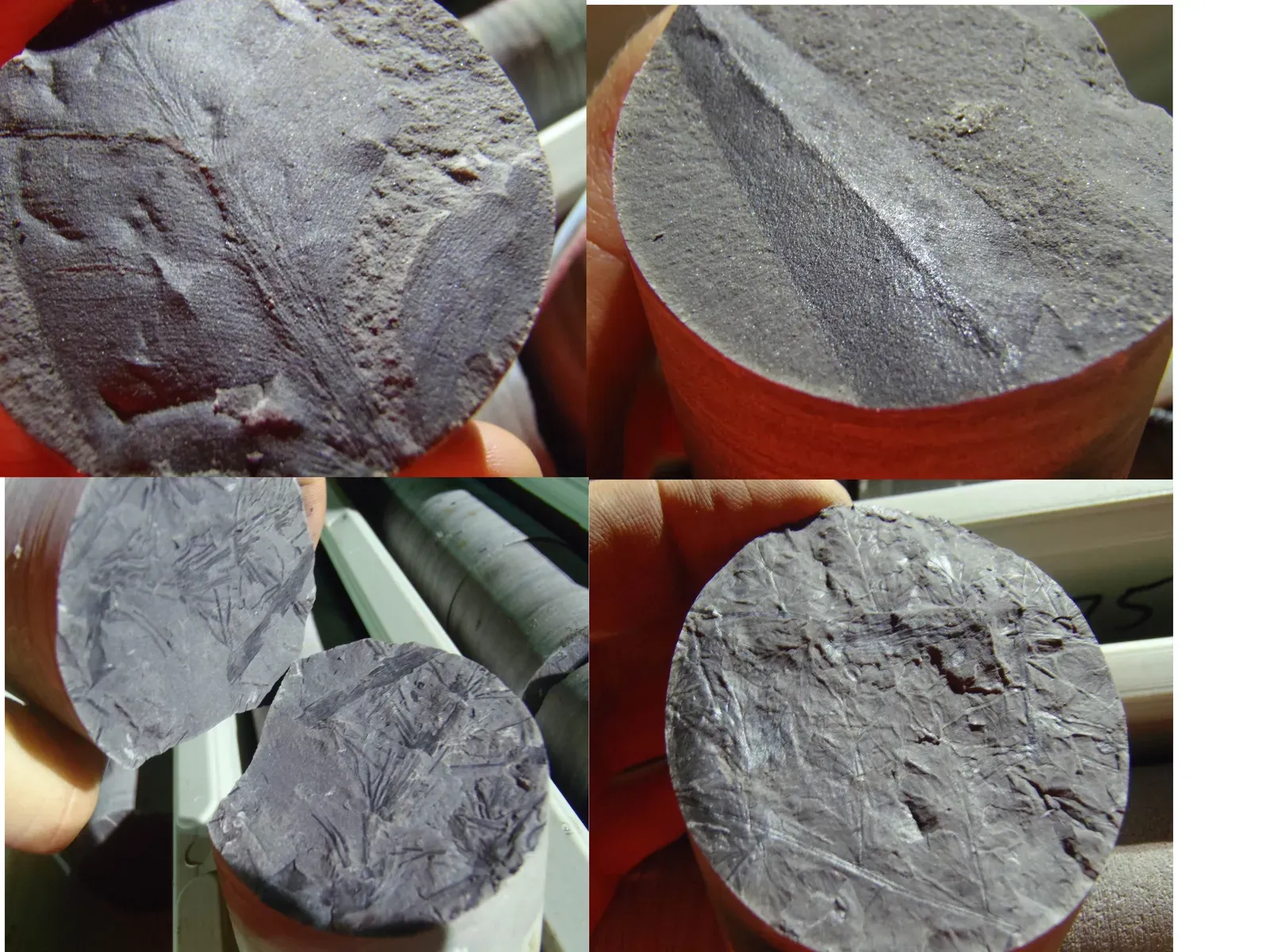
What is remarkable is how much of this story is still being uncovered. Scientists are drilling kilometers deep into ancient rock formations to recover climate records from hundreds of millions of years ago, finding ancient water trapped in salt crystals, reading wind direction from sandstone formations. The planet recorded everything. We are only now beginning to properly read it. And perhaps the most unsettling thought? The same kinds of feedbacks between land, ocean, atmosphere, and life that reshaped the world during Pangea are not unique to prehistory. They are the very same systems operating on our planet today.
What do you think would have been the most surprising thing about standing on Pangea? Tell us in the comments – the answer might be more complex than you’d expect.