The American Museum of Natural History unveiled a striking data visualization that plots every known dinosaur fossil across 150 million years of Earth’s history. This interactive map reveals patterns in dinosaur distribution, with particular clarity on the early ceratopsians – those beaked, herbivorous dinosaurs destined to evolve into horned giants like Triceratops. Fossils of these pioneers, such as Aquilops in North America, Stenopelix in northern Europe, and Psittacosaurus across East Asia, illustrate a story of rapid continental expansion during the Jurassic and Cretaceous periods.
Origins in the Shadows of the Jurassic
Origins in the Shadows of the Jurassic (Image Credits: Flickr)
The ceratopsian lineage traces back to the Late Jurassic, around 160 million years ago, when small, bipedal herbivores first appeared in what is now East Asia. Forms like Yinlong downsi emerged in this era, lacking the elaborate frills and horns of their later relatives but already sporting a distinctive beak for cropping vegetation. These early dinosaurs navigated lush environments teeming with giant sauropods and agile theropods.
Paleontologists long debated their precise origins, but fossil evidence solidified Asia as the cradle. The AMNH visualization captures this nascent phase, showing sparse but pivotal finds clustered in Chinese formations. From here, ceratopsians began a dispersal that would reshape their evolutionary path.
Psittacosaurus: The Asian Prolific Pioneer
Psittacosaurus dominated Early Cretaceous landscapes in East Asia roughly 125 to 105 million years ago, with hundreds of specimens preserving growth from hatchlings to adults. This parrot-beaked dinosaur measured up to two meters long, walked on two legs, and featured primitive bristles along its tail – perhaps for display or camouflage. Its abundance underscores a successful adaptation to forested floodplains.
The AMNH map highlights Psittacosaurus fossils dotting Mongolia, China, and nearby regions, signaling a population boom. Unlike descendants, it retained long forelimbs and lacked a bony frill, yet histological studies reveal rapid early growth rates. This species set the stage for neoceratopsians, bridging basal forms to more advanced kin.
Unexpected Footprints: Europe and North America Enter the Scene
Aquilops americanus, unearthed in Oklahoma, marks the earliest ceratopsian in North America at about 110 million years old. This diminutive skull, no larger than a fist, suggests a swift migration from Asia, likely via a Beringian land bridge. Its squared-off beak and subtle shelf foreshadowed frill development.
Meanwhile, Stenopelix from northern Germany offered a European counterpart around the same time, with limb bones and vertebrae akin to Psittacosaurus. Recent analyses confirm ceratopsian presence on the continent, challenging notions of isolation. The visualization clusters these outliers, depicting a tri-continental footprint by the Early Cretaceous. Such distribution hints at oceanic crossings or northern routes during warmer climates.
Evolution Toward Icons: Frills, Horns, and Diversity
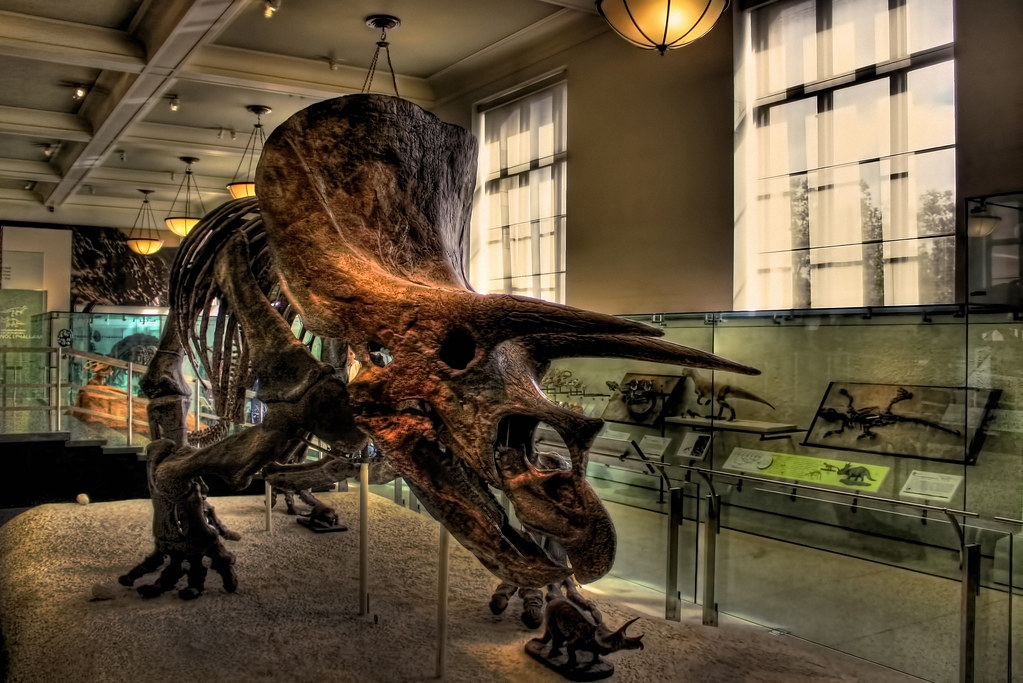
By the Late Cretaceous, ceratopsians transformed into quadrupedal behemoths, with neoceratopsians like Protoceratops introducing frills for defense or display. Ceratopsids, the horned subgroup, flourished in North America and Asia, exemplified by Triceratops with its three facial horns.
Diversification accelerated, yielding over 70 species adapted to coastal plains and inland basins. Growth series from sites like Mongolia reveal ontogenetic shifts, from bipedal juveniles to sturdy adults. Yet, all vanished 66 million years ago in the asteroid aftermath.
- Basal ceratopsians: Bipedal, Asia-dominant, 160–100 million years ago.
- Neoceratopsians: Frilled skulls, quadrupedal shift, Early–Late Cretaceous.
- Ceratopsids: Horned giants, North America–Asia, 80–66 million years ago.
- Key traits: Parrot-like beak, shearing teeth, battery dentition for tough plants.
- Fossil hotspots: Gobi Desert, Hell Creek Formation, Two Medicine.
Lessons from the Fossil Map
The AMNH’s data visualization not only charts ceratopsian spread but also underscores paleontology’s progress, with new European finds like Ajkaceratops filling gaps as recently as 2026. This tool democratizes discovery, allowing anyone to trace evolutionary pulses.
Key Takeaways
- Ceratopsians originated in Asia over 160 million years ago and rapidly dispersed globally.
- Early forms like Psittacosaurus thrived without horns, evolving defenses later.
- Fossil maps reveal interconnected dinosaur worlds, bridging continents long separated.
Ceratopsians remind us of nature’s ingenuity in adapting to ancient ecosystems, their legacy etched in stone across hemispheres. Watch the AMNH video to witness this saga unfold. What surprises you most about their journey? Tell us in the comments.