Hungary – Paleontologists uncovered a partial skull of an ancient terrestrial crocodile at the Iharkút site in western Hungary, prompting a major revision to maps of Late Cretaceous continents. The fossil, dating back 85 million years to the Santonian stage of the Cretaceous period, belongs to the species Doratodon carcharidens. This discovery resolves long-standing debates about the creature’s origins and Europe’s prehistoric connections.
A Breakthrough Skull Emerges from Fragmentary Past
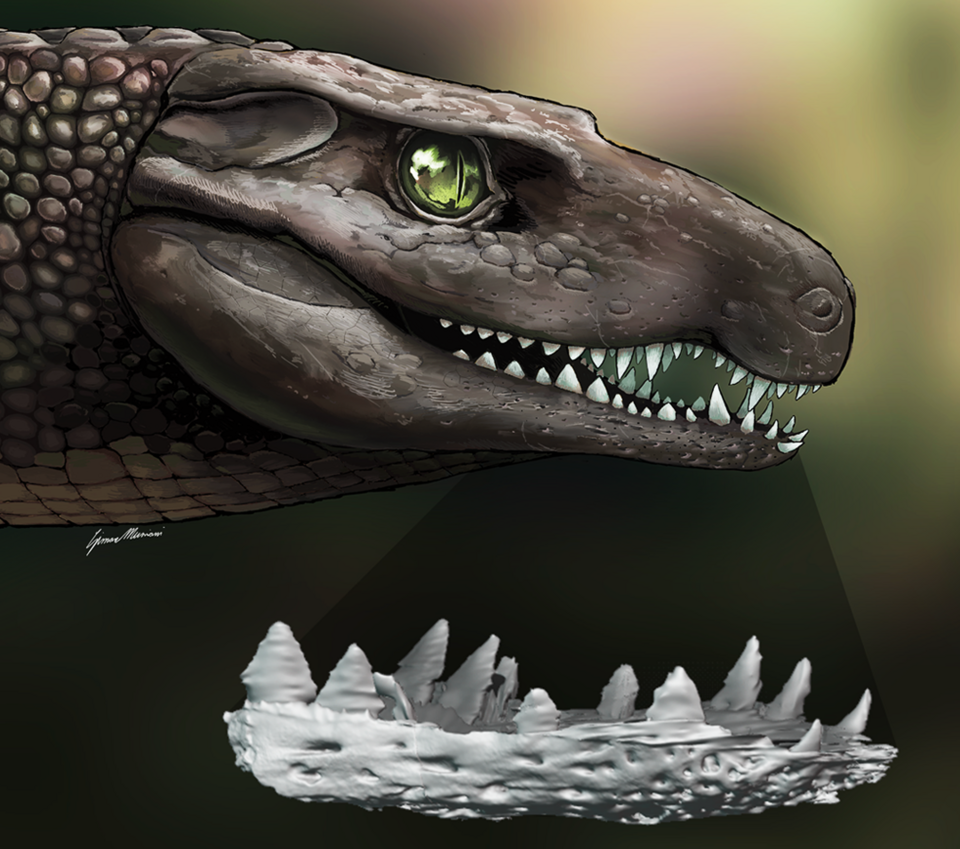
A Breakthrough Skull Emerges from Fragmentary Past (Image Credits: Wikimedia)
Researchers first spotted fragments of Doratodon carcharidens at Iharkút in 2018, but a matching upper jaw appeared six years later. The combined specimen, cataloged as MTM PAL 2024.159.1, includes key cranial elements such as the right maxilla, paired nasals, pterygoid, and left ectopterygoid, along with an isolated quadrate. This marked the most complete skull known for the species, transforming isolated teeth and jaw pieces into a clearer anatomical picture.
Previously, experts relied on sparse remains from sites across Europe, including Austria’s Grünbach Formation where the type specimen originated. The Hungarian find, from the Csehbánya Formation, offered fresh synapomorphies like a V-shaped intercondylar groove on the quadrate. Such details enabled robust phylogenetic analysis, shifting interpretations dramatically.
Unveiling the Predator’s Form and Fierce Bite
Doratodon carcharidens stood out as a small, land-adapted crocodylomorph, roughly 1.5 meters long with long legs suited for agile terrestrial hunting. Its deep, narrow rostrum featured ziphodont teeth—labiolingually compressed, serrated, and posteriorly curved—ideal for slicing flesh from prey. Unlike the aquatic crocodyliforms dominating European Cretaceous faunas, this predator resembled meat-eating dinosaurs in build and dentition.
The skull displayed a reduced antorbital fenestra, straight alveolar edges on a subvertical maxilla, and circular pits near alveoli. These traits distinguished it from relatives, while a single diastema between the second and third lower teeth set it apart from the Spanish D. ibericus. Researchers noted its somatosensory pits suggested versatile foraging, possibly blending land and semiaquatic habits.
From Gondwanan Invader to Laurasian Survivor
Earlier studies pegged Doratodon as a Gondwanan ziphosuchian migrant, citing shared ziphodont features with African and South American forms. The new phylogeny, using expanded datasets, placed it firmly within Paralligatoridae, a Laurasian neosuchian clade alongside North American and Asian taxa like Paralligator and Turanosuchus. Similarities to southern crocs arose through ecomorphological convergence, not ancestry.
“However, we had only very fragmentary remains of Doratodon, just teeth and incomplete jaws,” explained Dr. Márton Rabi of the University of Tübingen. The fuller skull revealed overlooked Laurasian traits, reclassifying even the Spanish Ogresuchus furatus as a northern neosuchian. This phylogeny implies the Pangea breakup around 180 million years ago drove early crocodyliform divergences.
| Previous View | New Classification |
|---|---|
| Gondwanan ziphosuchian (Africa/S. America link) | Laurasian paralligatorid (N. America/Asia origin) |
| Land bridge evidence | Convergent evolution |
| Late Cretaceous dispersal | Early Jurassic vicariance |
Redrawing Europe’s Fragmented Cretaceous Landscape
The Iharkút floodplain teemed with dinosaurs and reptiles on what was then an island archipelago amid the Tethys Sea. Doratodon‘s northern roots undermine the “Eurogondwana” hypothesis of prolonged Europe-Africa ties. Instead, purported southern immigrants likely represent vicariant relicts from Pangea’s primary split.
Fragmentary European and African records have fueled dispersal claims, but the study highlights weak phylogenies and sporadic finds. Exceptions like late hadrosaurids may involve oceanic routes. “Doratodon has, in a sense, redrawn the prehistoric map of Europe,” Rabi noted.
- Supports tectonic models of early Laurasia-Gondwana separation.
- Emphasizes convergence in predator adaptations.
- Calls for fuller skeletons over isolated teeth in ancestry debates.
- Reinterprets other enigmas like Ogresuchus.
- Highlights Iharkút’s role in vertebrate paleontology.
Key Takeaways
- Doratodon carcharidens thrived as a Laurasian terrestrial hunter 85 million years ago.
- New skull proves convergent evolution, not migration, shaped its fierce features.
- Fossil erases a pillar of late Europe-Africa land connections during dinosaur times.
This Hungarian fossil not only clarifies one crocodyliform’s story but underscores how complete specimens can reshape continental histories. As gaps in the fossil record persist, future digs may reveal more survivors from supercontinent days. “The study in Scientific Reports sets a precedent for cautious biogeography. What do you think about this shift in prehistoric maps? Tell us in the comments.