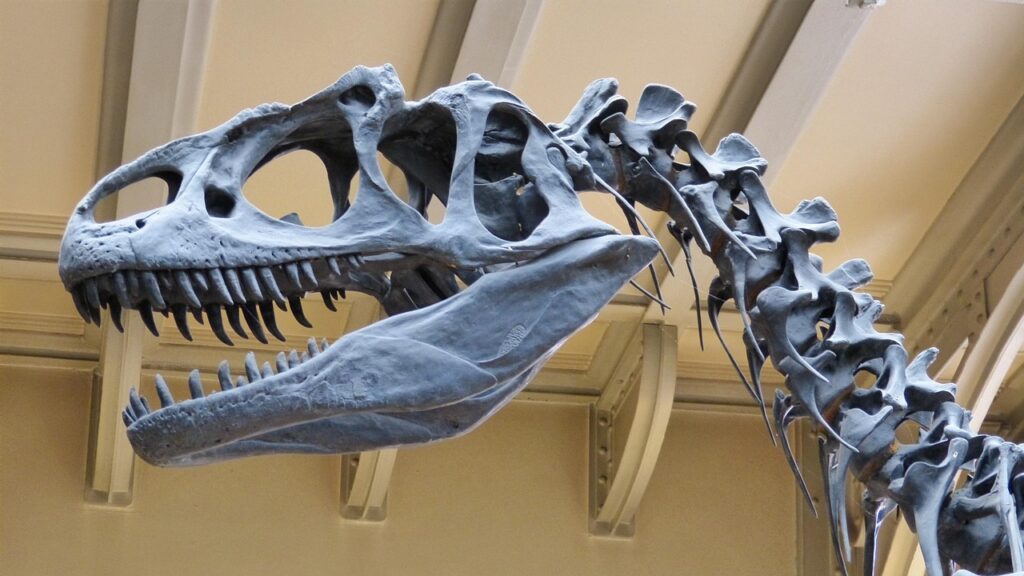
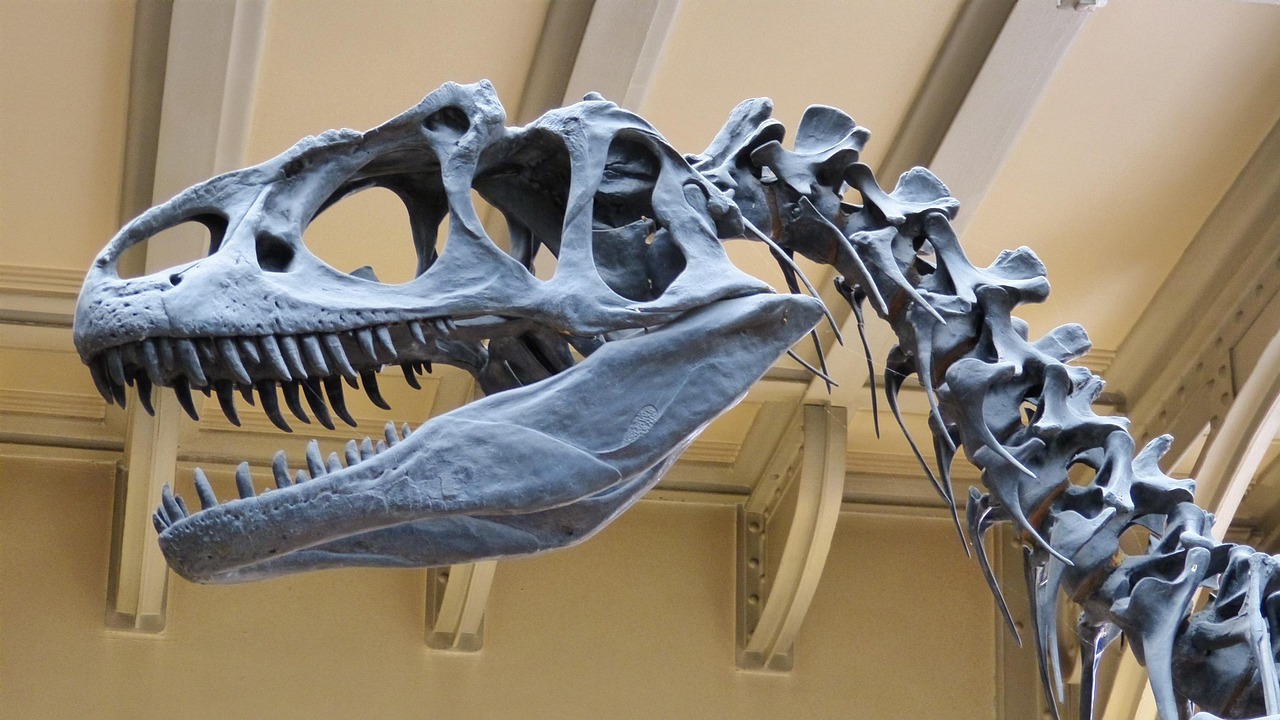
125 Million-Year-Old Dinosaur Braincase Reveals How One Giant Predator Evolved – Image for illustrative purposes only (Image credits: Pixabay)
Nakhon Ratchasima, Thailand — Deep within the sun-baked sediments of an ancient riverbed, two unassuming fossils have emerged as pivotal clues to a predator’s origins. Recovered from the Khok Kruat Formation, these partial braincases belong to Siamraptor suwati, a formidable dinosaur that prowled Southeast Asia around 125 million years ago.[1][2] The finds, detailed in a recent PLOS One study, confirm this creature’s place among the earliest carcharodontosaurs, a lineage of giants whose serrated teeth evoked shark-like ferocity.[3]
The Accidental Match That Completed a Predator’s Skull
Excavations by the Japan-Thailand Dinosaur Project yielded the specimens years apart. One braincase, cataloged as NRRU-F01020035, surfaced between 2003 and 2005, while a partial skull roof, NRRU-F01020036, appeared in 2007 from the same ~300 square meter site.[1] For years, their origins puzzled researchers until a chance alignment in 2023 revealed their connection.
Lead researcher Soki Hattori recounted the moment: “In 2023, the skull roof specimen was accidentally placed alongside the braincase, which made it clear that it belonged to the same species.”[3] Both hailed from the Aptian-stage Khok Kruat Formation, a subtropical floodplain teeming with Siamraptor remains—over 20 specimens in total. Detailed scans and comparisons matched unique traits, such as a wedge-shaped frontoparietal suture and two deep pits on the frontal bone’s edge, sealing their attribution to this species.[1]
Anatomy Frozen in Time: Clues from the Braincase
The primary braincase preserves frontals, parietals, orbitosphenoids, and more, offering a rare glimpse inside a theropod’s head. A tall nuchal crest rose prominently at the skull’s rear, anchoring powerful neck muscles to support a massive cranium. Fully split trigeminal nerve foramina and three distinct exits for cranial nerves X through XII underscored its allosauroid heritage.[1]
Subtler features hinted at daily life. An obtuse occipitofrontal angle and oriented semicircular canals suggested Siamraptor tilted its head slightly upward, perhaps to scan horizons or track prey from above. Partially roofed supratemporal fossae pointed to a thermoregulatory system, shielding eyes and brain from overheating in tropical climes. These traits, absent in closer relatives, marked early innovations in the carcharodontosaur blueprint.[2]
Tracing the Roots of a Global Predator Dynasty
Siamraptor suwati first gained recognition in 2019, when fossils from the same formation revealed an eight-meter-long carnivore with blade-edged teeth suited for slicing flesh rather than crushing bone. Phylogenetic analyses positioned it as a basal carcharodontosaur, branching early from ancestors like Allosaurus toward behemoths such as Giganotosaurus and Carcharodontosaurus.[4] The new braincases reinforce this, with a fresh analysis of 367 characters across 68 theropods confirming its spot at the lineage’s base.[1]
This placement bridges a 50-million-year void between Jurassic forerunners and Cretaceous titans. Dr. Mike Lee observed, “It links the Allosaurus with the … Carcharodontosaurus,” highlighting its hybrid skeleton: an Allosaurus-like frame paired with advanced shark teeth.[3] Such early divergence in Asia challenges assumptions of a solely Gondwanan origin for these dispersers, who later ruled every continent as apex hunters.
Braincase details illuminate gradual shifts. Fused parietals, a carcharodontosaur hallmark, hinted at skull reinforcement for bigger bites. Retained primitive recesses, like the caudal tympanic, contrasted with losses in derived forms, sketching a stepwise refinement. Paleontologist Phil Bell noted the broader value: “Most dinosaur species that we know of are actually based on rather fragmentary remains, so new discoveries that unquestionably belong to those species are really vital.”[3]
At roughly 125 million years old, Siamraptor embodied the spark of specialization. Its robust build supported a lifestyle of ambushing herbivores amid meandering rivers, foreshadowing the group’s explosive radiation.
What the Fossils Mean for Dinosaur History
Beyond anatomy, the specimens underscore Southeast Asia’s overlooked role in theropod evolution. The Khok Kruat site’s monospecific carcharodontosaur assemblage simplifies attributions, yet gaps persist—no snout fossils or full forelimbs complicate full portraits. Future digs may yield them, refining estimates of speed, senses, and sociality.
These braincases stand as testaments to persistence in paleontology. What began as orphaned rocks now reshapes family trees, reminding us that evolution’s story unfolds one fragment at a time. As carcharodontosaurs faded before tyrannosaurs rose, Siamraptor‘s legacy endures in stone, a predator whose early roar echoed across prehistoric landscapes.