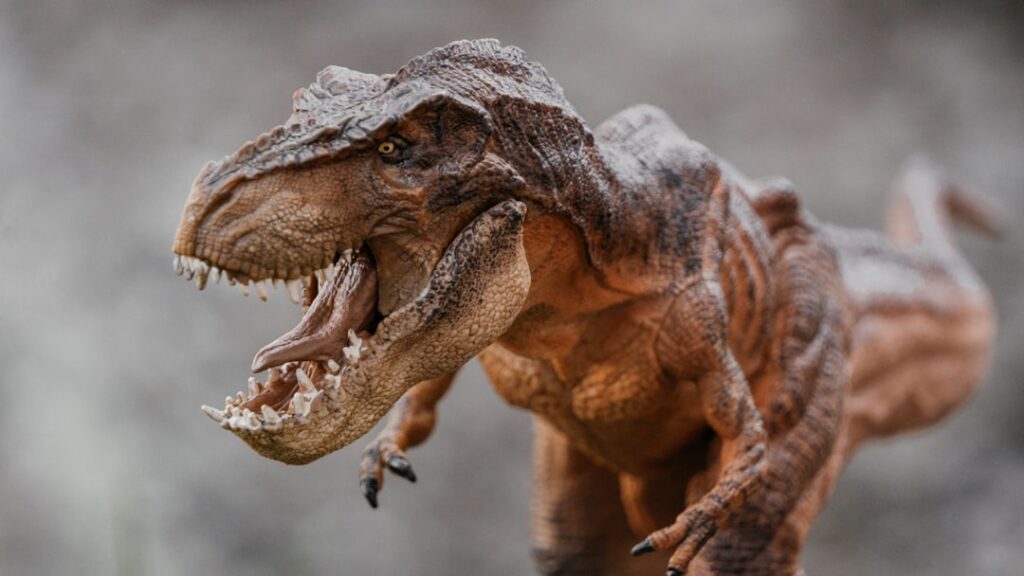
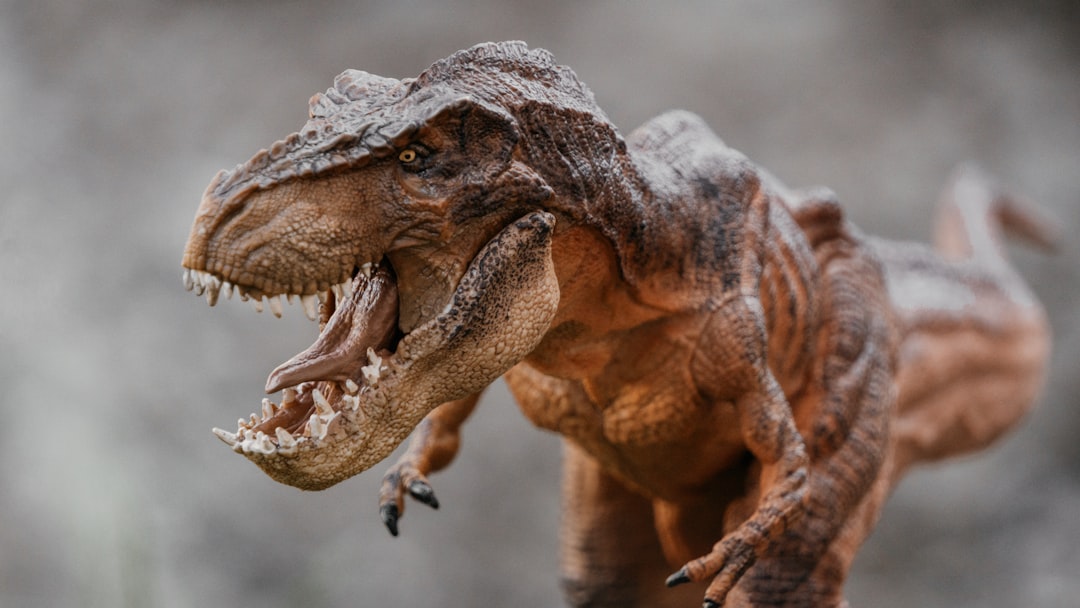
Blood vessels found in T. rex bones are rewriting dinosaur science – Image for illustrative purposes only (Image credits: Unsplash)
A fractured rib from Scotty, the most massive Tyrannosaurus rex specimen ever unearthed, has yielded preserved blood vessels that endured 66 million years. This rare find offers paleontologists fresh evidence of how these apex predators recovered from severe injuries, potentially survived brutal encounters, and remodeled their bones. Researchers employed cutting-edge imaging to peer inside the fossil without harm, challenging long-held views on tissue preservation in ancient remains.[1][2]
Scotty’s Evidence of a Hard-Knock Life
Scotty, discovered in Canada’s Saskatchewan region and now housed at the Royal Saskatchewan Museum, stands out as the largest and one of the most complete T. rex skeletons known. This predator, which roamed about 66 million years ago during the Late Cretaceous, bore multiple signs of trauma, including infections, combat scars, and a prominent fracture in one rib. The injury appeared to stem from a forceful blow, perhaps during a territorial clash with another dinosaur, and had begun to heal before Scotty’s death.[3]
The rib’s callus region, where new bone formed around the break, hosted an unusually dense network of tubular structures. These ranged from 100 to 500 micrometers in diameter – far larger than typical bone canals – and branched in patterns suggestive of rapid vessel growth to deliver nutrients and oxygen for repair. Such angiogenesis, or new blood vessel formation, mirrored processes observed in modern fractured bones, indicating T. rex possessed robust healing capabilities despite its size.[4]
High-Tech Probes Reveal Iron-Rich Relics
Conventional CT scans failed to penetrate the rib’s dense mineralization, so the team turned to synchrotron radiation at the Canadian Light Source. This particle accelerator generated intense X-rays for micro-computed tomography, achieving resolutions down to 17 micrometers and enabling 3D reconstructions of the interior. Chemical mapping via X-ray fluorescence and absorption spectroscopy pinpointed iron concentrations far exceeding those in surrounding bone matrix.[4]
The vessels emerged as permineralized casts, primarily pyrite partially oxidized to goethite and hematite in two distinct layers – an outer botryoidal form and an inner crystalline one. Trace elements like manganese, nickel, and zinc accompanied the iron, hinting at the original blood’s composition, possibly from hemoglobin. Lead researcher Jerit L. Mitchell, a physics PhD candidate at the University of Regina, first spotted these during undergraduate scans in 2019 and pursued the analysis with co-authors Mauricio Barbi, Ryan C. McKellar, Monica Cliveti, and Ian M. Coulson.[1][5]
Insights into T. rex Physiology and Survival
These preserved vessels illuminate bone remodeling in dinosaurs, a process that demanded heightened vascular support during recovery. The incomplete healing suggested Scotty perished months after the injury, yet the response underscored resilience in a creature weighing nearly 20,000 pounds. Comparisons to extant birds, dinosaurs’ closest living kin, could clarify metabolic rates and injury tolerance across theropods.[3]
- The vessels’ location in the healing callus confirmed trauma-induced growth, absent in undamaged bone sections.
- Iron’s role likely stabilized structures against decay, echoing mechanisms in earlier soft tissue finds.
- Such pathologies may explain why soft remnants persist more in injured fossils than healthy ones.
This builds on Mary Schweitzer’s 2005 report of flexible vessels and cells from a Montana T. rex femur, which similarly upended fossilization models. Together, they portray dinosaurs not as fragile relics but as dynamic animals capable of enduring life’s rigors.[5]
The Enduring Mystery of Soft Tissue Survival
Despite decades of attempts, scientists have never extracted dinosaur DNA, restricting genetic insights. Preservation here stemmed from rapid burial in anoxic sediments, followed by mineral infiltration that replicated vessel shapes without organics. The dual-layer mineralization reflected environmental shifts, like burial-exhumation cycles, that fortified the casts over eons.[2]
Mitchell noted the cross-disciplinary payoff: “With cross-disciplinary research and novel applications of advanced technologies, there is so much potential to recreate the past lives of dinosaurs like never before.”[2] The Scientific Reports paper, published July 4, 2025, urges prospectors to prioritize diseased or broken bones for similar yields.
Paving the Way for Deeper Dinosaur Revelations
This breakthrough signals a shift in paleontology, where physics tools unlock biology’s fine details. Future scans of other fractured theropod remains might map vascular evolution or even pigments and muscle attachments. While DNA eludes grasp, these vessels humanize T. rex, evoking a predator that fought, healed, and pressed on amid Cretaceous perils. For researchers and enthusiasts alike, Scotty’s rib promises ongoing discoveries that bridge 66 million years to the present.[1]