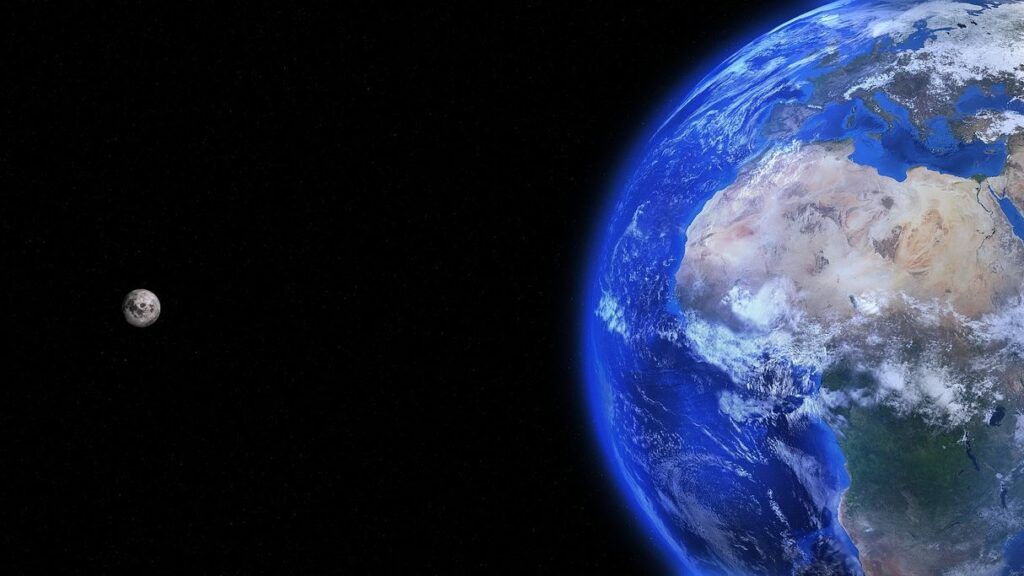
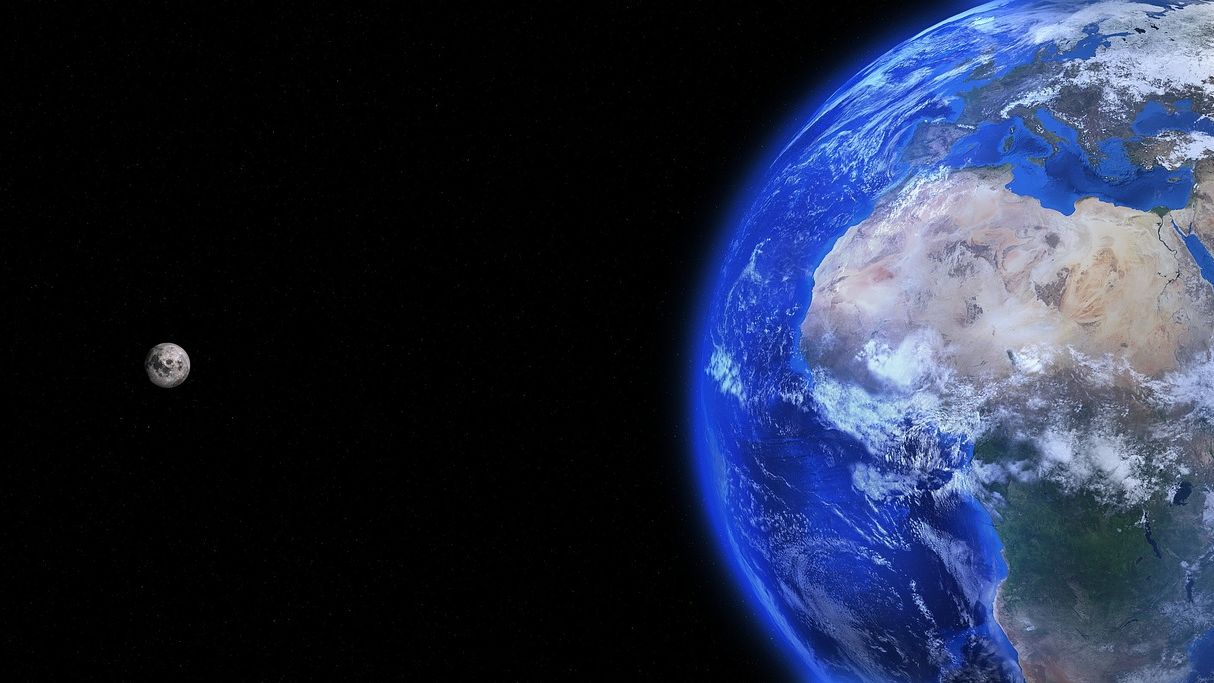
Mathematical method calculates most efficient Earth-moon route yet – Image for illustrative purposes only (Image credits: Pixabay)
Space travel demands extreme precision because every kilogram of propellant adds enormous cost and complexity to a mission. A team of researchers has now introduced a mathematical technique that sharpens calculations for the most fuel-efficient routes between the orbits of celestial bodies. When applied to travel between Earth and the Moon, the approach produced a trajectory that consumes less propellant than any route previously documented in the scientific literature.
The High Stakes of Orbital Travel
Moving a spacecraft from one orbit to another requires careful planning to minimize the velocity changes, known as delta-v, that determine fuel use. Traditional methods often rely on approximations that leave room for improvement, especially when multiple gravitational influences are at play. The new work focuses on transfers that pass near the L1 Lagrangian point, a gravitational balance location between Earth and the Moon. Small gains in efficiency here can translate into meaningful savings across an entire mission.
A Fresh Mathematical Framework
The researchers built their solution on the theory of functional connections, a technique that converts complex differential equations into simpler algebraic forms. This conversion allows exact solutions rather than iterative numerical guesses, reducing both computation time and potential error. The method handles the coupled gravitational effects of Earth, the Moon, and the Sun with greater fidelity than earlier models. As a result, mission designers can evaluate thousands of possible trajectories more quickly and with higher confidence in the outcome.
A Record-Low Fuel Route to the Moon
To test the framework, the team calculated an Earth-to-Moon transfer that begins in low Earth orbit and arrives in lunar orbit after passing through the L1 region. The total propellant cost for this path measures 3,342.96 meters per second. That figure sits 58.80 meters per second below the best previously published routes. Although the difference appears modest on paper, it represents a substantial reduction in the mass of fuel that must be launched from Earth. Lead author Allan Kardec de Almeida Júnior emphasized the practical stakes: “When it comes to space travel, every meter per second equates to a massive amount of fuel consumption.” The calculation also accounts for realistic constraints such as departure dates and arrival windows, making the result directly relevant to mission planning.
Broader Applications and Remaining Questions
The same mathematical approach can be extended to routes involving other planets or even multiple asteroids, where the number of gravitational influences grows quickly. Because the method yields exact solutions, it may help identify entirely new families of low-energy trajectories that current techniques overlook. At the same time, the study notes that real missions must still incorporate factors such as navigation errors, solar radiation pressure, and spacecraft hardware limits. Further validation through high-fidelity simulations and, eventually, flight tests will determine how much of the theoretical saving survives in practice.
– The new route saves 58.80 m/s of delta-v compared with prior best-known paths.
– The method relies on the theory of functional connections for exact solutions.
– Savings matter because every meter per second reduces launch mass and mission cost.
– The work appears in the journal Astrodynamics and involves researchers from Portugal, France, and Brazil.
Future lunar missions and cislunar infrastructure projects stand to benefit from any reliable reduction in propellant demand. The technique offers a clearer map of the gravitational landscape, helping planners chart courses that waste less energy. As agencies prepare for sustained operations near the Moon, tools that deliver even modest efficiency gains can compound into major advantages over repeated flights.