Southern Namibia – In the moonlit grasslands, Africa’s smallest wildcat emerges as a silent hunter, its diminutive form belying a fierce prowess.
A Tiny Frame, Enormous Appetite
A Tiny Frame, Enormous Appetite (Image Credits: Imgs.mongabay.com)
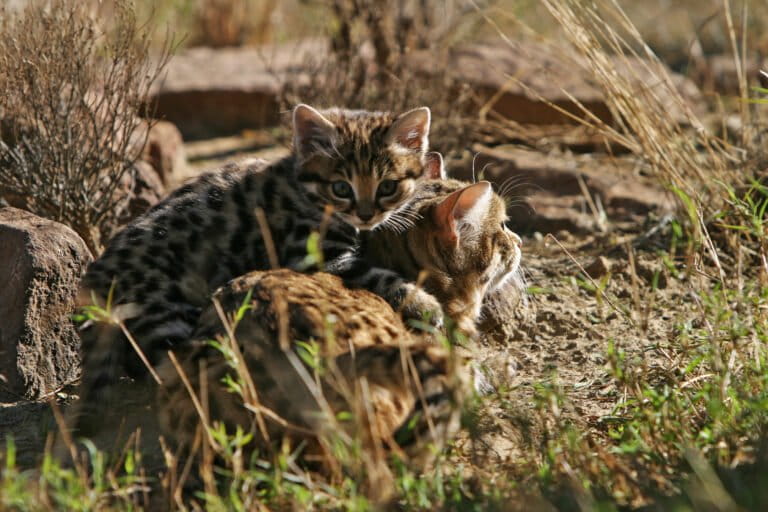
Smaller than most house cats, the black-footed cat weighs little more than a kilogram yet commands respect as one of the savanna’s most efficient killers. Nocturnal by nature, it stalks prey through tall grasses, pouncing with precision on rodents, birds, and insects. Observers have noted its remarkable hunting success rate, often exceeding that of larger felines.
This cat’s compact body allows it to navigate dense vegetation undetected. Its large eyes and ears enhance senses attuned to the night’s subtle sounds and movements. Such adaptations ensure survival in arid landscapes where food remains scarce.
Camouflage Master of the Night
The black-footed cat’s tawny fur, adorned with dark spots, provides ideal concealment against Namibia’s darkened terrain. This patterning disrupts its outline, making it nearly invisible to both prey and rivals. During hunts, it moves with deliberate stealth, freezing at the slightest disturbance.
Grasses sway gently as the cat glides forward, its spotted coat mimicking shadows and soil. This natural disguise proves essential in open areas exposed to potential threats like larger predators. The result allows sustained foraging without frequent interruptions.
Daytime Havens in Borrowed Burrows
As dawn breaks, the black-footed cat seeks refuge underground, squeezing into rodent burrows far too narrow for bigger animals. These tunnels, dug by small mammals, offer cool, secure shelter from the relentless sun and daytime dangers. The cat folds its lithe body to fit, emerging only after sunset.
This strategy highlights an unusual reliance on the homes of its prey. Rodents unwittingly provide sanctuary, protecting the cat from heat exhaustion and aerial predators. Such burrows maintain stable temperatures, crucial in Namibia’s fluctuating climate.
Survival Tactics in a Harsh World
The black-footed cat’s dual life – active nights and hidden days – demonstrates remarkable adaptability. Limited distribution confines it to specific southern African regions, where competition for resources intensifies. Burrows not only shield but also position it near hunting grounds.
Experts emphasize how this behavior underscores the cat’s resourcefulness. Populations persist despite habitat pressures, thanks to these ingenious retreats. Conservation efforts focus on preserving grasslands vital to its lifecycle.
- Size: Roughly one-third that of a domestic cat.
- Primary prey: Rodents, birds, insects.
- Hunting time: Strictly nocturnal.
- Shelter: Rodent burrows during daylight.
- Camouflage: Spotted tawny coat for blending.
Key Takeaways
- The black-footed cat’s small size enables access to rodent burrows unavailable to larger species.
- Nocturnal hunting maximizes energy efficiency in sparse environments.
- Burrow use exemplifies opportunistic survival in Africa’s challenging ecosystems.
The black-footed cat’s story reveals nature’s intricate balances, where even predators borrow from prey to endure. What adaptations in wildlife fascinate you most? Share your thoughts in the comments.