What if I told you that creatures stranger than any science fiction movie ever lived on our planet? Picture this: a shrimp the size of a school bus patrolling ancient seas, a snake so massive it could swallow a crocodile whole, or a worm with five eyes and a trunk-like snout that defied every rule of anatomy we thought we knew. These aren’t the products of Hollywood’s imagination – they’re real creatures that once called Earth home, and their fossilized remains continue to challenge everything we thought we knew about life on our planet. The fossil record is like nature’s own horror movie archive, filled with creatures so bizarre that paleontologists sometimes wonder if they’re looking at evidence of alien life forms. Yet these extraordinary beings evolved right here on Earth, in environments so different from today that they might as well have been alien worlds.
The Giant Sea Scorpion That Ruled Ancient Oceans
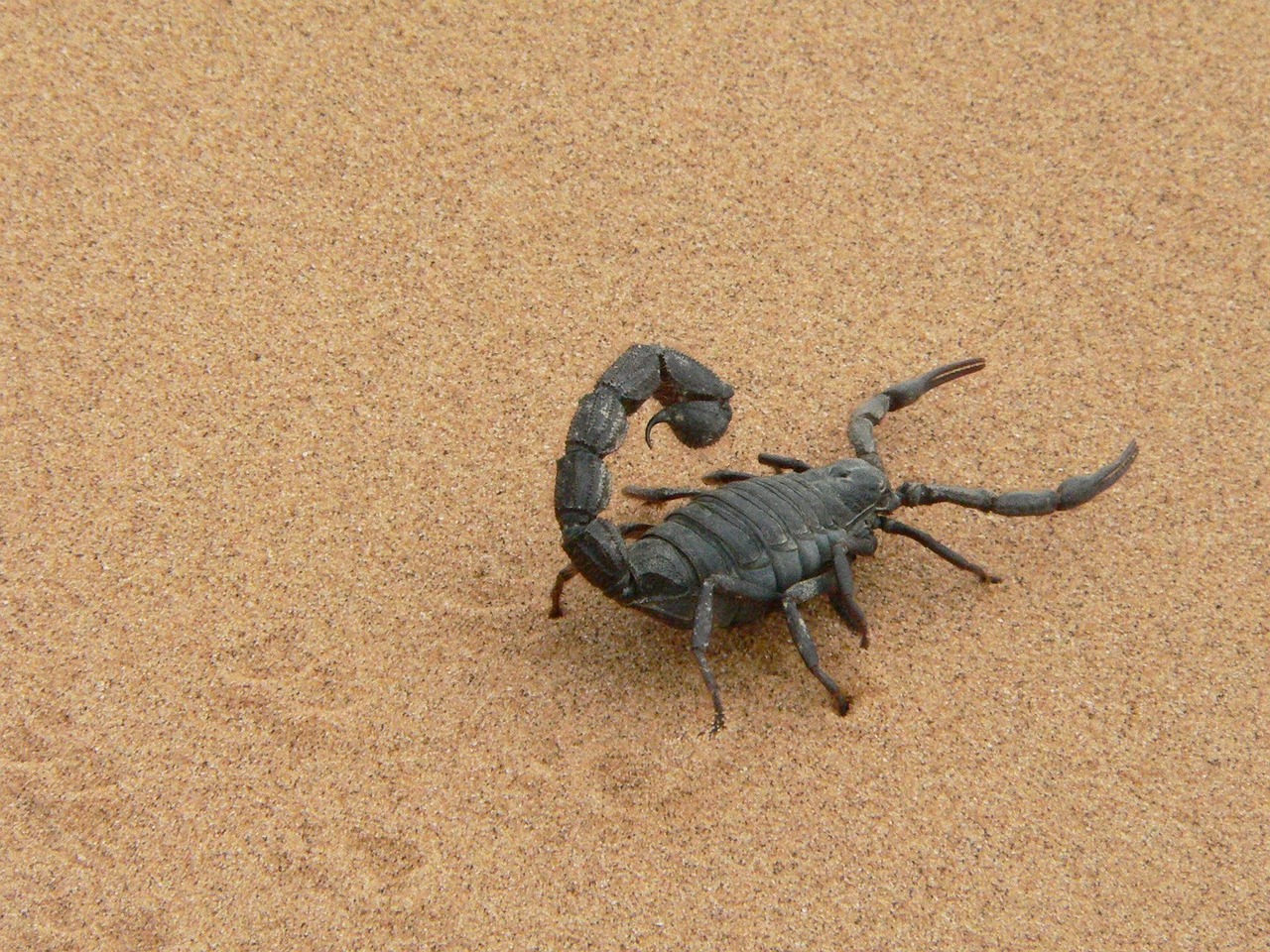
Jaekelopterus rhenaniae wasn’t your average backyard arthropod – this prehistoric sea scorpion stretched over 8 feet long, making it one of the largest arthropods ever discovered. Imagine encountering this monster in ancient seas around 390 million years ago, its massive claws capable of crushing anything in its path. This apex predator dominated the waterways of what is now Germany, wielding claws that measured nearly 18 inches in length. Scientists believe these creatures were ambush predators, lurking in murky waters before striking with lightning speed. The sheer size of Jaekelopterus challenged our understanding of how large arthropods could grow, especially in aquatic environments where buoyancy helped support their enormous frames. What makes this discovery even more remarkable is that it suggests ancient oxygen levels were significantly higher than today, allowing such massive invertebrates to thrive. The fossil evidence paints a picture of prehistoric seas teeming with giants that would make today’s largest crabs look like toys.
Hallucigenia: The Walking Nightmare
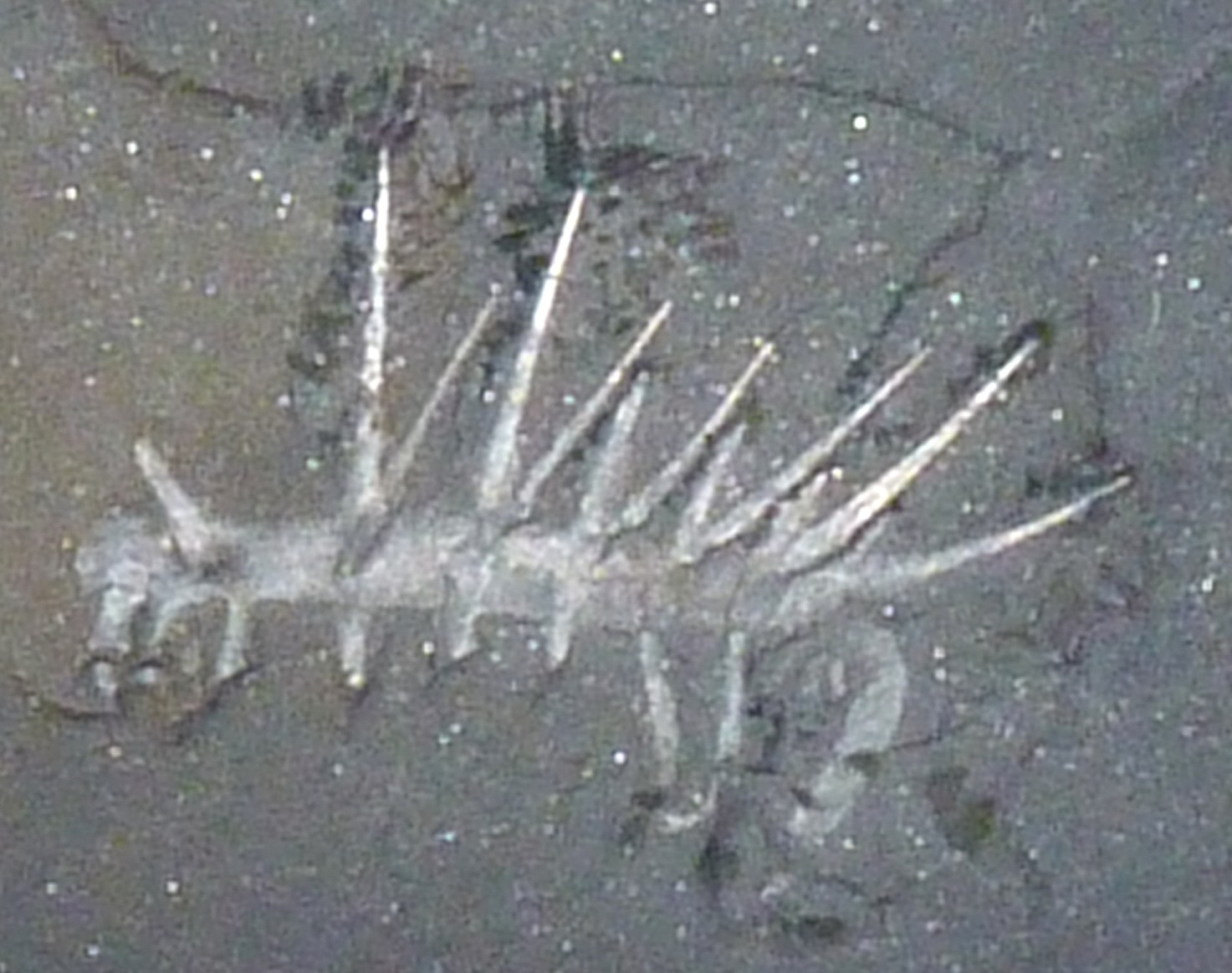
Picture a creature that looks like it was assembled by someone having a fever dream – that’s Hallucigenia, a bizarre animal from the Cambrian period that left paleontologists scratching their heads for decades. This spiny, tube-shaped creature measured about 2 inches long but packed more strangeness per square inch than almost any other fossil. Originally discovered in the famous Burgess Shale, Hallucigenia was so alien-looking that scientists initially couldn’t tell which end was the head and which was the tail. The creature sported seven pairs of defensive spines along its back and seven pairs of walking legs underneath, creating an appearance that seemed more suited to an alien planet than ancient Earth. It took years of careful study and additional fossil discoveries before researchers could properly reconstruct this walking enigma. The revelation that Hallucigenia was related to modern velvet worms only added to its mystique, showing how evolution can take the most unexpected turns.
Anomalocaris: The First Super Predator
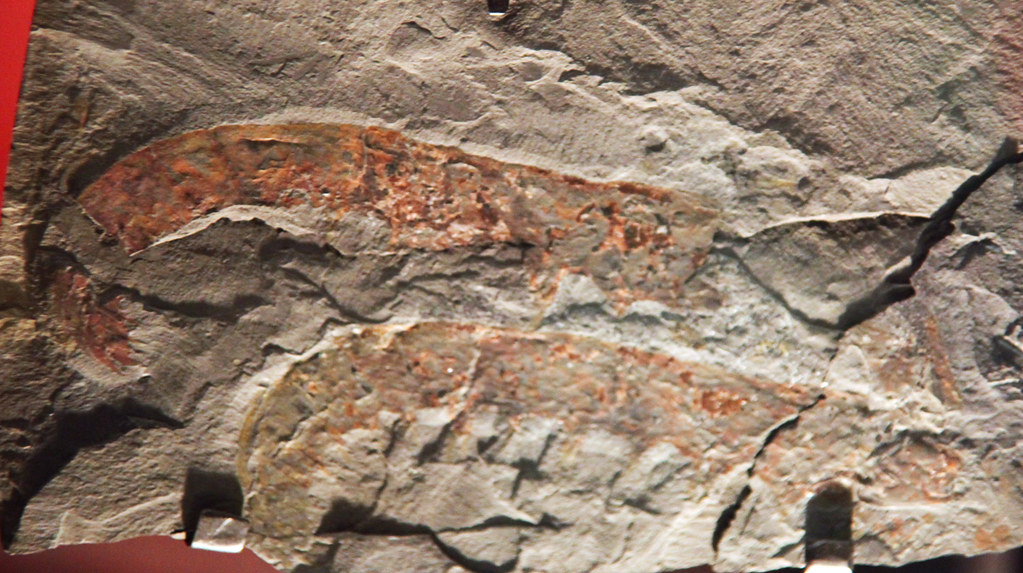
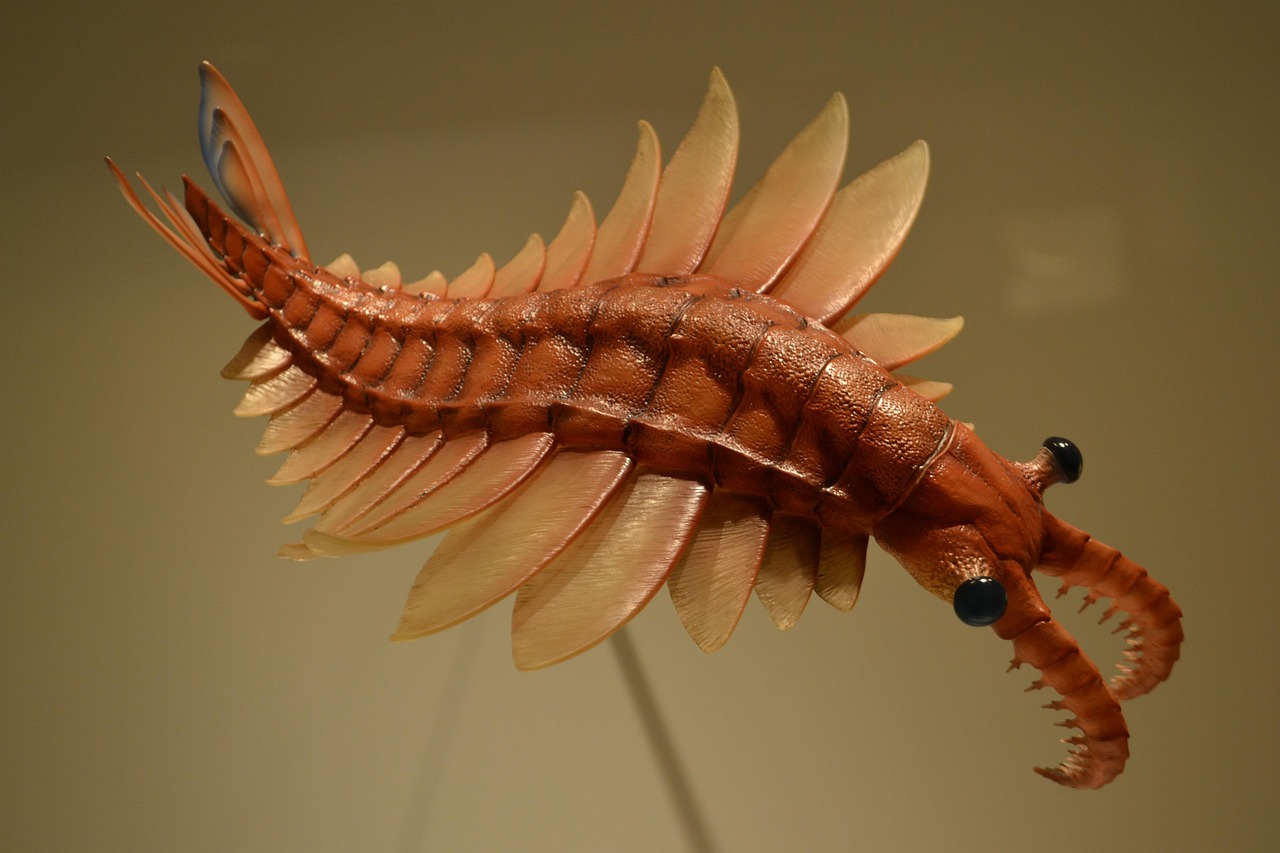
Before sharks ruled the seas, there was Anomalocaris – a swimming terror that grew up to 6 feet long and possessed grasping arms that could reach out like mechanical claws. This Cambrian period predator was unlike anything alive today, combining features that seem borrowed from multiple different animal groups. The creature’s most striking features were its two large frontal appendages, which it used to grab and manipulate prey before feeding them into its circular mouth lined with plates. Its body moved through the water using undulating fins along its sides, creating a swimming motion that paleontologists describe as both graceful and terrifying. What truly sets Anomalocaris apart is its sophisticated compound eyes – some of the most advanced visual systems known from the Cambrian period. These dinner-plate-sized eyes contained thousands of individual lenses, giving this ancient predator vision capabilities that rivaled modern arthropods. For smaller creatures of the time, spotting those massive eyes in the murky depths probably meant it was already too late to escape.
Titanoboa: The Snake That Could Swallow a Car
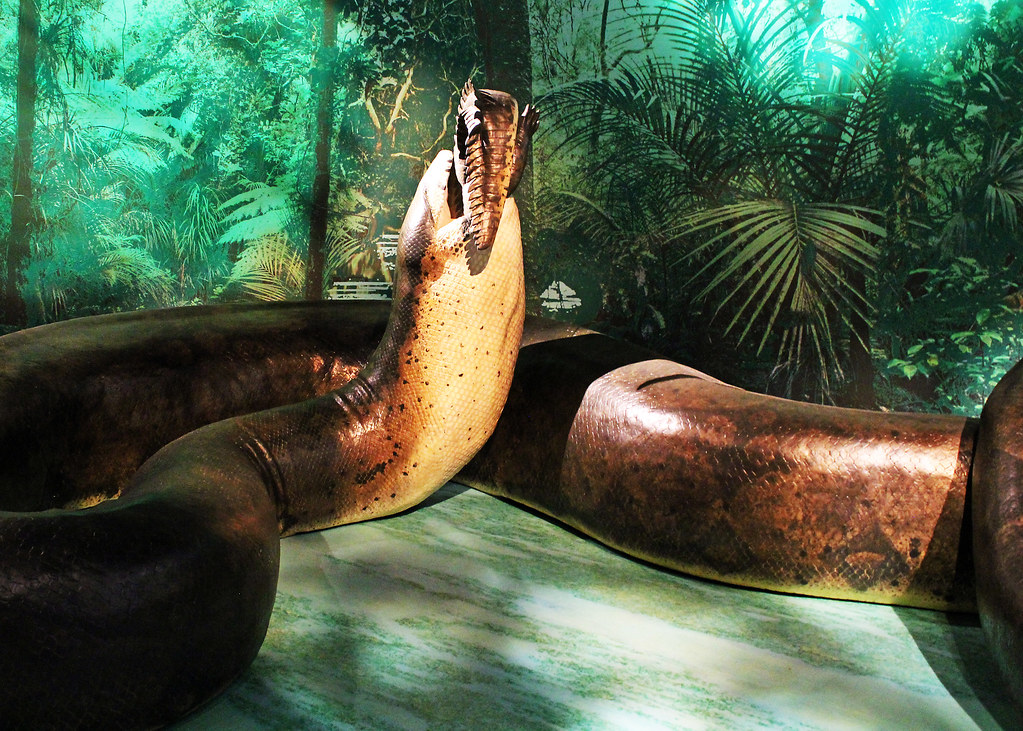
Forget everything you think you know about large snakes – Titanoboa cerrejonensis was a prehistoric serpent that measured up to 43 feet long and weighed as much as a small car. This Colombian giant lived around 60 million years ago in tropical rainforests so warm and humid they’d make the Amazon look temperate. The discovery of Titanoboa revolutionized our understanding of both snake evolution and ancient climate conditions. The snake’s massive size indicated that temperatures in prehistoric Colombia were much warmer than today – warm enough to support cold-blooded reptiles of incredible proportions. Unlike modern constrictors that primarily hunt mammals, Titanoboa likely fed on giant crocodiles and large fish in the swampy environments of ancient South America. The thought of a snake capable of overpowering a crocodile seems like something from mythology, yet fossil evidence proves these titans once slithered through prehistoric jungles.
Opabinia: The Five-Eyed Vacuum Cleaner
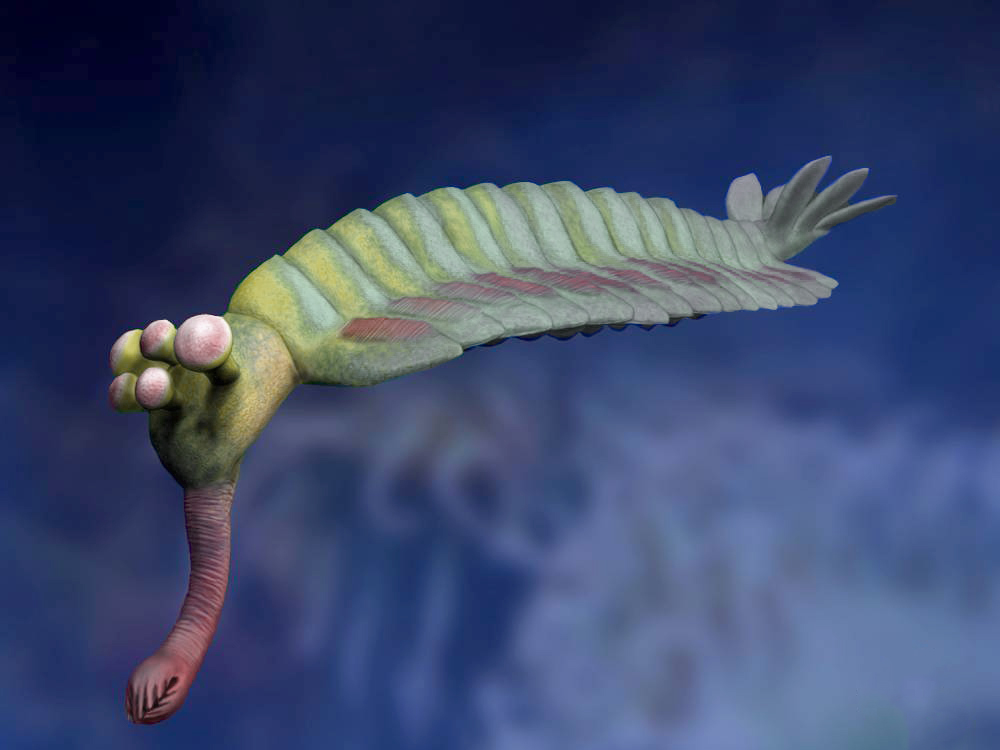
Opabinia regalis looks like nature’s attempt at creating the most impractical creature possible – a soft-bodied animal with five mushroom-shaped eyes and a flexible proboscis tipped with a claw-like grabber. This Cambrian oddity measured about 3 inches long but packed more weirdness than creatures ten times its size. The creature’s most distinctive feature was its vacuum-cleaner-like proboscis, which it used to pluck small prey from the seafloor and transfer them to its mouth located underneath its body. The arrangement of five eyes on stalks gave Opabinia nearly 360-degree vision, an adaptation that seems almost alien in its efficiency. What makes Opabinia particularly fascinating is that it represents an evolutionary experiment that went nowhere – it has no known living relatives and appears to be nature’s one-off creation. This creature embodies the explosive creativity of the Cambrian period, when life was testing out body plans that would never be tried again.
Helicoprion: The Buzzsaw Shark
Imagine a shark with a lower jaw that formed a perfect spiral of teeth, creating what looked like a living buzzsaw – that was Helicoprion, one of the most puzzling creatures ever pulled from ancient seas. For over a century, paleontologists debated how this bizarre dental arrangement could possibly function. The creature’s “tooth whorl” contained dozens of sharp teeth arranged in a spiral that could grow several feet in diameter. Recent research suggests that Helicoprion used this unusual appendage like a can opener, slicing into soft-bodied prey such as squids and other cephalopods that were abundant in Permian seas. What’s particularly mind-bending about Helicoprion is that it survived for millions of years with this seemingly impractical design. The fossil evidence shows these creatures thrived across multiple continents, proving that sometimes evolution’s strangest experiments can be surprisingly successful. Their extinction at the end of the Permian period coincided with the greatest mass extinction in Earth’s history, taking this living puzzle piece with it.
Wiwaxia: The Medieval Knight of Ancient Seas
Wiwaxia corrugata looked like someone crossed a slug with a medieval knight’s armor, creating a creature bristling with spines and covered in scale-like armor plates. This Cambrian period oddball crawled along ancient seafloors, protected by an array of defensive spikes that would make a porcupine jealous. The creature’s body was covered in two types of protective structures: flat, overlapping scales that provided basic armor, and longer spines that jutted out at various angles to deter predators. This dual-defense system was so effective that Wiwaxia fossils are relatively common in Burgess Shale deposits, suggesting these creatures thrived despite living during one of evolution’s most experimental periods. Scientists initially struggled to classify Wiwaxia, with some suggesting it was related to mollusks while others argued for a connection to annelid worms. Recent studies lean toward the mollusk theory, making Wiwaxia a possible ancestor of modern chitons, though its exact evolutionary relationships remain debated.
Dunkleosteus: The Armored Killing Machine
Dunkleosteus terrelli was essentially a 30-foot-long swimming guillotine, equipped with bony plates instead of teeth that could slice through almost anything in Devonian seas. This prehistoric fish redefined what it meant to be an apex predator, combining massive size with bone-crushing jaw power. Rather than traditional teeth, Dunkleosteus possessed sharp, bony plates that functioned like self-sharpening blades. Scientists estimate that this ancient predator could generate a bite force of up to 11,000 pounds per square inch – enough to snap a shark in half with a single chomp. The creature’s head and front portion were encased in thick bony armor, earning it the nickname “the armored fish.” This protection came at a cost, though – the heavy armor likely made Dunkleosteus a relatively slow swimmer, forcing it to rely on ambush tactics rather than high-speed chases. When you can bite through bone and armor plating, however, speed becomes less important than raw crushing power.
Tully Monster: The Unclassifiable Enigma
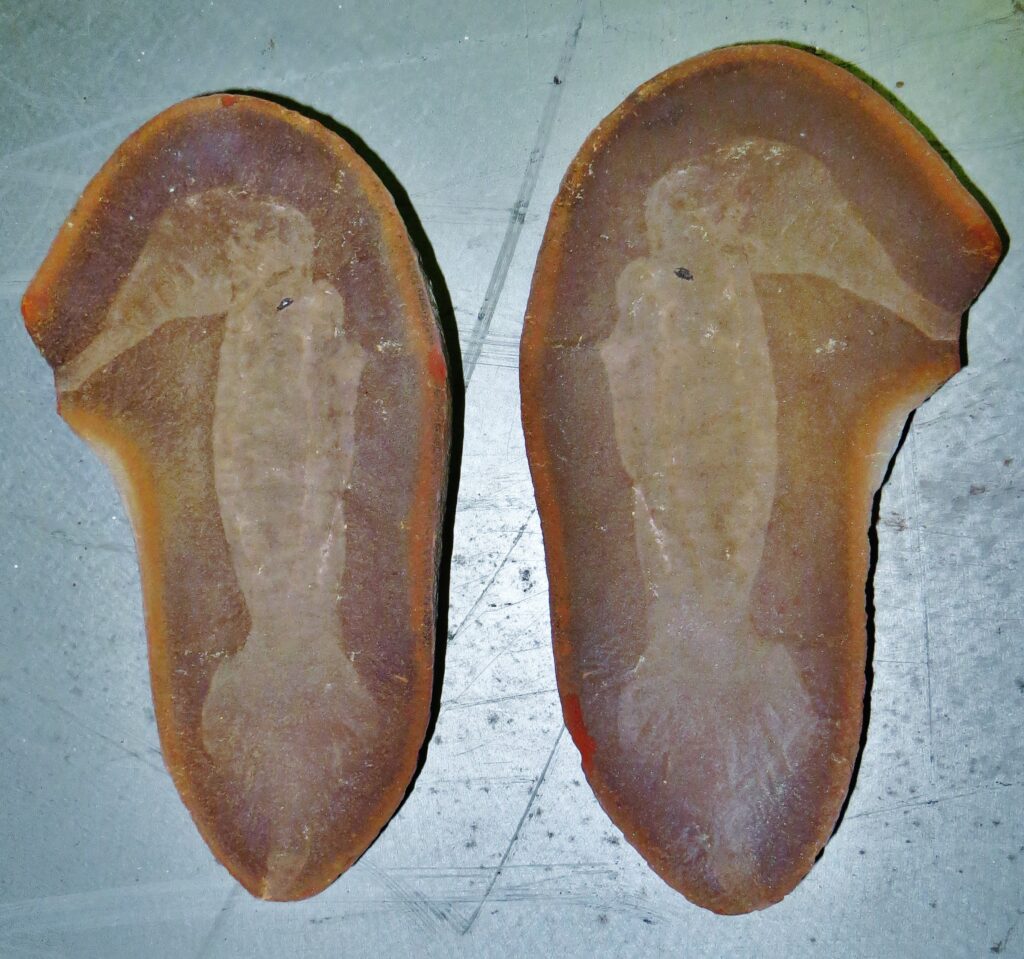
Tullimonstrum gregarium, better known as the Tully Monster, has puzzled scientists for over 50 years since its discovery in Illinois coal deposits. This 14-inch-long creature possessed a combination of features so unusual that researchers still can’t agree on what type of animal it actually was. The Tully Monster’s most distinctive feature was its long proboscis tipped with a toothy claw, which extended from what appeared to be its head region. Along its sides ran a series of fins or flaps, while its tail ended in a diamond-shaped fin similar to those found on some fish. Perhaps most puzzling of all were the creature’s eyes, which sat at the ends of rigid stalks extending from either side of its body. This arrangement has no known parallel in the animal kingdom, making the Tully Monster a true biological mystery. Despite decades of study and hundreds of fossil specimens, scientists continue to debate whether it was a vertebrate, invertebrate, or something else entirely.
Therizinosaurus: The Giant Sloth Bear That Was Actually a Dinosaur
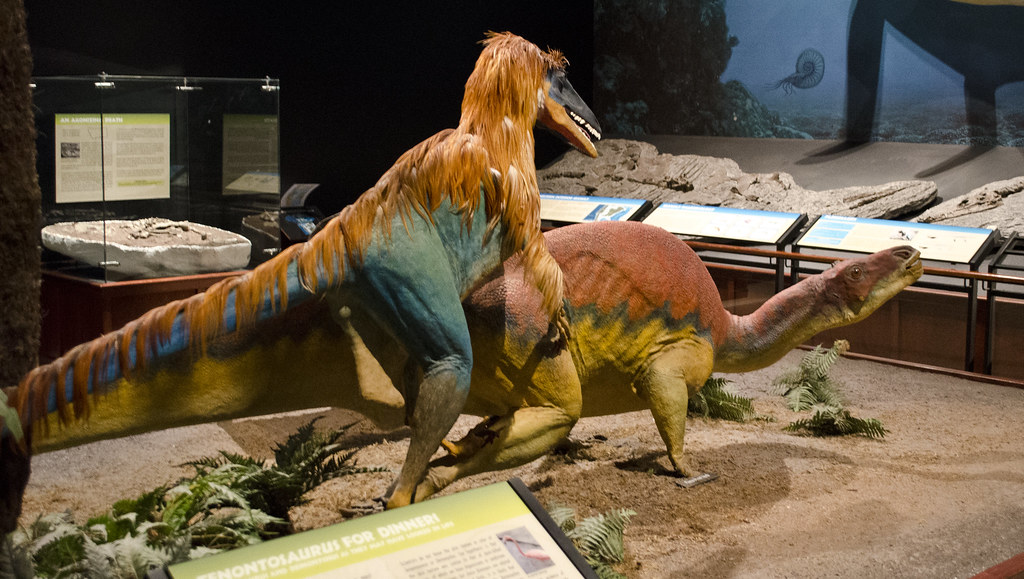
Therizinosaurus cheloniformis possessed claws that measured up to 3 feet long, attached to a creature that stood 16 feet tall and weighed as much as an elephant. For decades, paleontologists assumed these massive claws belonged to a giant turtle, leading to one of the most spectacular misidentifications in fossil history. When complete skeletons were finally discovered, scientists realized they were looking at one of the largest theropod dinosaurs ever found – but one that had evolved to be completely herbivorous. Those fearsome claws weren’t weapons but tools for stripping vegetation from tall trees, like massive pruning shears designed by nature. The revelation that Therizinosaurus was actually a plant-eating dinosaur challenged assumptions about theropod evolution and showed how dramatically these predatory dinosaurs could adapt to new ecological niches. Imagine the surprise of the first paleontologists who realized their “giant turtle” was actually a dinosaur that could have looked a T. rex in the eye.
Pikaia: The Ancestor We Almost Weren’t
Pikaia gracilens may not look like much – a 2-inch-long, worm-like creature from the Cambrian seas – but this unassuming animal represents one of the most important evolutionary transitions in Earth’s history. This tiny swimmer was one of the earliest chordates, making it a distant ancestor of every vertebrate alive today, including humans. The creature possessed a flexible rod running along its back called a notochord, the precursor to the vertebral column that would eventually become the backbone in more advanced animals. Its simple body plan included a pair of tentacles on its head and fins along its sides for swimming through Cambrian waters. What makes Pikaia’s story so remarkable is how easily it could have been lost to extinction. Fossil evidence suggests these early chordates were relatively rare compared to the arthropods and other invertebrates that dominated Cambrian seas. If conditions had been slightly different, the entire vertebrate lineage might never have evolved, and Earth’s history would have taken a completely different path.
Carnotaurus: The Horned Devil of South America
Carnotaurus sastrei earned its name, which means “meat-eating bull,” from the pair of prominent horns that jutted from its skull like a demonic crown. This 25-foot-long predator combined the hunting prowess of a theropod dinosaur with features so unusual they seemed borrowed from mythology. Unlike most large theropods, Carnotaurus was built for speed rather than brute strength. Its legs were proportionally longer than those of T. rex, and its body was more streamlined, suggesting it could run down prey in open pursuit rather than relying on ambush tactics. The creature’s arms were so reduced they made T. rex look well-armed by comparison – Carnotaurus had virtually no arms at all, just tiny vestigial bumps where arms should have been. This extreme reduction suggests that for Carnotaurus, everything was about the legs, jaws, and those distinctive horns. The combination created a predator that looked more like a charging demon than a typical dinosaur.
Ammonites: The Spiral Shells That Ruled Ancient Seas
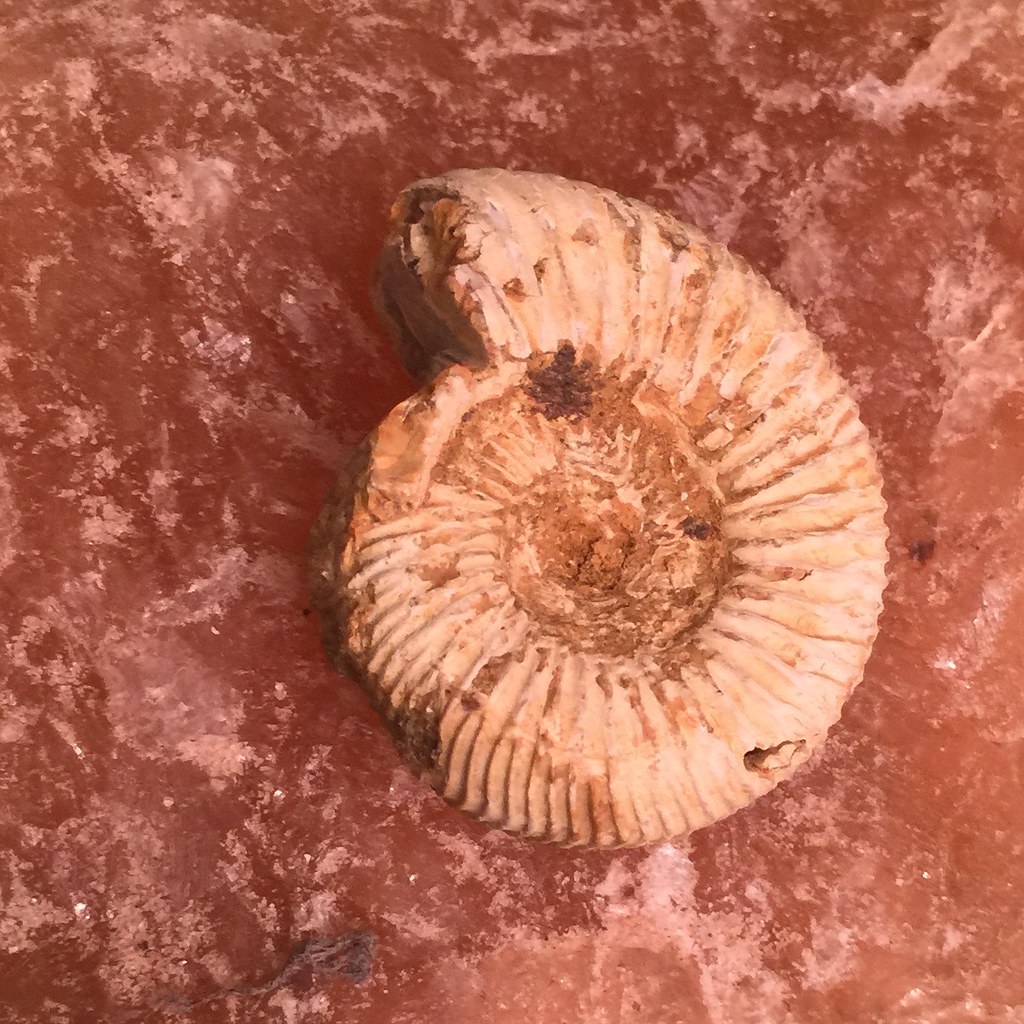
Ammonites were the cephalopod success story of the Mesozoic Era, evolving into thousands of species with shells that ranged from simple spirals to elaborate sculptures that resembled living art pieces. These relatives of modern squids and octopuses dominated marine ecosystems for over 300 million years. The variety of ammonite shell shapes and decorations was staggering – some species developed shells with ribs, spines, and flanges that created complex geometric patterns. Scientists believe these ornate shells served multiple purposes: streamlining for efficient swimming, protection from predators, and possibly even species recognition signals. What makes ammonites particularly fascinating is their sudden and complete extinction at the end of the Cretaceous period, the same event that killed the dinosaurs. Unlike their cephalopod relatives that survived in the deep ocean, every single ammonite species vanished, ending one of evolution’s most successful experiments in shell design. Their fossilized shells now serve as some of the most beautiful and important index fossils, helping geologists date rock layers around the world.
Arthropleura: The Giant Millipede That Wasn’t
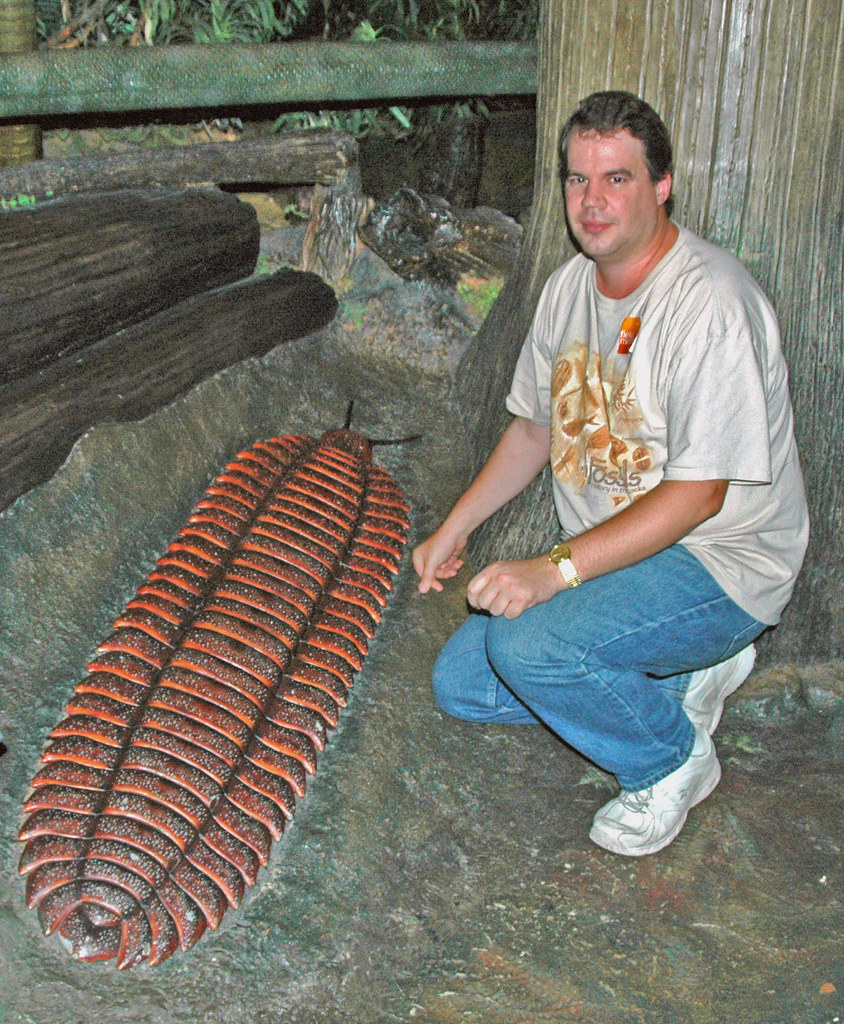
Arthropleura was a giant arthropod that stretched up to 8 feet long and resembled a massive millipede, but recent research suggests it may have been something entirely different. These Carboniferous giants roamed ancient forests 300 million years ago, when Earth’s atmosphere contained much higher oxygen levels than today. Despite their millipede-like appearance, Arthropleura likely had fewer legs than true millipedes and may have been more closely related to centipedes or even represented a completely separate arthropod lineage. Their diet remains a mystery – while their size suggests they were formidable predators, some evidence points to herbivorous feeding habits. The extinction of Arthropleura coincided with changes in atmospheric oxygen levels and climate conditions at the end of the Carboniferous period. These giants serve as a reminder that Earth’s ancient atmosphere was dramatically different from today’s, supporting ecosystems filled with creatures that couldn’t survive in our current environment. The thought of 8-foot-long arthropods scuttling through prehistoric forests adds an element of the fantastic to our planet’s deep history.
Conclusion: When Reality Surpasses Fiction
These bizarre prehistoric creatures remind us that Earth’s history is filled with evolutionary experiments so strange they challenge our imagination. From five-eyed vacuum cleaners to armored fish with bone-crushing jaws, the fossil record reveals a planet where the impossible became routine and the unthinkable thrived for millions of years. What’s perhaps most remarkable about these ancient oddities is that they weren’t failures – many of these bizarre body plans were incredibly successful, dominating their ecosystems for vast stretches of geological time. They remind us that evolution doesn’t follow a predetermined path toward familiar forms, but instead explores every possible solution to the challenges of survival.
Conclusion
As we continue to unearth new fossils from around the world, we’re constantly reminded that we’ve only scratched the surface of life’s incredible diversity throughout Earth’s history. Each new discovery has the potential to reveal creatures even stranger than the ones we’ve already found, creatures that will once again challenge our understanding of what’s possible in the natural world. Every time you see a science fiction movie featuring bizarre alien creatures, remember that our own planet once hosted beings just as strange and wonderful. Who knows what other incredible monsters are still waiting to be discovered in the rocks beneath our feet?