The Amazon Basin stands as a powerhouse of nature’s hydrological cycle, where vast forests actively produce and export moisture that nourishes agriculture and cities across South America.
Tropical Forests as Rain Factories
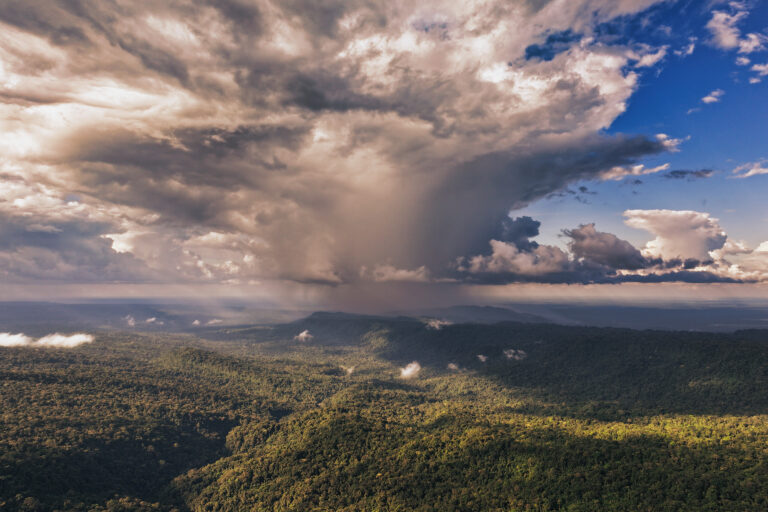
Tropical Forests as Rain Factories (Image Credits: Imgs.mongabay.com)
Researchers revealed that each square meter of tropical forest generates about 240 liters of rainfall annually across surrounding landscapes, with Amazon forests reaching up to 300 liters per square meter.
This output dwarfs traditional exports like timber. Forests release water vapor through evapotranspiration, drawing moisture from deep soils and pumping it into the atmosphere via leaves. Satellite data confirmed these effects, showing that even modest forest loss triggers measurable rainfall declines. In the Brazilian Amazon, small reductions in tree cover linked to dry-season precipitation drops of around five percent. Such findings underscore forests’ active role in climate dynamics.
The Mechanics of Moisture Recycling
Trees in the Amazon absorb rainwater through roots and transpire it back into the air, forming invisible “flying rivers” that carry vapor hundreds or thousands of kilometers.
These aerial streams sustain ecosystems far downstream, including farmlands in southern Brazil and beyond. Roughly three-fifths of land precipitation stems from terrestrial evaporation, much driven by plants. Winds transport this moisture westward, where it condenses into clouds and falls as rain. The process recycles water multiple times, with the Amazon creating up to 80 percent of its own rainfall. Degradation from logging weakens this cycle by reducing canopy density.
- Evapotranspiration pumps billions of tons of water daily into the atmosphere.
- Flying rivers support river flows, hydropower, and crop irrigation.
- Moisture travels from Atlantic inflows, recycled over the continent.
- Forest loss disrupts circulation, amplifying dry spells.
A $20 Billion Economic Lifeline
Forest-generated rain in the Brazilian Amazon alone holds an estimated $20 billion annual value, based on agricultural water prices – equivalent to $60 per hectare, surpassing timber revenues.
This service bolsters 85 percent of Brazil’s rain-fed agriculture, from soybeans to cotton. Hydropower dams rely on sustained river discharge fueled by this precipitation. Cities draw from reservoirs replenished by these flows. Dr. Jess Baker noted, “The Amazon alone produces rainfall worth US$20 billion each year.” Such valuations highlight forests’ role in regional prosperity.
Deforestation’s Cascade of Risks
Each percentage point of tropical forest loss cuts regional rainfall by 2.4 millimeters yearly, with amplified effects in the Amazon.
Clearing one square kilometer eliminates hundreds of millions of liters of rain production. This undermines crop viability, as certain fields may need more upstream forest than their own area. Fires and fragmentation exacerbate vulnerabilities, pushing toward a tipping point with drier conditions. Combined with climate shifts, these changes threaten South America’s breadbasket. Policymakers now weigh these hydrological costs against short-term gains.
Key Takeaways
- Amazon forests generate rainfall worth $20 billion yearly through flying rivers.
- Deforestation reduces precipitation by 2.4 mm per percent forest loss.
- This moisture sustains agriculture, hydropower, and water supplies continent-wide.
Protecting the Amazon means safeguarding a natural infrastructure more valuable than any commodity it yields. What steps should nations take to preserve these rain-generating ecosystems? Share your thoughts in the comments.