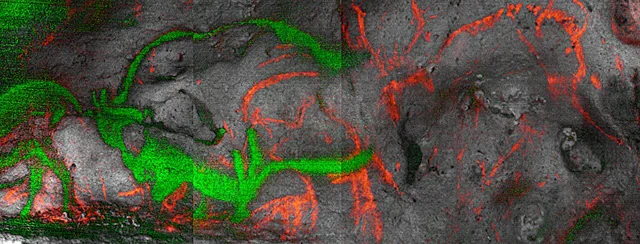
Armenia – Excavations at Lusakert Cave 1 have provided geochemical evidence that Middle Paleolithic hominins managed fire without relying on natural wildfires around 60,000 to 40,000 years ago. Researchers analyzed sediment samples to distinguish between hearth fires and environmental blazes, uncovering a pattern tied to human activity rather than climate-driven events. This finding challenges earlier views on when early humans fully harnessed this transformative technology, suggesting habitual control emerged earlier in prehistory.
Traces of Fire in Ancient Sediments

Traces of Fire in Ancient Sediments (Image Credits: Reddit)
High concentrations of heavy polycyclic aromatic hydrocarbons, or hPAHs, appeared in layers rich with stone tools and artifacts at the site. These compounds form during low-temperature wood burning typical of campfires, accumulating locally from hominin hearths. In contrast, light PAHs linked to widespread wildfires showed no such pattern.
Statistical analysis confirmed a strong correlation between hPAHs and occupation density, with a Pearson’s r value of 0.826. Layers 5 and 6 stood out, featuring elevated hPAHs amid low wildfire indicators. Charcoal and burnt bones further supported repeated fire use during intensive site visits.
Unraveling the Chemistry of Control
Scientists employed gas chromatography and mass spectrometry to quantify PAHs, separating those with 5-6 rings from lighter 3-4 ring variants. Wildfires produce mostly light PAHs that disperse over large areas, while hearth emissions favor heavier ones due to particulate settling near the source. This distinction proved crucial in linking fire traces to hominin behavior.
Stable isotope data from plant waxes added context, tracking vegetation and climate shifts without influencing the hPAH spikes. The lack of correlation between light and heavy PAHs, with a Spearman’s rho of just 0.141, ruled out natural fires as the primary source. Hominins thus maintained flames even when regional blazes were scarce.
Shifting the Timeline of Pyrotechnology
Evidence of fire exploitation dates back 1.5 million years, with control emerging before 300,000 years ago and deliberate creation around 50,000 years ago. The Lusakert findings demonstrate habitual, independent use during the Middle Paleolithic, a period associated with Neanderthals and early modern humans. Researchers noted spatial variability across sites, hinting at multiple developments within the Homo genus.
Prior studies from French Middle Paleolithic contexts showed different patterns, underscoring regional differences. At Lusakert, Levallois-style tools and obsidian artifacts aligned with peak fire evidence, painting a picture of sustained occupation warmed by controlled flames.
- 60–40 ka: Lusakert Cave occupation with independent fire use.
- <300 ka: Earliest fire control evidence.
- 50 ka: Oldest signs of fire creation.
- 1.5 Ma: Initial fire exploitation.
Implications for Early Human Adaptation
Mastery of fire offered warmth, protection, and cooking advantages, enabling expansion into diverse environments. The Armenian evidence suggests pyrotechnology played a key role in Middle Paleolithic survival strategies, decoupled from seasonal wildfire availability. This capability likely persisted across generations, fostering cultural transmission.
Debates continue on whether fire control contributed to Neanderthal extinction, but the study dismisses exclusivity to Upper Paleolithic modern humans. Instead, it highlights a shared technological heritage among archaic populations. Methods from this research could now apply to other sites, refining global fire-use maps.
| PAH Type | Rings | Source | Deposition |
|---|---|---|---|
| Light PAHs (lPAHs) | 3–4 | Wildfires | Regional dispersal |
| Heavy PAHs (hPAHs) | 5–6 | Hearths | Local accumulation |
- Middle Paleolithic hominins at Lusakert Cave controlled fire independently of wildfires 60–40,000 years ago.
- hPAHs correlated strongly with artifacts, proving habitual use.
- This pushes understanding of pyrotechnology’s antiquity and variability.
These revelations from Lusakert Cave reshape narratives of human ingenuity, showing fire as a reliable tool long before modern humans dominated. As research advances, more sites may illuminate this pivotal innovation. What do you think this means for our ancestors’ daily lives? Tell us in the comments.