Arvorezinha, Brazil – The admirable redbelly toad, a diminutive amphibian endemic to a mere stretch of southern Brazilian riverbank, continues to capture attention for its outsized role in environmental battles.
A Pocket-Sized Powerhouse Halts Progress
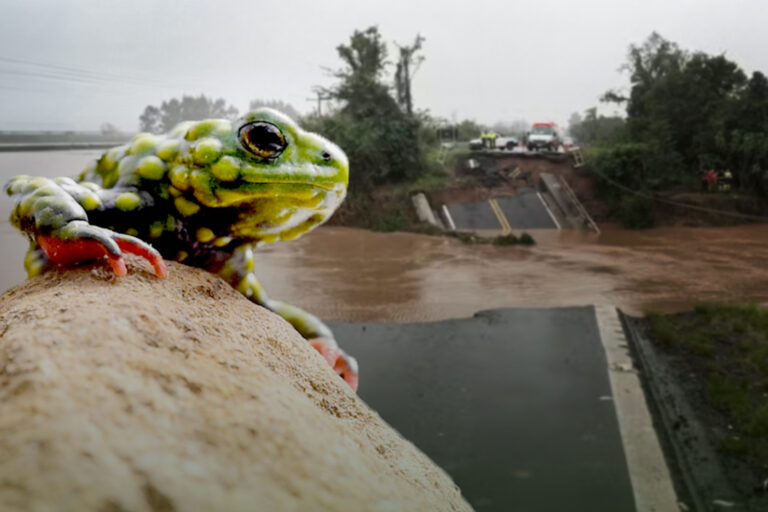
A Pocket-Sized Powerhouse Halts Progress (Image Credits: Imgs.mongabay.com)
Researchers first described Melanophryniscus admirabilis in 2006, marveling at its vibrant green back, colorful legs, and toxin-secreting belly glands marked by unique spot patterns like stellar constellations. This thumb-sized toad walks rather than hops and thrives in rocky outcrops amid humid forest. Its explosive breeding strategy relies on ephemeral puddles formed after heavy rains followed by warm sun.
In 2014, the species achieved a landmark victory. A proposed hydroelectric plant on the Forqueta River threatened to alter flows essential for the toad’s survival. Less than 300 meters from the habitat, the project risked extinction for the entire population of just over 1,000 individuals. Scientists from the Federal University of Rio Grande do Sul’s Herpetology Laboratory mobilized data showing critical endangerment. Brazil’s Federal Prosecution Service then embargoed construction – the first time an amphibian halted such a development.
Life on a Razor’s Edge
The toad occupies less than 700 meters of river margin in Perau de Janeiro, a steep valley surrounded by tobacco fields and pastures. Rocky edges and riparian forest provide moisture and cover, but the area spans only 0.035 square kilometers. Males call from elevated spots during late winter to early summer, drawing females to mate in sun-warmed pools.
Conservationists monitor the population through non-invasive photo-identification of belly patterns and genetic sampling. Divided into 31 monitoring quadrats, the site reveals steady reproduction cycles despite pressures. The habitat earned recognition as a Key Biodiversity Area in 2018.
Enduring Nature’s Fury
May 2024 brought Rio Grande do Sul’s worst floods on record, with the Forqueta River surging 20 meters and reshaping the landscape. Outcrops vanished under torrents, affecting 2.4 million people across 478 municipalities. Researchers feared the worst for this microendemic species.
Yet, in October 2025, teams recaptured 111 toads – including tadpoles and mating pairs – across the quadrats. “They are reproducing, which means the cycle has been maintained,” noted Michelle Abadie of the herpetology lab. Vegetation rebounded, signaling resilience, though preferred sites shifted.
Threats and Safeguards Ahead
Climate shifts amplify dangers, with droughts drying puddles and floods eroding habitat. Southern Brazil now sees 20% higher peak river flows and fivefold more extreme events. Agriculture encroaches via monocultures, while poaching looms for this strikingly colored toad.
Efforts persist through Brazil’s National Action Plan for threatened species and a proposed state bill declaring it genetic heritage. Community involvement, including schools near the private-land site, fosters stewardship.
- Photo-identification for population tracking
- Genetic studies via buccal swabs
- Habitat quality assessments
- Public awareness campaigns
- Policy advocacy against development
Key Takeaways
- The toad’s 2014 dam victory marked a global first for amphibian-led conservation.
- Post-2024 floods, reproduction persists, proving adaptability.
- Integrated monitoring and policy offer hope against mounting climate threats.
This toad’s story underscores nature’s tenacity and the value of proactive protection. What steps should communities take next to secure such fragile wonders? Tell us in the comments.