Brazil – Paleontologists announced a new species of enormous sauropod dinosaur whose Brazilian fossils closely match one from Spain, confirming land pathways linked the continents roughly 120 million years ago.
A Titan Emerges from Roadworks
A Titan Emerges from Roadworks (Image Credits: Wikimedia)
Workers at a construction site near Davinópolis in northeastern Maranhão state uncovered massive bones in 2021 that hinted at something extraordinary.
Those remains turned out to belong to one of Brazil’s largest known dinosaurs. The excavation revealed a partial skeleton, including a femur stretching 1.5 meters – longer than the height of many adults.
Elver Mayer of the Federal University of the São Francisco Valley led the research team. Leonardo Kerber, a paleontologist at the Federal University of Santa Maria, described the moment: “As the excavation progressed over the days, we began to see the evidence of that huge bone, which is the femur.”
He added, “This indicates it was a very large dinosaur. Today we know Dasosaurus is among the biggest dinosaurs ever found in Brazil.”
The fossils came from the Itapecuru Formation, dating to the Early Cretaceous period.
Dasosaurus tocantinensis: Anatomy of a Giant
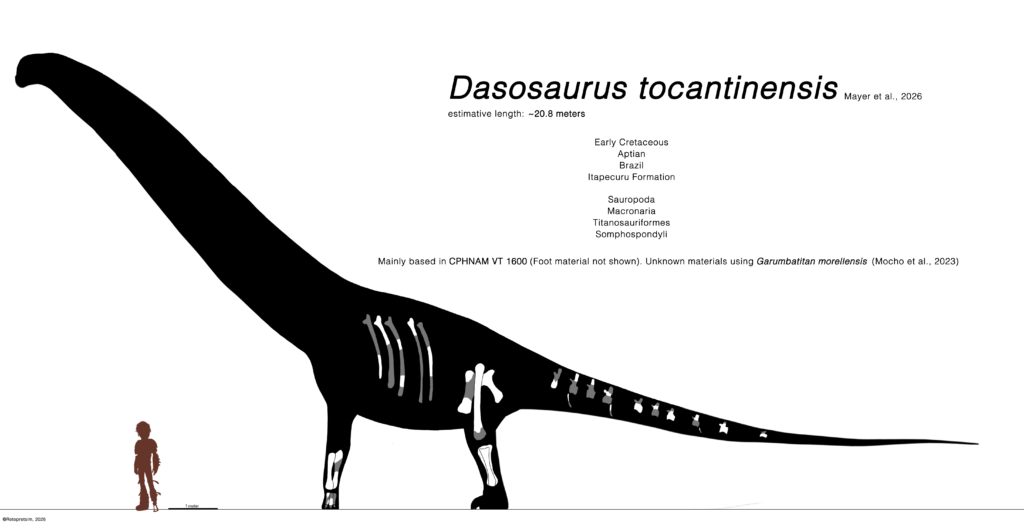
Researchers named the creature Dasosaurus tocantinensis, honoring the nearby Tocantins River.
This somphospondylan sauropod measured about 20 meters in length, comparable to two city buses placed end to end. Unique traits set it apart: its tail vertebrae featured three elongated ridges and grooves, while the thigh bone displayed a pronounced lateral bulge – features not combined in any prior species.
These characteristics placed Dasosaurus outside the dominant titanosaur group that later thrived in southern continents. The team detailed their findings in the Journal of Systematic Palaeontology.
- Femur length: 1.5 meters
- Total estimated length: 20 meters
- Distinct tail vertebrae: Three ridges and grooves
- Thigh bone feature: Pronounced lateral bulge
- Classification: Somphospondyli (titanosauriform sauropod)
Such details helped confirm its status as a novel species.
Unexpected European Cousin
Analysis linked Dasosaurus to Garumbatitan morellensis, a sauropod described from Spain that lived around 122 million years ago. Dasosaurus emerged as its closest known relative. This connection suggested their shared lineage originated in Europe before migrating southward.
Dispersal likely occurred via northern Africa between 137 and 113 million years ago, during the Valanginian to Aptian stages. At that time, the supercontinent Gondwana still held sway, with land bridges facilitating movement before the South Atlantic widened.
The Brazilian find thus illuminated faunal exchanges across regions now oceans apart.
Reshaping Early Cretaceous Maps
The discovery expanded the known variety of Early Cretaceous sauropods in northern South America.
Dr. Max Langer of the Universidade de São Paulo noted, “Apart from expanding the known diversity of Early Cretaceous sauropods in the northern part of South America, this discovery highlights biogeographical connections with more northern Gondwanan areas, as well as Europe.”
Numerical analyses supported a European origin for the Dasosaurus-Garumbatitan clade, challenging views of South America as an isolated outpost. These insights refine understandings of dinosaur migrations amid shifting plates.
Key Takeaways
- Dasosaurus tocantinensis ranks among Brazil’s largest dinosaurs at 20 meters long.
- Its closest kin, Garumbatitan morellensis, hails from Spain.
- The fossils prove active land routes tied Europe, Africa, and South America in the Early Cretaceous.
This Brazilian behemoth reminds us how dinosaurs roamed vast, unbroken landscapes long before modern borders emerged. What do you think about these transcontinental ties? Tell us in the comments.