Researchers have unlocked new insights into the secretive world of whitespotted eagle rays through innovative biologging technology.
Conquering Long-Standing Tagging Barriers
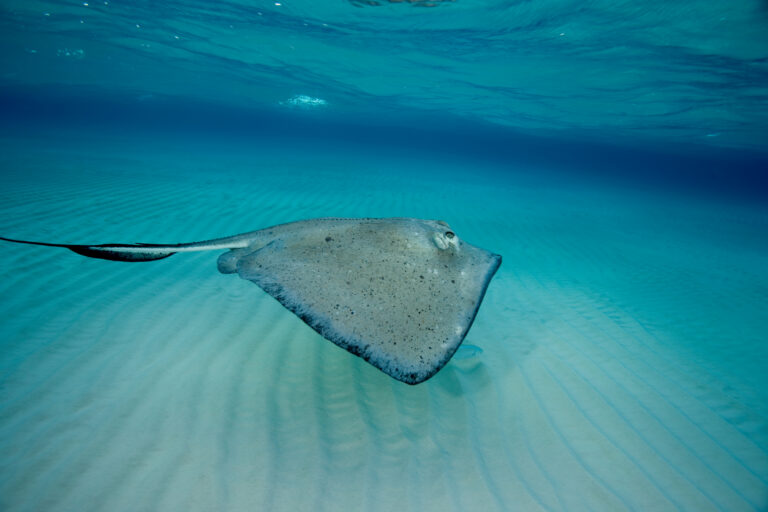
Conquering Long-Standing Tagging Barriers (Image Credits: Imgs.mongabay.com)
Biologging devices transformed studies of large marine species such as whales, sharks, and dolphins decades ago. Stingrays posed unique difficulties, however. Their ultra-smooth skin and absence of a dorsal fin thwarted traditional attachments, especially amid powerful swimming in turbulent waters.
A team at Florida Atlantic University’s Harbor Branch Oceanographic Institute tackled these issues head-on. They designed a compact multi-sensor tag tailored for the whitespotted eagle ray, a durophagous species that crushes hard-shelled prey like clams and conch. This ray spans over two meters in wingspan and weighs hundreds of kilograms, yet evaded detailed observation until now. Field tests in Bermuda marked the first successful deployments on such rays.
Clever Attachment Secures Critical Data
The tag affixes via two silicone suction cups on the anterior dorsal surface, paired with straps hooked to the spiracles – small openings behind the eyes. A galvanic timed release ensures detachment after 24 or 48 hours. This setup endured up to 59.2 hours in the wild, the longest recorded for external tags on pelagic rays.
Captive trials in Florida refined the method, boosting retention significantly. The 24.1 by 7.6 by 5.1 centimeter package weighs 430 grams in air and floats positively in water. Deployment takes seconds, minimizing stress and allowing natural behaviors.
Multi-Sensor Arsenal Captures Rich Insights
Sensors pack a punch within the lightweight frame. An inertial measurement unit logs motion at 50 hertz via accelerometers, gyroscopes, and magnetometers. A video camera records at 30 frames per second, while a broadband hydrophone detects sounds up to 22 kilohertz. Satellite and acoustic transmitters track positions.
- Motion data reveals swimming rhythms and postural shifts during feeding.
- Audio captures shell-cracking crunches, pinpointing predation events.
- Video documents habitats like sandy bottoms, reefs, and algal meadows down to 22 meters.
- Depth, temperature, and light sensors map environmental context.
Machine learning models, such as Random Forest, classify behaviors with high accuracy from synchronized streams.
Unveiling Foraging and Social Dynamics
Deployments exposed distinct activities. Rays browsed by skimming sediment with their rostrum, dug vertically for prey, and processed catches with audible snaps. One ray logged 16 feeding bouts, ascending over a meter post-capture. Social interactions and habitat preferences emerged, favoring high-flow inlets.
“We’re now able to observe not just where these rays go, but how they feed, how they move through their habitats, and how they interact with other species – insights that were virtually impossible to capture before,” said Matt Ajemian, senior author and lab director.
| Behavior | Key Indicators |
|---|---|
| Swimming | Wing oscillations, steady depth |
| Browsing | Rostrum skimming, low acceleration |
| Digging/Feeding | Pitching dives, shell-crunch sounds |
Boosting Conservation Through Better Understanding
Whitespotted eagle rays face global threats, classifying them as endangered. These tags position them as sentinels for ecosystem health, tracking prey like queen conch amid restoration efforts. Adaptations could suit other smooth-bodied rays or turtles.
The findings appeared in Animal Biotelemetry, with details in the FAU announcement.
This advance promises expanded monitoring, revealing how climate and habitat loss reshape marine food webs. What behaviors surprise you most in these ocean nomads? Share in the comments.
Key Takeaways
- First multi-sensor tags stayed on eagle rays up to 60 hours despite rough conditions.
- Sound and motion alone detect shell-crushing feeds, enabling simpler future devices.
- Data maps full behavioral repertoires, aiding protection of vulnerable species.