Early tetrapods, the first vertebrates to venture onto land around 375 million years ago, faced profound challenges in adapting their bodies to terrestrial life. A recent study analyzed fossils from 344 species spanning the Middle Devonian to Early Permian, revealing how respiratory changes drove key evolutionary shifts. Researchers found that innovations in lung ventilation decoupled body size limits and skull shapes, paving the way for the dominance of amniotes over lissamphibian-like lineages. These adaptations reshaped necks, ribs, and heads in ways that echoed through modern vertebrates.
Ancestral Constraints in the Water-to-Land Transition
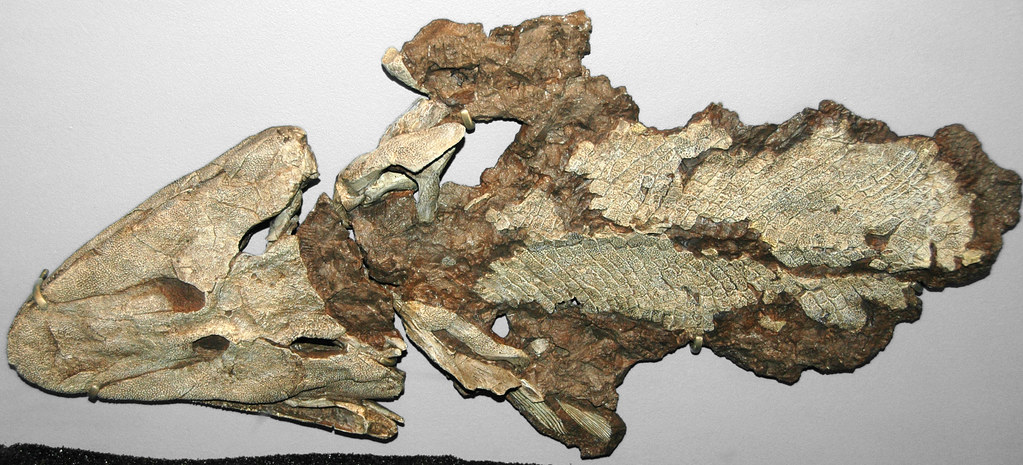
Ancestral Constraints in the Water-to-Land Transition (Image Credits: Flickr)
Primitive tetrapods inherited a respiratory system suited to aquatic life, relying on buccal pumping for lung ventilation and cutaneous gas exchange for oxygen and carbon dioxide. This setup imposed tight limits on body size and skull proportions. Ancestral forms started large but shifted toward smaller sizes on both the amniote and lissamphibian stems.
Short necks without distinct cervical vertebrae characterized early elpistostegalians, the fish-like precursors to tetrapods. Ribs remained short and straight, restricting mobility and ventilation efficiency on land. Such morphology favored broad, flat skulls adapted for buccal force but hindered deeper head shapes.
Short Necks and Ribs Defined Lissamphibian Precursors
Lissamphibian ancestors, including groups like Dissorophoidea and Amphibamiformes, evolved even shorter cervical regions compared to early tetrapods. Their ribs stayed short and straight, preserving the ancestral buccal pumping mode. This reliance on skin-based gas exchange demanded small bodies to maintain favorable surface-to-volume ratios for CO2 expulsion.
Quantitative models showed stronger evolutionary constraints in these lineages, with body sizes rarely exceeding small frog-like dimensions today – from 0.03 to 10,800 grams. Skull heights faced tight limits, enforcing flat profiles that limited muscle arrangements and bite forces. These patterns persisted, explaining why modern amphibians remain ecologically niche compared to their amniote relatives.
Costal Ventilation Sparked Amniote Freedom
Stem amniotes broke free through the evolution of costal lung ventilation, powered by mesiodistally curved, elongate ribs. This shift appeared early, as seen in fossils like Ichthyostega and Whatcheeria. Cervical counts increased, enabling longer necks that enhanced rib cage expansion.
Curved ribs allowed efficient air pumping without relying on mouth movements, relaxing constraints on maximum body size and skull form. Statistical analyses confirmed lower evolutionary rates in costal-ventilating taxa, with half-lives for change stretching to 6-22 million years versus under 1 million in others. Crown amniotes inherited these traits, fueling size disparities from dwarf lizards to massive herbivores.
Skull Shapes Transformed by Respiratory Shifts
Buccal ventilation locked early tetrapods into low, broad skulls, as neck shortness and rib limits tied head proportions to pumping mechanics. Costal innovations released these bonds, permitting taller skulls in amniotes.
Density plots and boxplots from the study highlighted greater variance in relative skull height among curved-rib taxa. Deeper skulls accommodated partitioned jaw muscles, boosting occlusion pressures for diverse diets including herbivory. This macroevolutionary pattern unfolded over 60 million years post-divergence, undeterred by mass extinctions.
| Lineage | Cervical Count | Rib Morphology | Ventilation Mode | Body Size Constraint |
|---|---|---|---|---|
| Lissamphibian Precursors (e.g., Amphibamiformes) | Short | Short, straight | Buccal + cutaneous | Strong (small sizes) |
| Stem Amniotes (e.g., Ichthyostega) | Increased | Elongate, curved | Costal | Relaxed (size increase) |
Legacy of These Ancient Adaptations
The study’s phylogeny mapped these changes mosaically across temnospondyls and other early groups, with elongate ribs re-evolving in some like eryopiforms but retained short in amphibamiforms. Overall, respiratory evolution not only diversified tetrapod forms but established amniote supremacy in terrestrial realms by the Early Permian.
Findings underscore how subtle anatomical tweaks propelled vertebrates’ conquest of land. For full details, see the paper in Science Advances.
Key Takeaways
- Costal ventilation via curved ribs and longer necks relaxed body size and skull constraints in amniotes.
- Lissamphibian lines stayed small due to persistent buccal and cutaneous respiration.
- These shifts enabled skull height increases, supporting advanced feeding and larger bodies.
Respiratory ingenuity turned evolutionary bottlenecks into opportunities, shaping the backbone of modern land life. What implications do these findings hold for understanding vertebrate diversity today? Share your thoughts in the comments.