Thuringian Forest, Germany – Scientists have established a precise new age for the celebrated Bromacker fossil site, pushing its timeline back by four million years to 294 million years ago. This discovery emerged from analysis of a thin volcanic ash layer unearthed during recent excavations, offering fresh insights into life on the supercontinent Pangaea during the early Permian period. The refined dating positions Bromacker as a pivotal reference for understanding evolutionary shifts in ancient terrestrial communities.
Thin Ash Layer Yields Monumental Age Shift
Thin Ash Layer Yields Monumental Age Shift (Image Credits: Flickr)
A mere few millimeters of volcanic ash transformed perceptions of Bromacker’s antiquity. During 2024 digs at the former quarry between Tambach-Dietharz and Georgenthal, researchers spotted a striking dark, reddish-purple tuff layer amid surrounding sediments. This contrast sparked hope for datable material. Sophie König, a museologist with the Friedenstein Stiftung Gotha, noted the immediate distinction: “When we uncovered the dark, reddish-purple ash layer, the difference to the surrounding rock was immediately apparent.”
Zircon crystals preserved within the tuff proved ideal for high-precision analysis. Previously, the site lacked such direct radioisotopic dates, relying on broader stratigraphic correlations that placed it around 290 million years old. The new findings confirmed a latest Asselian age, specifically 294.1 ± 0.4 million years. This adjustment anchors the Tambach Formation more firmly in early Permian chronostratigraphy.
Advanced Technique Delivers Unprecedented Accuracy
Teams applied uranium-lead (U-Pb) CA-ID-TIMS dating, a cutting-edge method that measures decay in zircon minerals like an internal clock. Zircons incorporate uranium during volcanic eruptions but resist lead initially, allowing precise age calculations. Extraction occurred at Friedrich-Schiller-Universität Jena, with analysis in TU Bergakademie Freiberg’s metal-free clean room—Germany’s sole facility for this technique.
Dr. Lorenzo Marchetti of the Museum für Naturkunde Berlin led the effort, collaborating with experts including Jakob Stubenrauch, Alexandra Käßner, and Marion Tichomirowa. Their work yielded two mean sample ages: 294.1 ± 0.4 Ma and 295.1 ± 0.4 Ma, with the former preferred due to statistical coherence. Published in Gondwana Research, the study marks the first such high-resolution date for this lagerstätte.
Exceptional Window into Permian Biodiversity
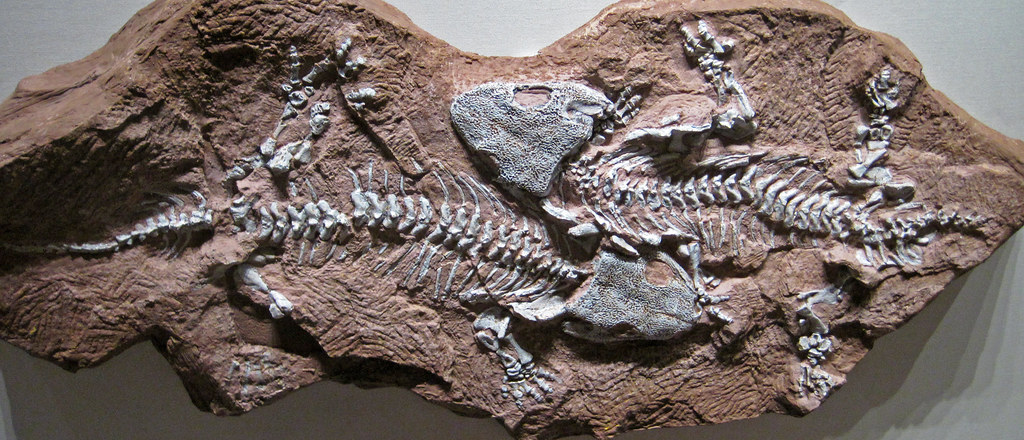
Bromacker stands out as a rare Permian konservat-lagerstätte, preserving articulated skeletons, trace fossils, and delicate remains in red beds of the Tambach Formation. Unlike typical sites dominated by aquatic forms or carnivores, it showcases a terrestrial ecosystem with abundant herbivorous diadectids amid seasonal floodplains and channels. The absence of fish underscores its upland setting on Pangaea.
Key discoveries include:
- Diadectes absitus and Orobates pabsti, pioneering herbivores that grazed on early vegetation.
- Seymouria sanjuanensis, a reptiliomorph bridging amphibian-reptile transitions.
- Synapsids like Dimetrodon teutonis and Tambacarnifex unguifalcatus, early mammal-line predators.
- Reptiles such as Eudibamus, displaying bipedal locomotion, and burrowing forms like Tambachia trogallas.
- Trace fossils: footprints (Ichniotherium, Dimetropus) and burrows (Tambia, Megatambichnus).
- Invertebrates and plants: conchostracans (Lioestheria andreevi), insects (Moravamylacris kukalovae), and conifers (Walchia piniformis).
These assemblages reveal complex behaviors, from raised gaits to social burrowing, in a highly seasonal environment
Earlier Emergence of Modern Food Webs
The redating compresses timelines for key innovations. Modern trophic structures—herbivores supporting predators—arose sooner, shortening the gap from initial plant-eaters to balanced ecosystems. Evolutionary rates accelerated, with features like epidermal scales and bipedality appearing in the late Asselian.
This aligns with global warming and aridification, fostering adaptations in low-latitude Pangaea. Correlations now refine biozones for tetrapods, amphibians, insects, and conchostracans worldwide, aiding dates for similar deposits. Marchetti emphasized: “This extraordinary fossil deposit provides a wealth of information about Permian ecosystems.”
Key Takeaways
- Bromacker now dated at 294.1 ± 0.4 Ma, latest Asselian.
- Earlier trophic pyramids and rapid organism evolution.
- Global benchmark for early Permian biostratigraphy and climate shifts.
The BROMACKER project, funded by German federal and Thuringian sources, exemplifies interdisciplinary success under Dr. Tom Hübner’s leadership. As a hub for biochronology and public outreach, it promises deeper revelations into Permian transitions. This precise anchor not only rewrites local history but elevates Bromacker’s role in global paleontology. What insights do these ancient ecosystems offer for today’s biodiversity challenges? Share your thoughts in the comments.