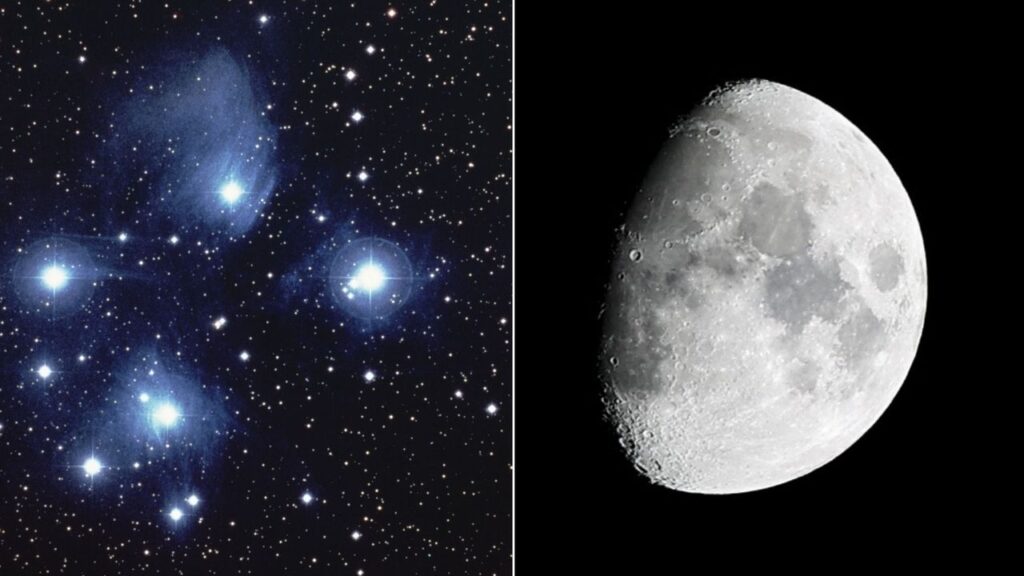
A striking conjunction unfolds in the evening sky as the waxing gibbous moon draws near the Pleiades star cluster, offering skywatchers a captivating display high above the southeastern horizon.
Prime Viewing Window Emerges Post-Sunset
Prime Viewing Window Emerges Post-Sunset (Image Credits: Cdn.mos.cms.futurecdn.net)
The moon reaches its closest approach to the Pleiades in the hours immediately following sunset on January 27. Positioned less than 5 degrees to the right of the lunar orb at dusk, the star cluster’s subtle glow competes with the moon’s bright reflection.
Observers notice the pair dominating the winter constellation Taurus. As twilight deepens into night, fainter stars in the Pleiades stand out more clearly against the darkening backdrop. The moon continues its eastward drift across the sky, setting shortly after 3 a.m. local time the next morning.
This alignment proves visible from most locations worldwide, provided clear skies prevail. Local moonrise and set times vary, so consult reliable sources for precise details in your area.
Unveiling the Pleiades Star Cluster
Commonly known as the Seven Sisters, the Pleiades ranks among the most prominent open star clusters visible to the unaided eye. Situated approximately 440 light-years from Earth, its light has traveled since the late 1500s.
The cluster harbors around 1,000 stars, though only a handful dazzle with blue-white brilliance. Their collective soft haze has inspired myths across cultures, earning the affectionate “Seven Sisters” nickname from the brightest members.
- Asterope
- Alcyone
- Celaeno
- Electra
- Merope
- Maia
- Taygete
These stars form a tight grouping within the constellation Taurus, making the Pleiades a favorite target for amateur astronomers year-round.[1]
Optimal Strategies for Observation
Begin your watch as the sun dips below the horizon, directing attention southeastward. The moon, at 76% illumination in its waxing gibbous phase, commands attention while the Pleiades lingers nearby.
Naked-eye viewing challenges arise from the moon’s glare, but persistence pays off as darkness settles. Elevate your vantage to a hilltop or open field to minimize obstructions. Check timeanddate.com/moon for location-specific rise and set data.
Avoid urban light pollution for the clearest sight. Patience enhances the experience, as the cluster’s nebulous appearance evolves with the night.
Equipment to Elevate the Sight
Simple tools transform a good view into an extraordinary one. Binoculars bridge the gap between casual glances and detailed appreciation.
| Viewing Method | Expected Details |
|---|---|
| Naked Eye | Moon’s glow with faint cluster haze; brightest stars faintly discernible post-dusk. |
| 10×50 Binoculars | Both moon and Pleiades in one field; reveals the seven bright sisters clearly. |
| 6-inch Telescope | Dozens of fainter cluster stars; lunar craters like Clavius and Tycho along the terminator. |
Larger apertures uncover deeper cluster layers and moon surface features. Beginners benefit from user-friendly models that track objects automatically.
Key Takeaways
- Target southeast after sunset; Pleiades sits right of the 76%-lit moon.
- Binoculars or telescopes unlock fainter stars and lunar details.
- Clear horizons and dark skies maximize visibility worldwide.
This fleeting sky pairing reminds us of the cosmos’s endless wonders, accessible even from backyards. Step outside tonight – what celestial sights will you capture? Share your views in the comments.