Scientists in Colombia revealed compelling evidence from a 13-million-year-old fossil that reshapes understanding of prehistoric predators. A leg bone belonging to one of South America’s fearsome terror birds bore deep tooth punctures from a massive caiman, suggesting the bird met its end in a violent clash near ancient waterways. This discovery, detailed in a recent study, marks the first record of such a bird in northern South America and highlights the risks even apex hunters faced.
A Grisly Fossil Find in the Tatacoa Desert
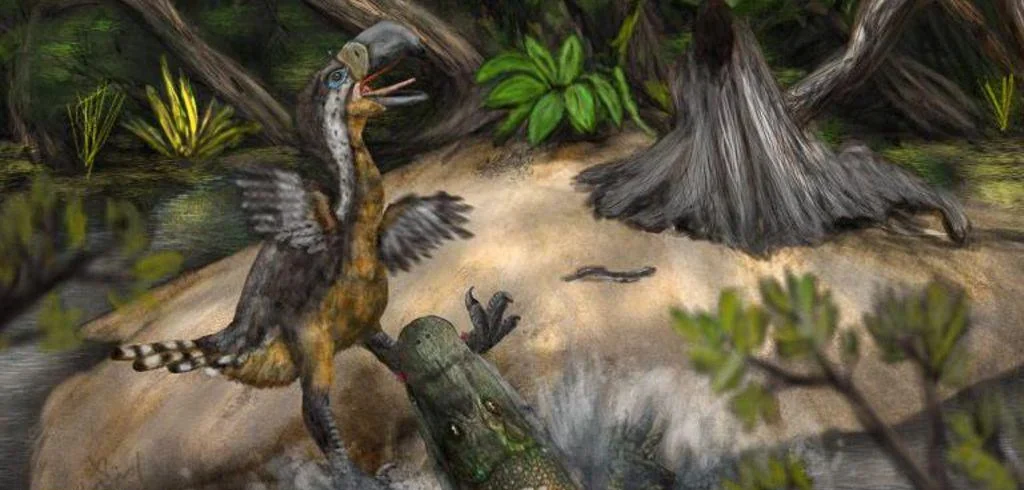
A Grisly Fossil Find in the Tatacoa Desert (Image Credits: Reddit)
Local paleontologist César Augusto Perdomo unearthed the fist-sized leg bone fragment more than 15 years ago in Colombia’s Tatacoa Desert, part of the rich La Venta fossil beds. Researchers later identified it as the lower left leg, or tibiotarsus, of a phorusrhacid terror bird. Four distinct puncture marks scarred the surface, analyzed through 3D scanning to reveal their precise shape, depth, and spacing.
The absence of healing around the wounds indicated the bird perished soon after the attack. Lead researcher Andrés Link of the University of Los Andes noted the marks’ alignment with crocodilian teeth. “There is no sign of healing in the bite marks on the bone, so if it wasn’t already dead, it died in the attack,” Link stated. This evidence pointed to a predatory bite or scavenging event, frozen in time from the Middle Miocene epoch.
Profiling the Victims and Victors
Terror birds dominated South American landscapes as flightless carnivores, standing up to 2.5 meters tall and weighing around 100 kilograms. Their powerful legs supported rapid sprints, while hatchet-like beaks delivered devastating strikes to prey. Yet this specimen, possibly the largest known, proved vulnerable.
The perpetrator emerged as Purussaurus neivensis, a caiman species thriving in Miocene wetlands. A subadult individual, roughly 4.5 to 5 meters long, left the marks. Adults of this reptile could exceed 10 meters, making them formidable aquatic ambushers. Digital models overlaid the fossil with caiman skulls, confirming a perfect match.
Reconstructing the Prehistoric Drama
During the Middle Miocene, the La Venta region formed a vast wetland network of rivers, swamps, and forests. Terror birds patrolled the land as top hunters, but water edges posed hidden dangers. The bird likely approached a river to drink, hunt, or cross, entering the caiman’s territory.
Researchers debated predation versus scavenging. A live ambush seemed plausible, with the caiman lunging from the shallows to clamp the leg. Alternatively, the reptile fed on the carcass after natural death. Link observed, “Terror birds were undoubtedly at the top of the food chain. But this evidence shows us that they could also fall as prey of large caimans when approaching large water bodies.”
- Deep punctures matched caiman tooth shape and size.
- No gnawing suggested a single, forceful bite.
- Linear arrangement indicated a jaw snap in motion.
- Victim’s size rivaled modern ostriches but with predatory adaptations.
- Predator’s youth implied even larger adults roamed nearby.
Challenging Notions of Ancient Food Webs
Prior views cast terror birds as unchallenged rulers of Miocene South America, filling niches left by dwindling mammals post-dinosaur extinction. This fossil upended that narrative, proving complex interactions across land and water. Similar traces appeared in older specimens, but this northern find expanded their range.
The study, published in Biology Letters, emphasized ecosystem dynamics. Terrestrial predators ventured near water for prey or hydration, risking aquatic rivals. Such overlaps mirrored modern African water holes, where lions fall to crocodiles. Link highlighted, “This is a fascinating story of the interaction of two very iconic animals in the past.”
| Creature | Height/Length | Habitat | Role |
|---|---|---|---|
| Terror Bird | 2.5 m tall | Land | Apex terrestrial predator |
| Purussaurus neivensis | 4.5-10 m long | Aquatic | Apex aquatic predator |
Key Takeaways from the Discovery
- Terror birds faced threats from giant caimans near water, blurring apex predator lines.
- 3D analysis pinpointed Purussaurus neivensis as the likely attacker.
- This northernmost terror bird fossil enriches Miocene South American paleontology.
This rare snapshot reminds us that prehistoric life thrived on unpredictability, where no hunter stood invincible. Food webs intertwined in ways modern eyes can scarcely imagine. What encounters from deep time might surface next? Share your thoughts in the comments.