South Africa – Scientists have long puzzled over a small skull unearthed in 1952, questioning its place among ancient mammal relatives. Advanced CT scans have now provided definitive answers, confirming Cistecynodon parvus as a distinct basal cynodont that endured the planet’s most devastating mass extinction. This discovery sheds light on the resilient lineages that bridged the Permian-Triassic boundary, offering clues to the early evolution of mammals.
One Skull’s Enduring Enigma
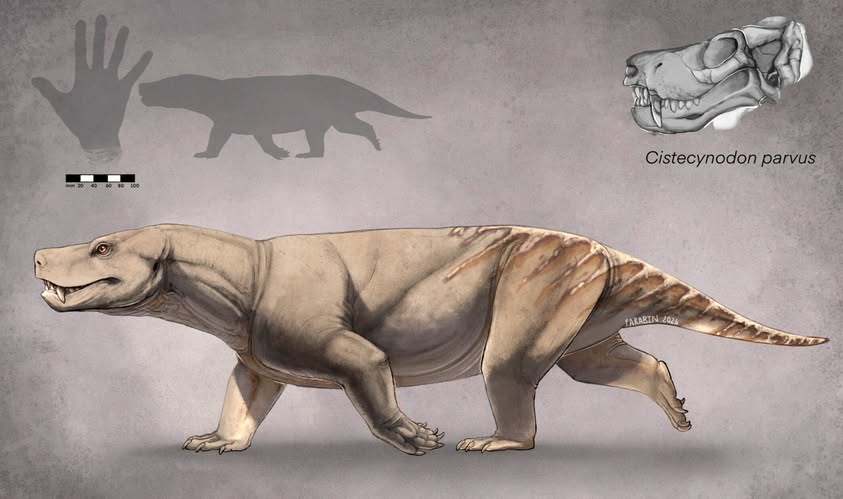
One Skull’s Enduring Enigma (Image Credits: Facebook)
The holotype specimen of Cistecynodon parvus, cataloged as BP/1/2520, measured just 5.72 cm long when paleontologists discovered it at Luiperdkop farm west of Maletswai in South Africa’s Eastern Cape. Found in the Burgersdorp Formation’s Trirachodon-Kannemeyeria Subzone, this fossil dated to the Middle Triassic, roughly 247 to 237 million years ago. For decades, experts debated its identity: some viewed it as a juvenile of a larger species, others as kin to advanced cynodonts, and a few even excluded it from the group entirely.
Early classifications shifted it across the evolutionary tree without consensus. The scarcity of material – just this single skull – fueled the uncertainty. Recent reexamination, however, leveraged modern imaging to reveal intricate details previously inaccessible.
Revealing Anatomy Through Digital Precision
Researchers employed micro-PET/CT scanning with a voxel resolution of 0.0562 mm to create 3D digital models of the skull, lower jaw, brain endocast, and inner ear. This technology exposed features like an open secondary palate along the midline, despite the specimen’s subadult to early adult ontogenetic stage. The dental formula stood at I4/i3, C1/c1, PC6/pc7, with tricuspid postcanines suggesting a carnivorous or insectivorous diet.
Notable traits included a robust lower jaw with a fused dentary symphysis and dual jaw articulations. The inner ear featured a highly enlarged vestibule, measuring 7.06 mm³, alongside a reduced parietal foramen and absent carotid foramina. These characteristics set Cistecynodon apart from contemporaries and confirmed its validity as a unique taxon.
A Basal Cynodont’s Phylogenetic Home
Phylogenetic analyses, building on prior matrices, positioned Cistecynodon as a basal non-eucynodont cynodont within Epicynodontia, often sister to Galesauridae. This placement relied on synapomorphies such as a curved zygomatic arch and reduced interpterygoid vacuities. Unlike more derived eucynodonts like Cynognathia or Probainognathia, it retained primitive features, including the medially open palate.
Some traits converged with advanced groups, like the absent quadrate ramus of the pterygoid, but overall data supported its basal status. Consensus trees from multiple datasets reinforced this view, with strong Bremer support. The study ruled out prior notions of it as a probainognathian or galesaurid juvenile.
Adaptations for a Subterranean Life
The inflated inner ear vestibule pointed to heightened sensitivity for low-frequency sounds, a hallmark of fossorial animals in modern taxa. Combined with a shallow floccular fossa and compressed endocast, these suggested poor gaze stabilization suited to underground navigation. An estimated body mass of around 587 grams aligned with a small, burrowing lifestyle.
Absence of certain foramina and a simple maxillary canal further indicated specialized habits. Researchers inferred an obligate fossorial existence, aiding survival in harsh post-extinction environments. Such adaptations echoed those in other synapsids that weathered ecological upheavals.
- Enlarged inner ear vestibule for low-frequency hearing.
- Reduced parietal foramen and absent carotid foramina.
- Open secondary palate, primitive for its age.
- Tricuspid postcanines for precise shearing.
- Robust jaw with fused symphysis.
Relict Lineage Across Cataclysmic Change
Cistecynodon parvus emerged as a southern African basal cynodont lineage that outlasted the end-Permian mass extinction around 252 million years ago. It persisted as a relict into the early Middle Triassic amid the radiation of more advanced forms. This survival highlighted niche specialization in burrows during recovery phases.
“Cistecynodon parvus is reconstructed as a basal lineage of cynodonts in Southern Africa that survived the end Permian mass extinction and persisted as a relict fauna through to the early Middle Triassic,” the researchers noted. No later records suggest it vanished without descendants, underscoring the fragility of such holdouts.
Key Takeaways
- CT scans validated Cistecynodon parvus as a distinct basal cynodont.
- Fossorial traits likely enabled survival past the Permian extinction.
- Offers insights into non-mammalian cynodont diversity in Triassic recovery.
This rediscovery exemplifies how non-invasive tech revives forgotten fossils, refining our grasp of mammal origins. What other extinction survivors might await similar scrutiny? Tell us in the comments.