Southern Amazon Basin – Scientists have uncovered stark evidence that widespread forest clearing has triggered a sharp decline in rainfall across the region over the past four decades. A study published in Nature Communications revealed that deforestation accounted for 52 to 72 percent of an 8 to 11 percent reduction in annual precipitation between 1980 and 2019. This loss disrupts the delicate balance of moisture recycling that sustains the rainforest, exacerbating dry seasons and heightening vulnerability to tipping points. The findings underscore how human actions amplify environmental stresses beyond those projected by climate change alone.
Rainfall Plummets Amid North-South Divide
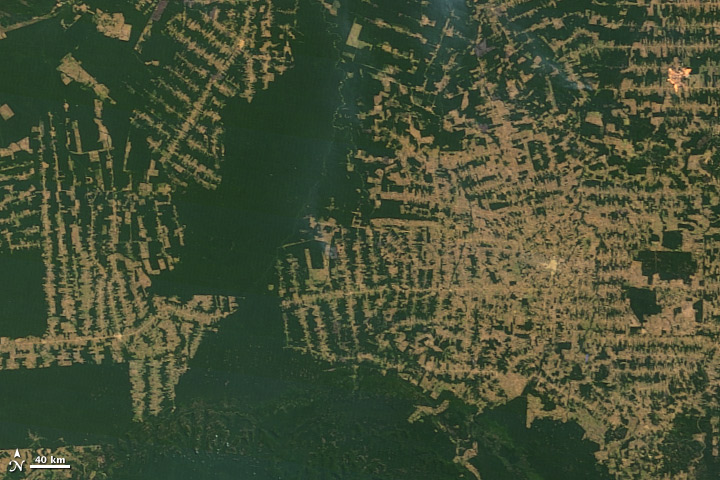
Rainfall Plummets Amid North-South Divide (Image Credits: Upload.wikimedia.org)
Researchers observed a pronounced dipole pattern in precipitation trends across the Amazon. While the northern basin experienced a slight, nonsignificant increase, the southern basin saw consistent declines, with rates reaching 3.9 to 5.4 millimeters per year from 1982 to 2016. This equated to an overall 8 to 11 percent drop in yearly totals, affecting 77 to 80 percent of the southern area.
The study linked these shifts directly to a 7.7 percentage point loss of forest cover in the southern basin during the period. Hotspots of deforestation exceeded 1 percent annual loss, primarily from agriculture and fires. Notably, a 1 percent reduction in forest cover correlated with a 6-millimeter-per-year rainfall decrease. Such patterns extended dry conditions, threatening ecosystems and communities reliant on steady rains.
Mechanisms: How Trees Shape the Skies
Deforestation interrupts the Amazon’s moisture cycle at its core. Trees release vast amounts of water vapor through evapotranspiration, fueling about 30 percent of the region’s recycled precipitation. When forests vanish, this process weakens, slashing available atmospheric moisture.
Effects ripple beyond local areas. Upwind deforestation across South America—where natural cover fell 16 percent since 1985—alters vapor transport. The study identified increased atmospheric stability, with convective available potential energy dropping 21 percent, alongside longer moisture pathways and 19 percent less local retention. These changes promote outflow, starving downwind rains.
- Reduced evapotranspiration from forest-sourced moisture.
- Heightened atmospheric stability suppressing convection.
- Extended transport distances for water vapor.
- Boosted moisture export from the basin.
- Weakened land-atmosphere feedbacks sustaining wet seasons.
Climate Models Miss the Full Picture
Current projections may paint an overly optimistic view. The research compared observations to models and found they underestimated precipitation sensitivity to forest loss by up to 50 percent. Observed drops reached 0.32 percent per percentage point of forest decline, versus models’ 0.16 percent average.
“Earth system models are amazing things, but they have to be accurate absolutely everywhere,” said co-author Chris Huntingford of the U.K. Centre for Ecology & Hydrology. Gaps in simulating South American water transport and evaporation likely contribute to the shortfall. Lead author Jiangpeng Cui emphasized the novelty: “Many studies only focus on the local scale… We combined observational data with moisture tracking across South America.” Refinements could reveal tipping points arriving sooner than anticipated.
Risks to the Rainforest and Calls for Action
The southern Amazon lost one-fifth of its Brazilian forests between 1970 and 2019, often to soy and cattle. Recent droughts, like those in 2023-2024, isolated Indigenous groups and spurred food shortages. Without intervention, high-deforestation scenarios forecast 10.6 to 15 percent further rainfall cuts by century’s end.
Restoration offers hope. Reforestation could boost seasonal rains by up to 5 millimeters per day and reverse moisture losses. Yet challenges persist: natural recovery spans over a century, demanding policy support, incentives for communities, and agroforestry integration. “Everyone should contribute—from policymakers to local communities,” noted expert Eva Nafiseh Goodarzi.
| Scenario | Projected Rainfall Change (Southern Amazon) |
|---|---|
| High Deforestation | Up to -15% |
| Business-as-Usual | -10.6% |
| Reforestation | -2.3% |
Key Takeaways
- Deforestation drives 52-72% of southern Amazon’s rainfall decline.
- Models underestimate impacts by 50%, hastening dieback risks.
- Reforestation can restore moisture and buffer climate threats.
As the Amazon teeters closer to irreversible change, curbing forest loss emerges as a critical lever for stability. Halting deforestation not only preserves rainfall but safeguards global climate patterns. What steps should governments prioritize to protect this vital ecosystem? Share your thoughts in the comments.