Devon, England – A tiny fossil plucked from a windswept beach in 2015 has upended scientists’ views on the origins of lizards, snakes, and the tuatara. This 242-million-year-old specimen, the oldest confirmed member of the lepidosaur lineage, dates to the Middle Triassic period just before dinosaurs dominated the planet. Detailed scans revealed an unexpected mix of primitive and specialized traits, prompting researchers to rethink the ancestral blueprint of one of Earth’s most successful reptile groups.
An Unassuming Find with Monumental Implications
An Unassuming Find with Monumental Implications (Image Credits: Reddit)
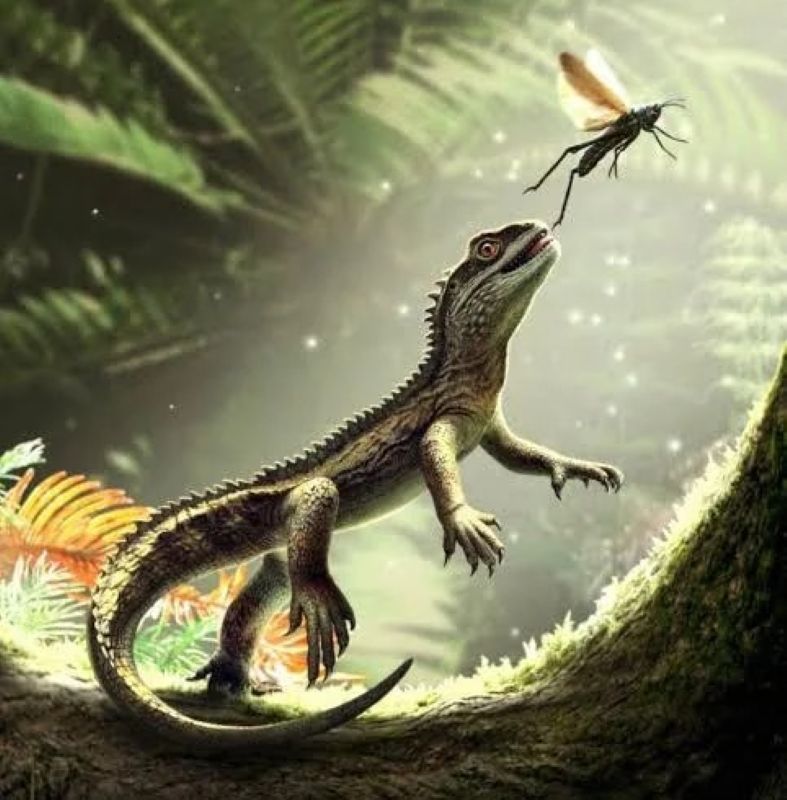
Amateur fossil hunter Rob Coram discovered the specimen amid the pebbles of a Devon shoreline. Embedded in a Helsby Sandstone nodule, the fossil measured mere centimeters, its full skeleton fitting easily in an adult’s palm. Initial examinations hinted at something remarkable, but only advanced technology exposed its true nature years later. The creature, named Agriodontosaurus helsbypetrae, earned its moniker – “fierce-toothed lizard from the Helsby rock” – for its striking dentition.
Preservation proved exceptional, allowing non-destructive analysis of its delicate skull. Researchers at the University of Bristol, led by MSc student Daniel Marke and Professor Michael J. Benton, confirmed its status as a rhynchocephalian, kin to New Zealand’s tuatara. This placed it 3 to 7 million years older than prior lepidosaur records, anchoring the group’s timeline firmly in the Anisian stage of the Triassic.
Startling Anatomy Defies Expectations
The skull, barely 1.5 centimeters long, featured large, triangular, blade-like teeth arranged to pierce and shear tough insect cuticles. Unlike modern lizards and snakes, it lacked teeth on the palate and showed no evidence of skull hinging for swallowing large prey. Yet it retained an open lower temporal bar in the cheek region – a trait scientists anticipated in the common ancestor.
“The new fossil shows almost none of what we expected,” Marke noted. “It has no teeth on the palate and no sign of any hinging. It does, though, have the open temporal bar, so one out of three.” Large orbits suggested keen eyesight for hunting small arthropods, mirroring the tuatara’s modern strategy. This insectivorous specialist thrived in undergrowth, its strong bite force enabling survival amid Triassic upheavals.
Overturning Long-Standing Assumptions
Lepidosaurs encompass over 12,000 species today, their success tied to versatile skulls and diets. Prevailing models predicted ancestors possessed key squamate features like kinetic skulls early on. Agriodontosaurus disproved this, revealing an largely akinetic skull and absent palatal dentition – traits that evolved later in branches like snakes and advanced rhynchocephalians.
Phylogenetic studies positioned it as a basal sphenodontian, crownward of earlier forms like Gephyrosaurus. This European origin aligned with the Triassic Revolution, when modern ecosystems emerged. The fossil highlighted feeding innovations, such as marginal teeth dominance, as pivotal for diversification under dinosaur shadows.
High-Tech Scans Unlock Hidden Details
Standard X-rays fell short; synchrotron radiation at the European Synchrotron (ESRF) and Diamond Light Source provided the resolution needed. Beamline BM18’s phase-contrast tomography pierced the enclosing rock, yielding 3D reconstructions. Students meticulously processed the data, uncovering nuances invisible to the eye.
- High-energy scans captured teeth en echelon for shearing.
- Orbital margins resembled squamates, blending lineages.
- No mesokinesis or streptostyly confirmed a rigid skull.
- Preserved postcrania hinted at agile, terrestrial life.
“The new beast has relatively large triangular-shaped teeth and probably used these to pierce and shear the hard cuticles of its insect prey, pretty much as the tuatara does today,” Benton observed. These tools transformed a humble nodule into a evolutionary cornerstone.
Implications for Reptile Diversity
The discovery reframes lepidosaurs’ trajectory, emphasizing gradual trait assembly over sudden emergence. Tuatara, often dubbed a living fossil, now links to a vibrant ancient radiation. Early forms like Agriodontosaurus underscore adaptability – large teeth compensated for rigid jaws, fueling insect predation success.
Amid Triassic recoveries post-extinction, such reptiles carved niches dinosaurs overlooked. This basal rhynchocephalian bridges gaps, suggesting palatal teeth re-evolved independently. Findings appeared in Nature, solidifying its role in vertebrate paleontology.
Key Takeaways
- Oldest lepidosaur pushes origins to 242 million years ago, predating dinosaurs.
- Missing expected traits reveal mosaic evolution in skulls and feeding.
- Insectivory and rigid jaws defined early success, echoing tuatara today.
This Devon gem illustrates how fleeting beach treasures rewrite deep time. As lepidosaurs proliferated into thousands of forms, their story proves evolution favors the versatile. What surprises might the next fossil hold? Share your thoughts in the comments.