Dordogne – Researchers have accomplished a scientific milestone by securing the first absolute radiocarbon dates for Paleolithic cave paintings in the region. The team analyzed charcoal-based pigments from Font-de-Gaume cave near Les Eyzies, revealing ages slightly more recent than earlier stylistic assessments. This advance confirms the artworks originated during the Upper Paleolithic period, despite longstanding technical hurdles.
A Century-Old Mystery Cracked Open
A Century-Old Mystery Cracked Open (Image Credits: Reddit)
Visitors have marveled at Font-de-Gaume’s walls since their discovery in 1901. The cave features colorful depictions of bison, horses, and abstract forms, earning it UNESCO World Heritage status as part of the Prehistoric Sites and Decorated Caves of the Vézère Valley. Until now, experts relied on stylistic comparisons to estimate ages around 18,000 to 16,000 years old. Direct proof remained elusive.
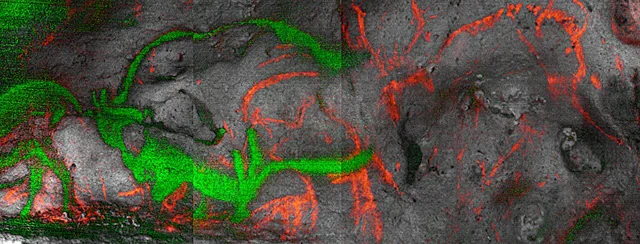
A team led by CNRS researcher Ina Reiche changed that course. They targeted two black figures: a bison and an abstract mask. Non-invasive imaging first exposed traces of charcoal in the pigments, overturning assumptions of purely inorganic materials like iron oxides. Authorities granted rare permission for micro-samples after these findings.
Advanced Techniques Conquer Tiny Samples
Dating cave art posed immense difficulties in Dordogne sites, including nearby Lascaux. Pigments appeared mineral-based, offering no organic matter for radiocarbon analysis. Touching walls was strictly forbidden to preserve the heritage.
The researchers deployed Raman microspectrometry, hyperspectral imaging, infrared false-color imaging, and reflectance imaging spectroscopy. These tools detected carbon signatures without damage. Accelerator mass spectrometry then dated the minuscule samples. Contamination risks from modern graffiti or visitors were ruled out through rigorous verification.
Lucile Beck, Ingrid Caffy, and others from institutions like Chimie ParisTech-PSL and the Laboratoire de mesure du carbone 14 handled the precise measurements. Their protocol sets a model for future efforts.
Key Dates from the Upper Paleolithic
The results pinpointed specific timelines for the figures. Most samples aligned closely, affirming Paleolithic creation. Here’s a breakdown:
| Artwork Element | Date Range (cal BP) |
|---|---|
| Bison painting | 13,461–13,162 |
| Mask (main parts) | 15,981–15,121 and 15,297–14,246 |
| Mask left eye | 8,993–8,590 |
These calibrated dates, referenced to 1950, place the primary artworks around 13,000 to 15,000 years ago. The younger mask eye suggests possible later retouching. All fell within the Upper Paleolithic, validating long-held views with hard evidence.
Ripples Through Prehistoric Research
This marks the inaugural direct dating of Dordogne Paleolithic paintings. Previously, regional art chronology depended on indirect methods or artifact associations. The findings refine timelines for artist communities.
Ina Reiche noted the prior gap: “Our experiments [mean] nobody could really give experimental proof that these paintings are indeed Paleolithic.” Expert Inés Domingo Sanz emphasized the value: “Any opportunity we have to obtain dates is really important, because it helps us fix the art to particular periods of time.”
- Opens doors to date other Dordogne caves like Lascaux.
- Confirms charcoal use in black pigments, expanding dating prospects.
- Enhances understanding of Upper Paleolithic cultural evolution.
- Demonstrates ethical, minimal-impact sampling.
- Published in PNAS on March 9, 2026 (DOI).
The methodology promises broader applications. Scientists anticipate applying it to additional figures, bridging gaps in human artistic history.
Key Takeaways
- First radiocarbon dates for Dordogne cave art: 13,000–16,000 years old.
- Charcoal pigments detected via non-invasive imaging.
- Upper Paleolithic confirmed, slightly younger than stylistic guesses.
This discovery illuminates the ingenuity of Ice Age artists and the power of modern science. As techniques evolve, more prehistoric voices may emerge from the stone. What do you think this reveals about our ancestors? Tell us in the comments.