Researchers in the Makovicky lab at the University of Minnesota have unearthed compelling evidence about how duck-billed dinosaurs, known as hadrosaurids, achieved supremacy among herbivores toward the end of the Mesozoic era. Through meticulous fieldwork and innovative analysis of fossil jaws, the team explored these creatures’ advanced dentition and its role in shaping ecosystems. Their findings reveal a complex story of competition and adaptation amid dramatic geological shifts.
Hadrosaurids Emerge as Herbivore Powerhouses
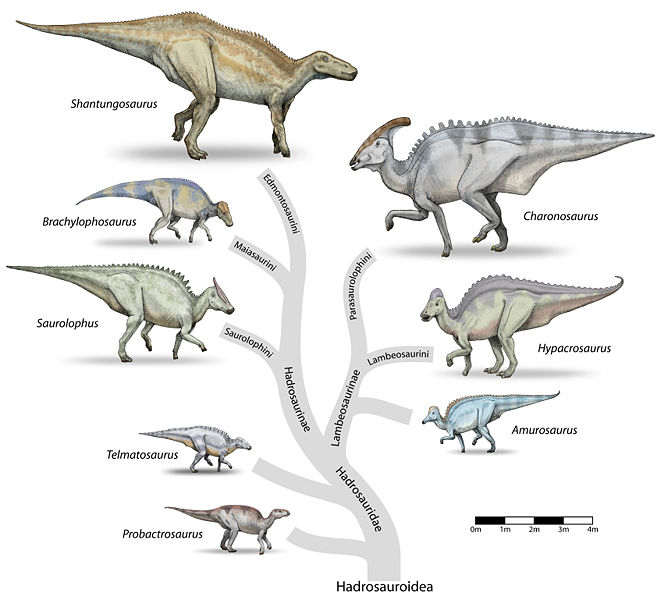
Hadrosaurids Emerge as Herbivore Powerhouses (Image Credits: Upload.wikimedia.org)
Duck-billed dinosaurs dominated the latest Cretaceous landscapes of Asia and North America as the era’s primary herbivores. These animals featured a remarkable grinding dentition, with up to five replacement teeth per socket and a dental battery exceeding 500 teeth in large individuals. This setup allowed them to process tough vegetation efficiently, setting them apart from contemporaries.
Scientists long hypothesized that such dental sophistication enabled hadrosaurs to outcompete other plant-eaters. The Makovicky lab tested this idea by developing precise metrics to assess feeding capacity, drawing on scans of complete fossil jaws from multiple species. Results painted a nuanced picture of evolutionary success tied to regional dynamics.
Global Fieldwork Fuels Fossil Discoveries
The Makovicky lab pursued discovery-driven expeditions worldwide to address gaps in Mesozoic diversity knowledge. A 20-year collaboration in Argentina’s Neuquén Basin yielded diverse dinosaurs, while efforts in the Western Interior Basin of North America gathered fossils alongside chronostratigraphic data. These sites illuminated biodiversity responses to events like the Western Interior Seaway’s formation.
In Missouri’s Ozark foothills, the team excavated at a rare site preserving complete hadrosaur skeletons, including Parrosaurus missouriensis. Graduate students joined digs, uncovering juvenile duck-bills and associated vertebrates in challenging, clay-rich sediments. Such fieldwork not only boosted specimen counts but also refined understandings of depositional environments.
- Argentina’s Neuquén Basin: Long-term digs revealed large carnivores and tiny alvarezsaurids alongside hadrosaurs.
- Western Interior Basin: NSF-funded transects from Montana to Texas linked fossils to climate shifts.
- Missouri Ozarks: Produced Parrosaurus with distinctive thumb spikes and primitive dentition features.
- Wyoming and past Antarctic sites: Contributed to broader macroevolutionary patterns.
Advanced Metrics Reveal Tooth Wear Secrets
Viktor Radermacher, a PhD candidate in the lab, pioneered a tooth wear metric to quantify chewing efficiency in herbivorous dinosaurs. He analyzed individual teeth and entire toothrows from a dozen species, using 3D scans for precision. Phylogenetic methods then estimated values for related but unsampled taxa.
Statistical tests applied to this data highlighted hadrosaur advantages. Their complex chewing surfaces and worn tooth volumes surpassed those of more primitive herbivores, supporting ideas of niche expansion. Ceratopsids showed similarly advanced but distinct dental performance.
| Dinosaur Group | Dental Feature | Feeding Proxy |
|---|---|---|
| Hadrosaurids | >500 teeth battery | High complexity, multiple replacements |
| Ceratopsids | Advanced magazines | Different surface metrics |
| Primitives | Basic dentition | Lower wear capacity |
Competition and Coexistence in Western North America
Hadrosaurs appeared alongside ceratopsids in western North America, together displacing herbivores with simpler teeth. This duo dominated resources, but evidence suggested minimal direct rivalry between them. Isotope analyses confirmed they targeted different plants.
Elsewhere, the dominance pattern proved less clear, pointing to local factors like the Sevier orogeny and sea level changes. The lab’s Western Interior work revealed pulsed deposition rates that biased fossil preservation, influencing perceived turnover rates. These insights reshaped views on biotic interactions.
Broader Lessons from the Fossil Record
The Makovicky lab’s efforts extended beyond hadrosaurs to macroevolution, including growth-stage taxonomy and vicariance from plate tectonics. Discoveries like oversplitting in Psittacosaurus refined diversity estimates. Such work underscored how geological upheavals molded dinosaur faunas.
Key Takeaways:
- Hadrosaur dental batteries enabled resource dominance in late Cretaceous North America.
- Coexistence with ceratopsids displaced primitives without direct competition.
- Global fieldwork addresses sampling biases, revealing nuanced biodiversity patterns.
These revelations from duck-billed dinosaurs highlight the intricate interplay of anatomy, ecology, and geology in prehistoric worlds. As research continues, it offers vital parallels for modern biodiversity challenges. What aspects of dinosaur evolution intrigue you most? Share in the comments below.