Bayanga, Central African Republic – Deep within the Congo Basin’s impenetrable rainforests, Dzanga Bai stands as a remarkable exception where elusive forest elephants emerge en masse. These critically endangered animals, usually concealed by thick vegetation, converge daily on this mineral-rich clearing in Dzanga-Sangha National Park. The site offers a vital window into their behaviors and social lives, drawing researchers and a growing number of tourists despite challenging access.
Elephants’ Daily Pilgrimage to the Mud
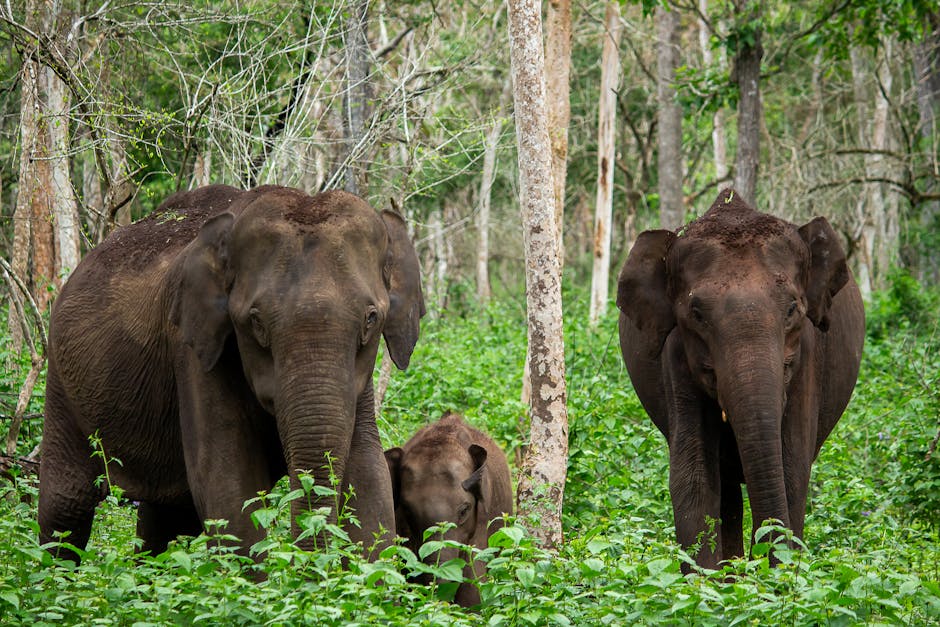
Elephants’ Daily Pilgrimage to the Mud (Image Credits: Pexels)
Forest elephants approach Dzanga Bai cautiously from the surrounding forest edges, wading into shallow pools knee-deep in mud. Counts reveal a minimum of 40 to 50 individuals present at any time, with peaks reaching 211 in a single observation last December. The clearing spans about 10 hectares, featuring a sandy pan bisected by a stream that enhances its appeal.
These gatherings contrast sharply with typical sightings elsewhere in Central Africa, where small groups of 10 to 20 prove the norm. Mothers keep calves close, while young bulls assert themselves without major conflicts. The shallow water creates a safe haven, functioning as a playground for families. Elephants dig into the soil, extracting essential minerals absent from their leafy forest diet.
The Mineral Magnet’s Vital Role
Dzanga Bai’s soil brims with sodium, magnesium, calcium, potassium, and zinc – nutrients crucial for digestion and reproduction in forest elephants. Their trunks pump mud and water, shaping the landscape over centuries through trampling and feeding. This process maintains the open glade, visible even from space via satellite imagery.
Researchers note repeated visits, with over 4,000 individuals identified since 1990 and 85 percent returning multiple times – some over 100 visits. Yvonne Kienast, a behavioral biologist with Cornell University’s Elephant Listening Project, observed: “The Dzanga Bai is the only known clearing where you get hundreds of forest elephants… But here, the minimum is 40 or 50.” These minerals support health in a diet dominated by mineral-poor foliage.
- Sodium for electrolyte balance and nerve function.
- Magnesium and calcium for bone health and muscle activity.
- Potassium aiding heart and reproductive functions.
- Zinc supporting immune response and growth.
Research Unlocks Social Secrets
Decades of study have cataloged more than 1,600 forest elephants, revealing slower reproduction rates compared to savanna counterparts and lower male survival due to poaching. Kienast, working in the area since 2021, identifies animals by ear patterns and tusk shapes. Greeting ceremonies unfold with excitement before dispersal, highlighting complex social bonds. “When I started, I thought we knew everything about forest elephants from the literature… The more time I spend here, the more I realize we don’t,” she remarked.
From elevated platforms, observers log activities from dawn to dusk. Efforts now emphasize training local researchers, fostering ownership among Central Africans. Past work by Andrea Turkalo spanned 25 years, providing baseline demographics amid regional declines of 62 percent from 2002 to 2011.
Conservation Amid Persistent Threats
Poaching remains a grave danger, exemplified by the 2013 massacre of 26 elephants in two days during civil unrest. WWF partners with the Central African Republic’s Ministry of Forest to train rangers and support communities. Tourism grew to about 800 visitors in 2025, generating fees for locals while capping numbers for minimal impact. Guides like Léonce Madomi note visitors’ awe: “They have never seen elephants gathered like this, in groups, as families.”
Access from Bangui takes days over rough roads, deterring crowds but preserving the site. Stability aids growth, though perceptions of insecurity linger. Recent inventories show stable populations here, contrasting basin-wide collapses.
A Hub for Diverse Wildlife
Beyond elephants, Dzanga Bai attracts bongos, red forest buffalo, giant forest hogs, and occasionally sitatungas. Lowland gorillas also visit nearby bais. This biodiversity underscores its role as an ecological hotspot in the UNESCO-protected area.
Key Takeaways
- Dzanga Bai hosts 40-150+ forest elephants daily for vital minerals.
- Long-term research reveals social complexities and conservation needs.
- Growing eco-tourism balances protection with community benefits.
Dzanga Bai endures as a beacon for forest elephants, blending natural wonder with urgent conservation imperatives. As threats loom, its protection safeguards not just pachyderms but the Congo Basin’s intricate web of life. What experiences have you had with wildlife in remote forests? Tell us in the comments.