East Greenland – A fragile jaw fragment unearthed from ancient Arctic sediments has illuminated the shadowy beginnings of docodontans, primitive mammal relatives that thrived during the Mesozoic era. Discovered in the Rhætelv Formation of the Kap Stewart Group, this specimen dates to the Early Jurassic around 200 million years ago, marking the earliest confirmed record of the group. The fossil narrows a longstanding 40-million-year gap in their evolutionary history to just 33 million years, suggesting these creatures first emerged in the Europe-Greenland region during the Late Triassic before dispersing widely.
A Tiny Relic with Monumental Implications
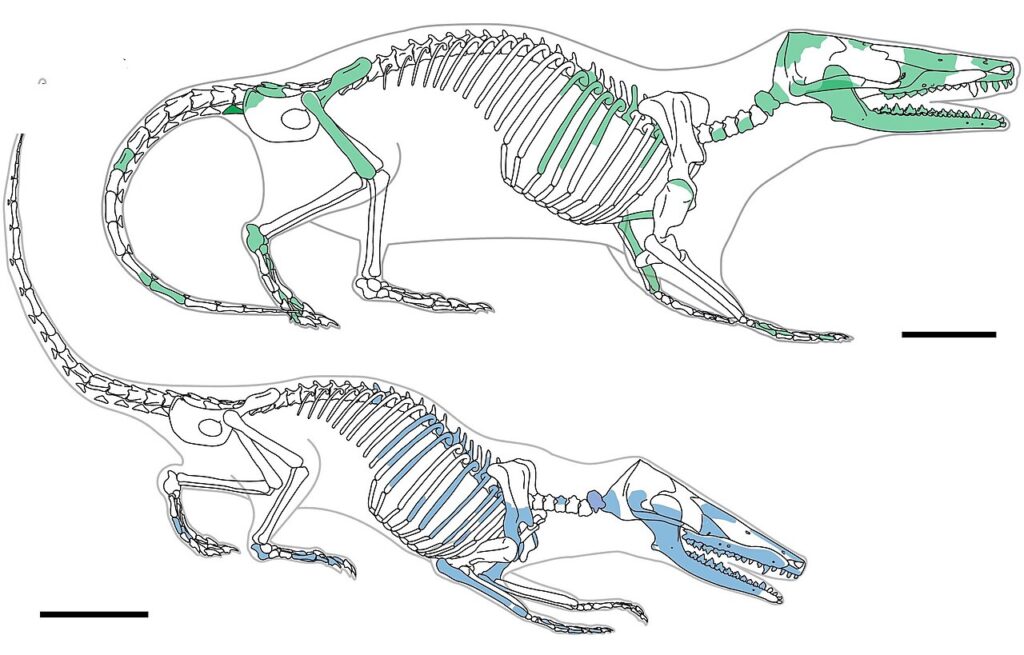
A Tiny Relic with Monumental Implications (Image Credits: Wikimedia)
Researchers stumbled upon the specimen, cataloged as NHMD 1184958, in the Jameson Land Basin amid rocks from the Rhaetian-Sinemurian stages. This marked the first mammaliaform fossil from the Rhætelv Formation, a site preserving rare glimpses of early terrestrial life in an oxygen-poor lake environment battered by storms. Micro-CT scanning revealed an incomplete dentary bearing a single preserved second molar and roots of another tooth, all scaled to just millimeters in length.
The animal itself resembled a modern mouse in size, likely foraging for insects in a world dominated by dinosaurs. Lead author Sofia Patrocínio noted the jaw’s delicacy during her master’s research: “The piece of jaw is so small and fragile, it’s amazing how much information we can get from something so tiny.”
Nujalikodon cassiopeiae: A New Dawn for Docodontans
Named Nujalikodon cassiopeiae after the Inuit hunting goddess Nujalik and the Cassiopeia constellation – evoking the tooth’s cusp pattern – this species stands as the oldest definitive docodontan. Phylogenetic studies positioned it as a basal member of Docodonta or its closest kin, bridging uncertainties in early mammaliaform trees.
Its molar closely mirrors the putative Late Triassic docodontan Delsatia from France and the docodontan Dobunnodon, hinting at shared ancestry. Such affinities push the clade’s origins to the Late Triassic in the now-connected lands of Europe and Greenland, prior to their spread across Laurasia.
- Preserved second molar with complex cusps and ridges.
- Roots of an adjacent tooth, enabling digital reconstruction.
- Unique dental features distinguishing it from contemporaries.
- Evidence of early tooth complexity evolution.
- First such find in the Rhætelv Formation.
Teeth That Powered Diversification
Docodontans distinguished themselves with molars boasting multiple cusps and intricate ridges, surpassing the simpler teeth of most fellow mammaliaforms. This dental sophistication likely expanded their diet beyond basic fare, fostering ecological versatility by the Middle to Late Jurassic.[3] Co-author Elsa Panciroli explained: “Docodontans are one of the earliest groups of mammaliaforms, and have more complex teeth than most other mammaliaforms at this time, with a lot of cusps and ridges.”
From their presumed European cradle, descendants reached Portugal, Germany, Russia, China, and the United States. Yet, scant Early Jurassic terrestrial fossils worldwide left major gaps – until now. Panciroli added: “There are very few places in the world where the fossils of terrestrial animals are preserved from the Early to Middle Jurassic. This is why there is such a big gap in our knowledge.”
Team Behind the Revelation
A multinational effort led by Sofia Patrocínio of Portugal’s Universidade de Évora, alongside Elsa Panciroli of National Museums Scotland and experts like Octávio Mateus and Jesper Milan, detailed the find in Papers in Palaeontology. Their analysis combined morphology, phylogeny, and biogeography to affirm the Triassic roots.
The discovery underscores Greenland’s pivotal role in mammal evolution, a land bridge in ancient Pangaea. Patrocínio highlighted: “Its highly detailed teeth show signs of early complexity that likely helped mammal relatives diversify later in the Jurassic.” No modern descendants survive, their extinction tied to shifting ecosystems, climates, or habitats.
Key Takeaways
- Nujalikodon cassiopeiae narrows docodontan ghost lineage by 7 million years, confirming Late Triassic origins in Europe-Greenland.
- Complex teeth enabled dietary breadth and global dispersal across Laurasia.
- Rare Early Jurassic fossils highlight the find’s value for broader terrestrial evolution.
This Greenland gem not only fills a critical evolutionary void but also invites deeper exploration of Mesozoic mammaliforms. As docodontans’ story emerges from obscurity, it reminds us how fragile remnants reshape our understanding of life’s ancient tapestry. What do you think about this prehistoric breakthrough? Tell us in the comments.